Grooming & Shedding Comparison
Flat vs Curved Slicker Brush: Which Shape Suits Your Pet
Short answer
A curved head follows the contour of the body, so it keeps more pins in contact across the back, sides and hindquarters. A flat head gives even contact on flatter areas, legs and chest, and gives more control on small animals. Most households are better served by a curved brush in the right size.
Same pins, different shape
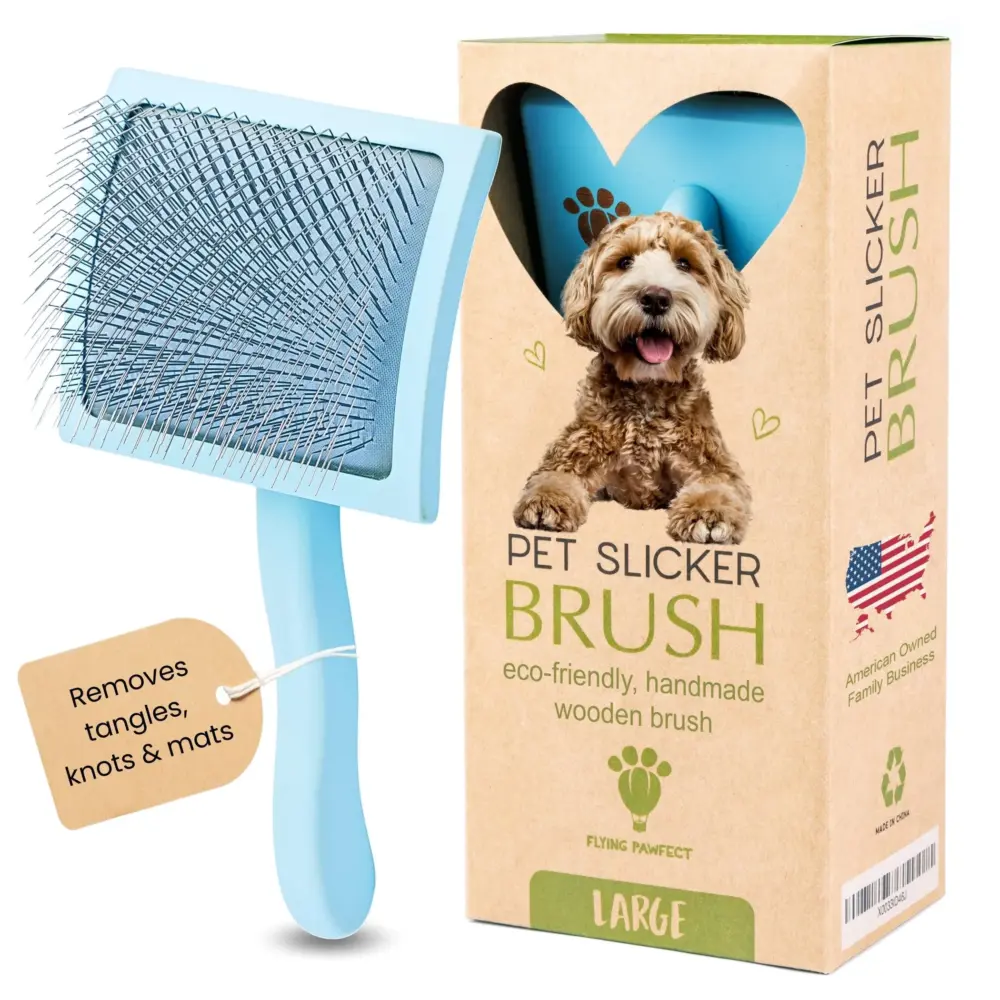
A slicker brush is a bed of fine angled pins set in a flexible cushion. It lifts loose hair out of the undercoat and works through tangles, and it is the standard tool for most medium and long coats. The pins are the same on both shapes; what changes is how the head sits against the dog.
Dogs are not flat. A curved head matches the barrel of a ribcage and the slope of a hindquarter, which means more of the pins stay in the coat through a stroke. A flat head bridges a curve, so the middle of the brush does the work and the edges lift away.
What a curved head does better
- Keeps contact across the ribcage, flanks and hindquarters
- Covers ground in fewer strokes on a medium or large dog
- Reaches the undercoat more consistently on a rounded body
- Reduces how long a session takes, which matters for a dog who dislikes grooming
- Generally kinder on the wrist, because fewer strokes are needed
What a flat head does better
- Even pin contact on flatter areas: the chest, the shoulders, the top of the back
- Legs, where a curve lifts away from a narrow limb
- Small animals, where a large curved head is unwieldy
- Finishing work after a de-shedding tool has done the bulk
- Working carefully around a sore or thin-coated area
Side by side
| Curved head | Flat head | |
|---|---|---|
| Body contact | Follows the contour | Even on flat areas |
| Best areas | Back, sides, rear | Legs, chest, finishing |
| Coverage | More per stroke | Less per stroke |
| Control on small pets | Harder | Easier |
| Typical use | Main brush | Detail and finishing |
Matching the shape to the coat
Coat type decides how often you need the tool; body shape decides which head suits. Long and double coats need a slicker regularly, because loose undercoat that is not removed becomes matting. Short, smooth coats rarely need one at all, and a rubber tool or a de-shedding comb is usually a better fit.
If you are not sure what your dog has, our guide on types of dog brushes and how to tell if a dog has a double coat both help.
Size matters as much as shape
A brush that is too large for the animal is the most common mistake. On a cat or a terrier, a full-size head makes it impossible to work carefully around legs, face and belly, and the result is usually a pet who starts avoiding the brush.
As a rough rule: small for cats, puppies and toy breeds; medium for most dogs up to spaniel size; large for anything bigger with real coat. Where you groom more than one animal, two sizes are more useful than one of each shape.
-
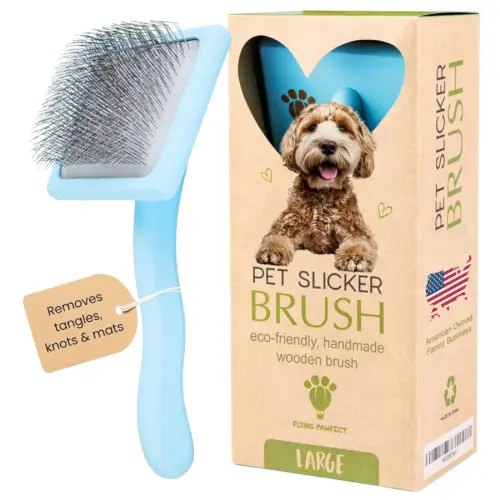
Curved Slicker Brush for Dogs and Cats, Choose size & color
Price range: $38.95 through $40.95
Why it fits: A curved head in three sizes, which makes it the default choice for most medium and large coats.
-
Flat Slicker Brush for Dogs and Cats, View product
$40.95
Why it fits: A large flat head for broad areas and finishing work after the main brush has done its job.
-
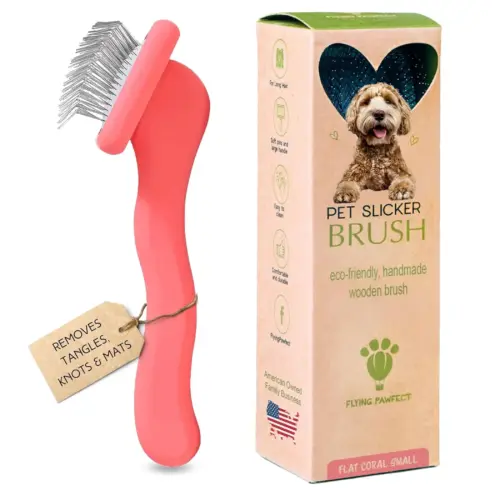
Flat Slicker Brush, Small, View product
$38.95
Why it fits: A small flat head for cats, puppies and toy breeds, where control matters more than coverage.
-
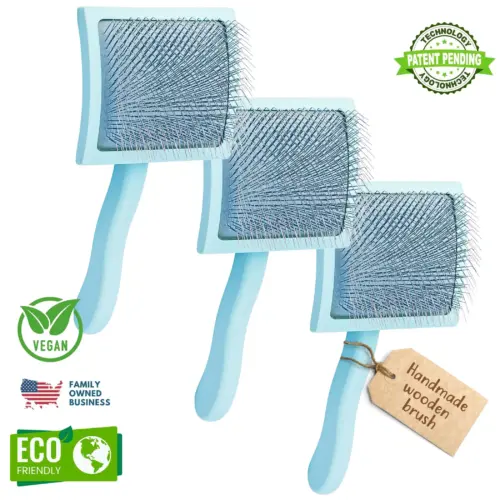
Curved Slicker Brush, Large, View product
$68.95
Why it fits: Three large curved brushes in one pack, for multi-pet homes or a shared grooming space.
-
Sakabase
Curved Slicker Brush, View product
$39.95
Why it fits: A curved slicker for undercoat and mats, with a handle shaped for longer sessions.
-
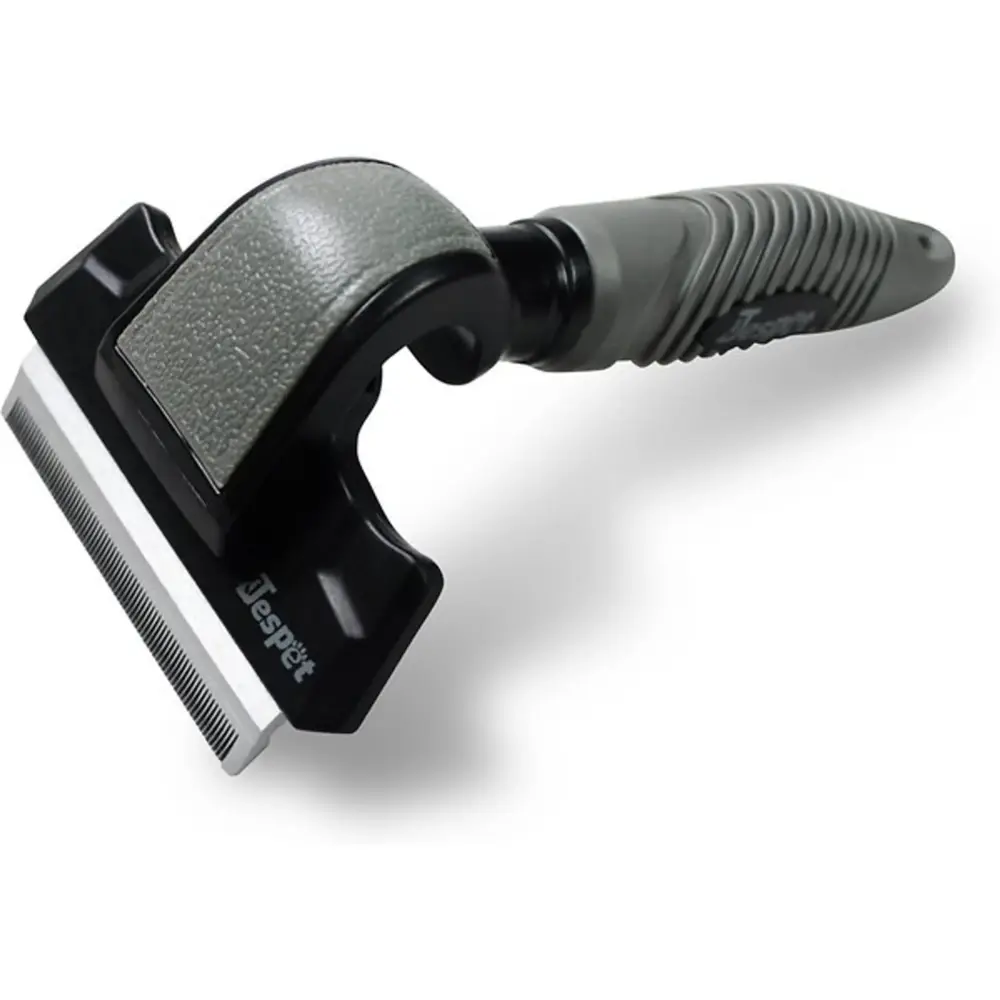
JESPET
De-Shedding Tool for Dogs & Cats, Choose size
Price range: $27.95 through $29.95
Why it fits: A de-shedding tool for the seasonal coat drop, used before the slicker rather than instead of it.


Technique beats both
A slicker used badly causes brush burn: red, irritated skin from pins dragged across it under pressure. It is the single most common grooming injury at home and it is entirely avoidable.
- Hold the brush loosely rather than gripping it.
- Work in the direction the coat grows, in short strokes.
- Keep the pins flat against the coat rather than digging the tips in.
- Use light pressure; the pins do the work, not your arm.
- Work in sections, finishing one area before moving on.
- Check the skin as you go; it should look normal, never pink.
- Stop while it is still going well rather than when your dog has had enough.
Safety note
Never force a slicker through a solid mat. Work the edge of it, or cut it out with blunt-ended scissors held flat against the skin. Tight mats against the skin are a job for a groomer or a vet, because the skin underneath is often sore.
Cats need a lighter hand
Cat skin is thinner and tears more easily than dog skin, so the same brush used with the same pressure causes damage much faster. Use a small head, almost no pressure, and short sessions. Most cats accept the back and sides long before the belly, and some never accept the belly at all.
Brushing a cat that hates being brushed covers the build-up, and for cats who cannot be handled at all, how to use a cat grooming bag covers the tool that helps.
Where a slicker is the wrong tool
A slicker brush is excellent on medium, long and double coats, and genuinely unsuitable for several others. Using one on the wrong coat wastes effort at best and irritates skin at worst.
| Coat | Better tool |
|---|---|
| Short and smooth | Rubber curry or grooming mitt |
| Wiry, hand-stripped | Stripping knife or a groomer |
| Heavy double coat in moult | Undercoat rake, then a slicker |
| Tightly curled | Comb first, slicker lightly after |
| Thin, fragile or elderly skin | Soft brush and a very light hand |
The undercoat rake point matters most seasonally. During a heavy moult a slicker alone takes a long time, whereas a rake removes the bulk in minutes and the slicker then finishes the job properly.
Looking after the brush itself
A slicker that is full of hair stops working, and a slicker with bent pins starts scratching. Both are avoidable with a minute of attention.
- Lift the hair mat out after every session
- Wash the pins in warm soapy water occasionally
- Dry fully, pins down, so the backing does not rust
- Check for bent or splayed pins and retire the brush if you find them
- Check for missing protective tips, which leave a sharp point
- Keep one brush per animal in a multi-pet home
- Store it where it will not be sat on or dropped
A brush is cheap and skin is not. If the pins look uneven or a tip has come off, replace it rather than persevering. How to clean a dog brush covers the washing in more detail.
Common questions
Is a slicker the same as a de-shedding tool?
No. A slicker lifts loose hair and works through tangles with fine pins. A de-shedding tool has a blade edge that pulls out undercoat far more aggressively. Slicker versus de-shedding tool compares them properly.
How often should I use one?
Long and double coats benefit from a few minutes several times a week, and daily during a seasonal moult. Short coats need it rarely. How often to brush a dog covers it by coat type.
My dog has red skin after brushing. What did I do wrong?
Almost certainly too much pressure, or too many passes over the same spot. Lighten the touch, use shorter strokes and move on sooner. Stop entirely if the skin is already irritated and let it settle.
Should I brush before or after a bath?
Before, always. Water tightens existing tangles into mats that are far harder to remove afterwards. How to bathe a long-haired dog covers the order.
How do I clean the brush itself?
Lift the mat of hair out with a comb or your fingers after each session, and wash the pins occasionally in warm soapy water, drying fully so the backing does not rust. How to clean a dog brush covers it.
For what to do about existing mats, see getting mats out of dog hair, and for the technique in detail, how to use a slicker brush.
Head shape is only half the decision. What size slicker brush do I need covers matching the head size and pin length to your dog’s coat, which is the part people get wrong more often.
Related guides
-
Buying guide
What Size Slicker Brush Do I Need? Matching Head to Coat
Buying a slicker by the dog’s size gets it wrong about half the time, because the head size should match the area you are brushing and the pin length should match the coat. This covers both, plus the pressure trap on large heads and when a multi-pack makes sense.
-
Comparison
Should You Shave Your Dog in Summer? What to Do by Coat Type
A shaved double coat doesn’t cool a dog and can grow back patchy. See which coats can take a summer trim, when a shave-down is the right call, a hot-weather brush-out routine, what to do if your dog is already shaved, and how lion cuts work for cats.
-
Comparison
Dog Grooming at Home vs a Groomer: What to Do Yourself, What to Book
Brushing, de-shedding, nails, baths and wipe-downs are home jobs for most dogs; haircuts, hand-stripping, tight mats and sanitary trims belong with a groomer. Compare the two job by job, see which coats need a professional, and get the questions to ask a new groomer.