Grooming & Shedding Buying guide
What Size Slicker Brush Do I Need? Matching Head to Coat
Short answer
Match the head to the area you are brushing, not to the dog overall. A large head covers the back and sides of a big dog quickly; a small head is the only usable option on faces, feet, legs, tails and cats. Pin length should slightly exceed the coat depth so the pins reach skin level without being buried. Most owners of a long or double-coated dog end up needing both sizes.
Our picks at a glance
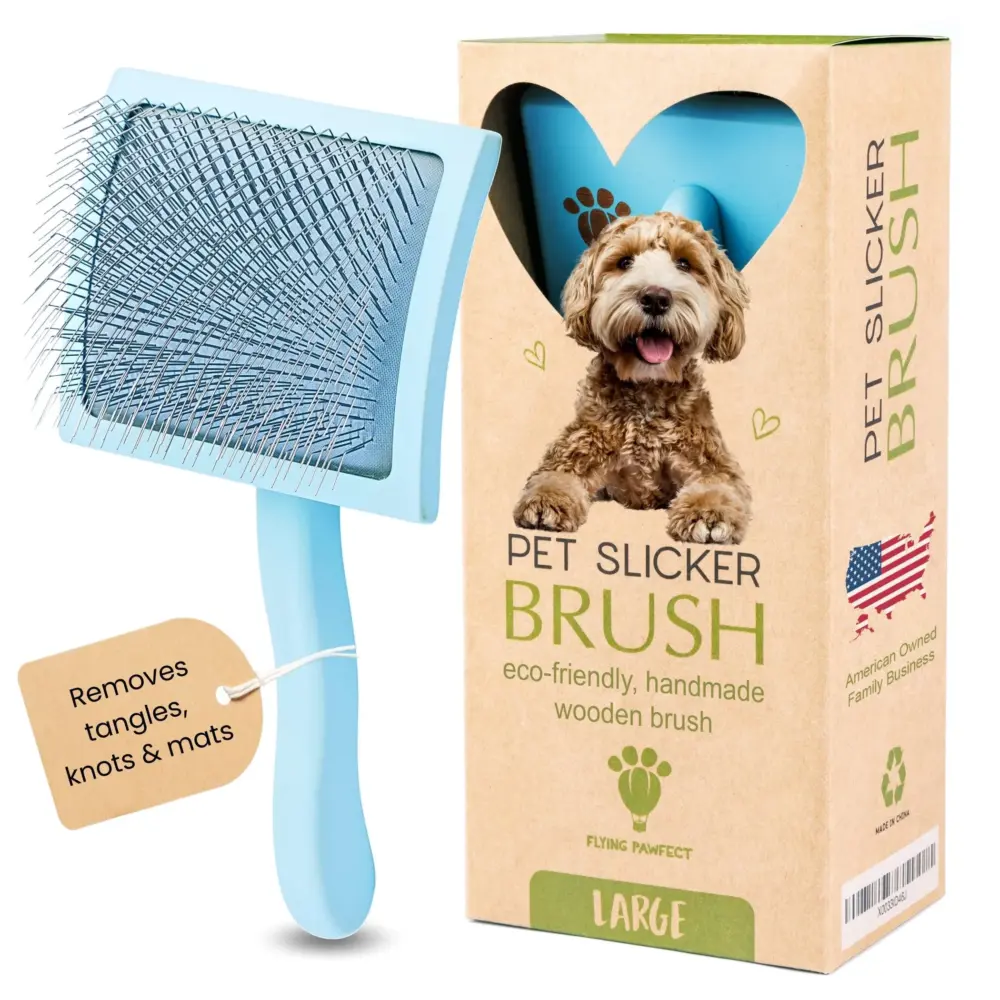
- Curved Slicker Brush for Dogs and CatsA curved head that follows the body line across the back
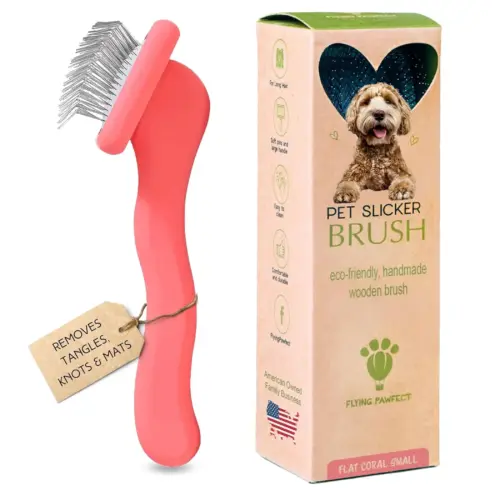
- Flat Slicker Brush, SmallA small flat head for cats
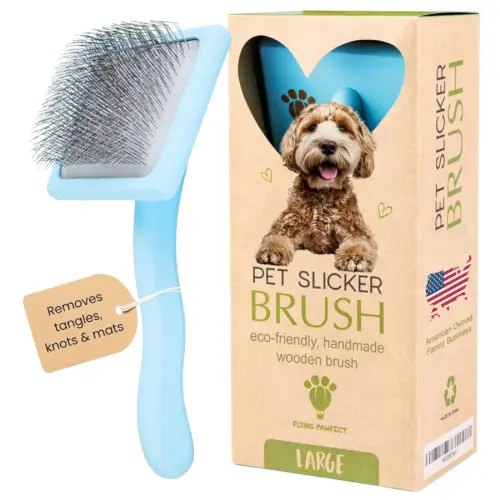
- Flat Slicker Brush for Dogs and CatsA large flat head for covering legs
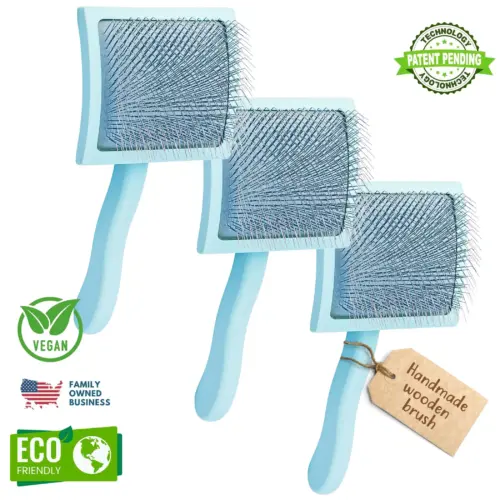
- Curved Slicker Brush, LargeThree large curved brushes in one pack
Why size is not just about the dog’s size
The instinct is to buy large for a large dog. That works for the back and ribs and fails everywhere else, because a big dog still has thin legs, a narrow face, feet, ears and a tail, and a wide head cannot work those areas without the edge of the brush digging into skin.
Think about it as the area you are brushing rather than the animal attached to it. A golden retriever needs a large brush for the body and a small one for the feathering behind the legs and the ears. A cat needs a small one everywhere.
The second variable is you. A large brush on a thick coat takes real force to pull through, which is tiring and is where people start pressing too hard. If your wrist aches after ten minutes, the brush is too big or the pins are too short for the coat.
Head size and the area you are brushing
| Head size | Use it on | Avoid it on |
|---|---|---|
| Small | Cats, puppies, toy breeds, faces, feet, tails, ears | Large bodies; it takes forever |
| Medium | Small and medium dogs all over; detail work on big dogs | Very thick coats on giant breeds |
| Large | Backs, sides and hindquarters of medium to large dogs | Faces, legs, feet, cats |
Flat and curved heads are a separate decision from size. A curved head follows the contour of a rounded body and keeps the pins in the coat across the whole stroke; a flat head gives even contact on flatter areas, legs and chest, and is better for finishing. Flat vs curved slicker brush covers that choice in full.
Pin length and coat depth
Pins need to reach through the coat to skin level without the brush body pressing on the skin. Too short and you are only combing the top of the coat while the mats underneath stay untouched. Too long and the pins waggle and bend rather than working.
- Short, smooth coats: a slicker is rarely the right tool at all; a rubber brush or a bristle brush does more.
- Medium coats: standard pin length, most general-purpose slickers.
- Long coats: longer pins, so the brush reaches the base of the hair.
- Double coats: longer pins again, because the undercoat sits below a protective top layer.
- Curly and wool coats: longer, firmer pins, worked in sections.
The honest test: brush a section, then part the coat down to the skin and look. If there is still loose undercoat or a mat sitting there, the pins are not reaching and a longer-pinned brush is the answer rather than more pressure.
Firm, soft and what each one does
Pin firmness is the variable people notice least and feel most. Firmer pins stay straight through a dense coat and do more work per stroke; softer pins flex, which is gentler on skin and much more forgiving of a heavy hand.
Softer, slightly longer pins are the safer default for anyone brushing their own pet, because the common failure is pressing too hard rather than not hard enough. Professional groomers often use firmer pins because their technique is already light.
Pin tips matter too. Rounded or coated tips are kinder; sharp uncoated tips scratch. Run the brush over your own forearm before using it on your pet: it should feel like firm contact, not like scratching.
Small heads for faces, feet and cats
A small head is not a brush for small animals. It is a precision tool everyone needs, regardless of dog size, and it is the one most people are missing.
Faces, behind the ears, under the chin, between the toes, down the legs and along the tail all mat badly and are all impossible with a large head. On a doodle or a long-coated breed, those are precisely the places that mat first, because they get the least brushing.
For cats it is the only sensible size. Cat skin is thinner and tears more easily than a dog’s, so use almost no pressure and keep sessions short. Most cats accept the back and sides long before the belly. How often to brush a cat and brushing a cat that hates it are the ones to read first.
Large heads and the pressure trap
A large head covers ground fast and that is exactly what makes it risky in a hurry. More pins across a wider area means more total force for the same hand pressure, and the edges of a wide head are the part that catches skin.
Brush burn, which is a red, irritated patch of skin, comes from a slicker used with too much pressure or held at the wrong angle, and it is most common with large brushes on short-coated or thin-skinned dogs. The coat should look opened after a stroke; the skin should look unchanged.
Keep the pins flat against the coat rather than digging in at an angle, work in short strokes and in sections, and check the skin as you go. How to use a slicker brush covers the technique properly.
Owning two is normal
The usual working set for a long or double-coated dog is a large or medium curved brush for the body and a small flat one for the detail areas. That is two brushes rather than one compromise, and it is why nobody finds a single slicker that does everything well.
For a short-coated dog, one medium brush plus a deshedding tool is a more useful pair than two slickers. Slicker brush vs deshedding tool covers the difference, and types of dog brushes covers the whole range.
Multi-packs and when they make sense
A three-pack of identical brushes is not for one dog. It makes sense in three situations: a multi-pet household where keeping one brush per animal avoids passing skin problems between them, a shared grooming space, or simply keeping one upstairs, one downstairs and one in the car so brushing actually happens.
Keeping a brush per animal is the strongest argument. Mites, ringworm and bacterial skin infections all transfer on shared grooming tools, and a brush is far harder to disinfect properly than it looks.
Our picks
-
Curved Slicker Brush for Dogs and Cats, Choose size & color
Price range: $38.95 through $40.95
Why it fits: A curved head that follows the body line across the back, sides and hindquarters, with soft stainless-steel pins. Three sizes, so you can match the head to the dog.
-
Flat Slicker Brush, Small, View product
$38.95
Why it fits: A small flat head for cats, puppies and small dogs, and for the faces, legs and tails that a full-size brush cannot reach on any dog.
-
Flat Slicker Brush for Dogs and Cats, View product
$40.95
Why it fits: A large flat head for covering legs, chest and the broader flat areas quickly, and for finishing after a deshedding session.
-
Curved Slicker Brush, Large, View product
$68.95
Why it fits: Three large curved brushes in one pack, for multi-pet households where each animal should have their own, or for keeping one in more than one place.
Handle shape and why your wrist matters
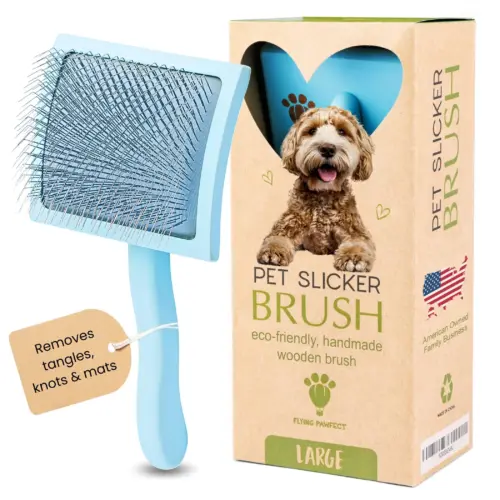
The handle gets ignored in every buying guide and it is the reason sessions end early. Brushing a double-coated dog properly takes twenty minutes or more, and a brush that forces the wrist into an awkward angle turns that into five.
Look for a long handle rather than a stub, since length gives leverage and keeps the wrist straight, and for a slip-resistant grip, because hands get damp during grooming. An angled or ergonomic handle takes load off the wrist on long sessions, which matters most if you are grooming more than one animal.
The sign you have the wrong handle is that you start pressing harder as you tire, which is exactly when brush burn happens. If your hand aches, stop and finish tomorrow rather than pushing through.
Self-cleaning heads: worth it or not
Self-cleaning slickers have a button that retracts the pins, releasing the collected hair in one pad. They are genuinely convenient, and there are two trade-offs worth knowing.
The mechanism adds bulk behind the head and a little weight, and the retracting plate means the pins cannot be set as firmly as on a fixed head, so a self-cleaning brush tends to be slightly less effective on a dense undercoat. For a short session on a medium coat, that is irrelevant. For a long session on a heavily shedding double coat, a fixed head with a comb to clear it does more work.
The other consideration is longevity: a mechanism is a thing that can fail, and a fixed head has nothing to break. If you groom a lot, keep a simple fixed brush as well.
Common questions
Can I use a dog slicker on a cat?
Only a small one with soft pins, and with far less pressure than you would use on a dog. A large dog slicker on a cat is the most common cause of a cat who will not be brushed again.
How do I know if the pins are too long?
If they bend visibly during a normal stroke, or the brush skates over the coat without engaging, they are too long or too soft for that coat. If the brush body contacts the skin, they are too short.
How often should I clean the brush?
Every session. A slicker packed with hair stops reaching the coat and starts dragging. Lift the hair out with a comb or a brush rake, and wash the head properly every month or so; how to clean a dog brush takes two minutes.
Related guides
-
Comparison
Flat vs Curved Slicker Brush: Which Shape Suits Your Pet
Flat and curved slickers are the same tool in two shapes, and the shape decides where the pins keep contact. This comparison covers which suits which coat and body, and why technique matters more than either.
-
How-to
How to Bathe a Long-Haired Dog Without Making Mats Worse
Long coats are won or lost in the drying. This guide covers brushing out before water, getting shampoo down to the skin, rinsing until it squeaks, and the brush-and-dry technique that stops mats forming.
-
How-to
How to Use a Cat Grooming Bag Safely
A grooming bag is a restraint, which makes using it properly a safety question rather than a convenience one. This guide covers choosing a size, introducing it over days, running a session, and the signs that mean stop.