How to Get Mats Out of Dog Hair at Home, and When to Stop
To get mats out of dog hair at home, work on one small, loose mat at a time in a dry coat: hold the hair between the mat and the skin so the skin isn’t pulled, tease the mat apart with your fingers, then brush it out from the ends inward with a slicker brush. A mat that sits tight against the skin, covers a large patch or hurts your dog to touch is not a home job; take it to a groomer, or to your veterinarian if the skin underneath looks sore. Never cut a mat out with scissors.
Quick check: can this mat come out at home?
Part the hair until you can see where the mat meets the skin, then sort it:
- A loose tangle or small mat you can slide a fingertip under: work it out at home.
- A small mat close to the skin: give it one short, gentle try.
- A mat tight to the skin, a large matted area, or red or sore skin: skip the home attempt; see when to stop, below.
Where dogs get matted, and why
A mat starts as loose hair twisting around the hair that is still growing. Friction and moisture pack it tighter each day until it felts into a dense clump, usually in the same places:
- Behind the ears, where the hair is often fine and soft and scratching twists it.
- Armpits and the backs of the front legs, where the coat folds with every step.
- Under a collar or harness, where straps rub the neck, chest and elbows.
- Belly, groin and the backs of the hind legs, pressed together when your dog sits or lies down.
- Around the tail and between the toes, where long hair collects debris and stays damp.
Long, silky and curly coats tangle most easily. A double coat mats when shed undercoat stays in and knots into the live hair, which is why new mats often turn up during spring and fall shedding season. A coat left damp after a swim, a rainy walk or a bath can tangle quickly, and some puppies go through a tangly stretch while the adult coat grows in.
Long-haired cats mat in many of the same spots but have thinner skin; see how to groom a long-haired cat, mats included.
What you need before you start
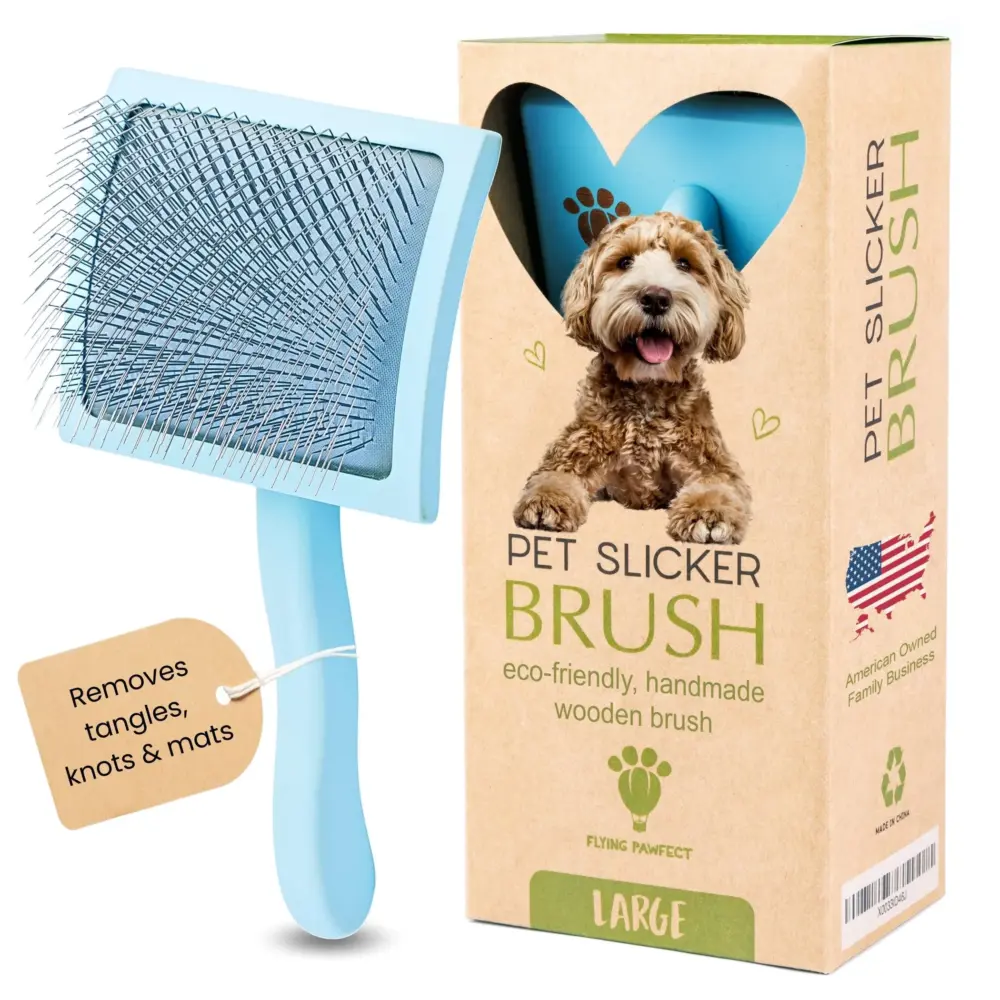
- A slicker brush, whose fine, firm pins separate a loosened mat a few strands at a time.
- A metal comb, if you have one, to check that a section is clear down to the skin. We don’t stock combs; any sturdy one will do.
- Cornstarch or a detangling spray made for dogs (optional), to help the hair slide apart.
- Small treats, a helper if possible, good light and a non-slip surface.
Leave out scissors and the de-shedding tool. A de-shedding edge is made to lift loose undercoat from a brushed-out coat, not to break up a mat, so it catches and pulls.
The Sakabase Curved Slicker Brush is made for dogs and cats with medium to long hair. Its curved head follows the body so more pins touch the coat with each stroke, and the pins reach the undercoat on long and thick coats. Its own instructions for mats match the method below: hold the hair at the base and brush from the ends inward. To check that a slicker suits your dog’s coat, see slicker brush vs deshedding tool.
-
Sakabase
Curved Slicker Brush
$39.95

How to get mats out of dog hair, step by step
Most small mats come out without cutting if you go slowly. Work on a dry coat, one mat at a time, for a few minutes per session.
- Check the base. If the skin looks normal and you can slide a fingertip between mat and skin, carry on. If not, go to the stop list below.
- Loosen it, if you like. Work a pinch of cornstarch or a little detangling spray into the mat with your fingertips, away from the eyes and nose.
- Hold the hair at the base. Pinch the hair between the mat and the skin. Your hand takes the pull, so your dog’s skin doesn’t.
- Pick it apart with your fingers. Tease the outer edge into smaller clumps, pulling strands out to the side rather than up off the skin.
- Brush from the ends inward. With light pressure and short strokes, brush the tips of the loosened hair, then work a little closer to your hand with each pass.
- Check down to the skin. Once the slicker glides through, run a comb or your fingers to the skin to find any leftover knot.
- Reward and rest. Give a treat, check for pink or scratched skin, and let a stubborn mat wait for another day.
The pins should glide over the skin, not drag along it; pink skin means you are pressing too hard or working one spot too long. Always detangle before a bath, not after: water tightens a mat.
Keeping your dog calm while you detangle
- Keep it short. One mat or a few minutes, then stop while your dog is still relaxed.
- Pay as you go. A small treat every few strokes at first, then space them out.
- Bring a helper. One person feeds treats at nose level and scratches the chest; the other works on the coat.
- Pick a quiet time, such as after a walk.
- Brush the easy places too, so the brush doesn’t always mean pulling.
Some dogs settle better with something to lick while you work; see what to put on a lick mat.
Lip licking, yawning, turning away or a stiff body mean your dog needs a break. A yelp, growl or snap means stop for the day.
When to stop and call a groomer or veterinarian
Stop and book a professional groomer if:
- The mat is tight to the skin and you can’t get a fingertip under it.
- Mats cover a large area or have joined into one matted sheet.
- The mat is near the eyes, on the ear flaps, around the genitals or under the tail.
- A small mat hasn’t loosened after a few minutes of gentle work.
- Your dog cries out, growls or snaps when you touch the mat.
Groomers take tight mats off with clippers, in line with VCA Animal Hospitals’ advice on dog coat care: clippers only on mats, never scissors, and a groomer or veterinarian when tangles are severe or extensive.
See your veterinarian if you find red, raw or broken skin, sores, swelling, a bad smell or discharge under a mat; if a mat has tightened around a leg, a toe or the tail; if soiled, matted hair is caked around the rear end; or if your dog limps or keeps licking one spot.
Preventing mats: a brushing rhythm, gear fit and drying
A brushing rhythm that matches the coat
Preventing mats in dog hair comes down to catching tangles while they are still loose. Long, silky and curly coats generally need brushing every day, while shorter coats can go longer; see how often to brush a dog, by coat type for a schedule. Part the hair and brush in sections down to the skin, because skimming the top layer leaves knots underneath. On a busy day, a two-minute pass behind the ears, under the front legs and along the harness lines catches new tangles before they tighten.
Collars, harnesses and coats
Gear that shifts rubs, and rubbing makes mats. A collar or harness should let two fingers slide flat under each strap without forcing; our guide on how to measure a dog for a harness, collar or coat covers the fit. Take the harness off at home so the hair beneath it can lie flat, and brush along the strap lines after walks.
After water, and between groomer visits
After a swim or a bath, blot the coat with a towel rather than rubbing it in circles, which twists long hair, and brush it through the same day, once it is fully dry. For coats that keep growing, ask your groomer about keeping the hair shorter behind the ears, under the legs and between the pads.
Browse our dog and cat grooming tools, or more grooming and shedding guides.
Matted dog hair FAQ
Can I cut a mat out with scissors?
No. Skin gets pulled up into a mat, so it lies closer to the blades than it looks, and one sudden move can turn a trim into a cut. A mat that won’t brush out needs a groomer with clippers.
What can I put on matted dog hair to loosen it?
A pinch of cornstarch or a detangling spray made for dogs can help a slicker slip through a small, loose mat. Conditioner is more useful once the mats are out, since bathing a matted coat tightens them. Nothing dissolves a mat that is tight to the skin; that needs a groomer.
Why does my dog get mats behind the ears?
The hair there is often finer and softer than the rest of the coat, and scratching, head shaking and a nearby collar keep twisting it. Brush there every day or two, or ask your groomer to keep it shorter. If your dog scratches its ears or shakes its head a lot, ask your veterinarian to check the ears.
Is matted hair painful for dogs?
Often, yes. Mats pull on the skin as they tighten, and the ASPCA warns that even very mild mats can irritate the skin and lead to infected sores, and that fleas and ticks can hide deep inside them. If the skin under a mat looks red or raw, see your veterinarian.
Should I shave my matted dog?
If much of the coat is matted, a groomer’s short clip is often kinder than a long dematting session, and the coat grows back. Leave the clippers to the groomer, since skin pulled up into a tight mat is easy to nick, and ask how short to go for your dog’s coat type.
Related guides
-
How-to
How to Bathe a Long-Haired Dog Without Making Mats Worse
Long coats are won or lost in the drying. This guide covers brushing out before water, getting shampoo down to the skin, rinsing until it squeaks, and the brush-and-dry technique that stops mats forming.
-
Comparison
Flat vs Curved Slicker Brush: Which Shape Suits Your Pet
Flat and curved slickers are the same tool in two shapes, and the shape decides where the pins keep contact. This comparison covers which suits which coat and body, and why technique matters more than either.
-
Guide
Why Do Dogs Roll in Smelly Things? How to Stop It and Clean Up
Nobody knows for sure why dogs roll in poop, dead fish and worse. The leading theories and their holes, the signs a roll is coming, the leash, leave-it and recall habits that prevent it, a cleanup plan for the walk, the ride and the bath, and when to call your veterinarian.