How to Groom a Long-Haired Cat at Home, Mats Included
To groom a long-haired cat at home, brush little and often: a few minutes every few days, one part of the body at a time, working down to the skin, where mats start. Give the hidden spots the most attention (behind the ears, the armpits, the belly and the backs of the legs) and finish with a comb. Small tangles can be eased out from the ends inward; a mat tight to the skin goes to a groomer or your veterinarian, never to scissors.
Short answer: a few minutes every few days, one section at a time
How often to brush a long-haired cat depends on the coat. The ASPCA’s cat grooming tips say long-haired indoor cats need a grooming session every few days, while VCA Animal Hospitals recommends daily brushing for long, silky or curly coats. Treat every few days as the minimum, and move toward daily for a fine, silky coat, in heavy shedding or when knots keep coming back.
- Each session: a few minutes, one or two body areas, ended before your cat gets restless.
- Depth: part the fur and brush the layer next to the skin; skimming the top leaves knots underneath.
- Nails: one or two at the end of a session.
Brushing a shorter coat? See how often to brush a cat, by coat length.
Where long-haired cats mat, and why
A mat starts as loose hair that never leaves the coat. It wraps around growing hair, and every step, scratch and nap twists it tighter until it felts into a dense clump against the skin. The ASPCA warns that matted hair can be painful and lead to underlying skin problems. Check these spots first:
- Behind the ears, where the hair is finest, and around the neck where a collar or harness rubs.
- The armpits and the backs of the front legs, which fold with every step.
- The belly and inner thighs, pressed together when your cat lies down.
- The backs of the hind legs (the fluffy “britches”) and the base of the tail.
- The lower back and rump, the hardest part for a cat to reach with its tongue.
Mats build fastest in shedding season and in cats that groom less; VCA notes that arthritic or overweight cats can find self-grooming difficult.
The tools for a long coat
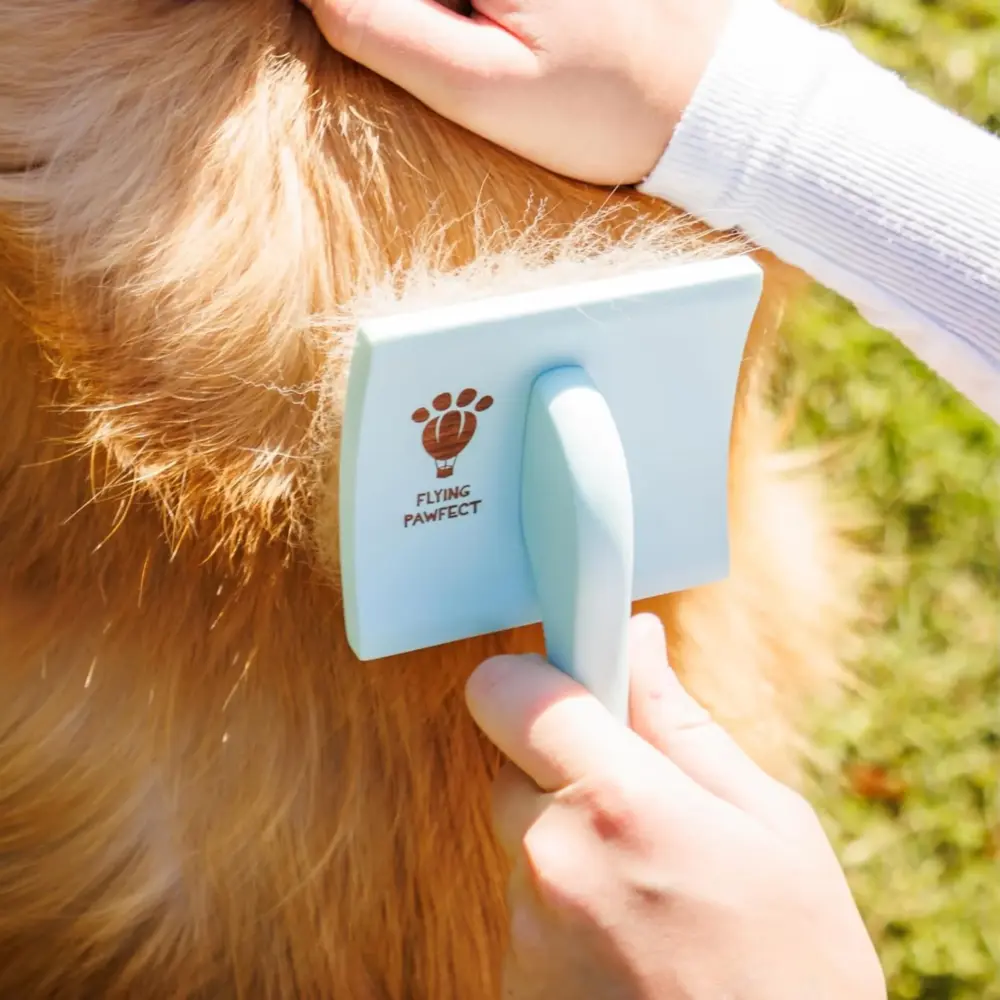
- A slicker brush. The Sakabase Curved Slicker Brush is made for dogs and cats with medium to long hair. Its curved head puts more pins on the coat with each stroke, and the fine, firm pins reach the undercoat and work through tangles. Cat skin is thin, so use the lightest pressure that still moves through the coat.
- A wide-toothed metal comb, to check each section is clear to the skin. We don’t stock combs; any sturdy one with rounded teeth will do.
- A de-shedding tool, for a thick undercoat only. The JESPET De-Shedding Tool has a stainless-steel edge that reaches through the topcoat and lifts loose undercoat before it can knot into the long hair. It is made for double-coated dogs and cats, in Small and Large. Use it on a brushed-out coat, never on a mat.
Part the fur to the skin: a dense, woolly underlayer means the third tool helps; a fine, silky coat can do without. Our guide to slicker brush vs deshedding tool compares the two in detail.
-
JESPET
De-Shedding Tool for Dogs & Cats
Price range: $27.95 through $29.95
-
Sakabase
Curved Slicker Brush
$39.95


How to groom a long-haired cat, section by section
Groom a dry coat when your cat is relaxed, such as after a meal. Use short strokes in the direction the hair grows, letting the pins glide rather than drag.
- Hands first. Feel the whole body for knots, and skip any spot your cat flinches at. Mention a new lump or sore spot to your veterinarian.
- Back and sides. Brush the top layer, then part the fur with your free hand and brush the layer beneath, working toward the skin.
- Neck and chest. Work through the ruff a layer at a time, lifting the top hair with your free hand. If your cat wears a collar, slip it off and check the fur underneath.
- Behind the ears. Fold the ear gently forward and use short, light strokes. Keep the brush away from the eyes.
- Armpits. Lift one front leg slightly forward, brush a few strokes, set it down and switch sides.
- Belly and back legs. With your cat lying on its side, or standing while you reach underneath, brush a little at a time, holding long hair near the skin so nothing pulls. Stop before your cat objects.
- Tail. Part the hair along the middle and brush each side out gently.
- Comb check. Run the comb to the skin everywhere; where it catches, there is a tangle.
Back and sides one day, belly and legs the next is a fine routine. If your cat swats at the sight of a brush, start with how to brush a cat that hates being brushed.
How to get mats out of cat fur without scissors
Start with one test: can you slide a comb tooth or fingertip between the mat and the skin? If so, and the skin looks normal, try this:
- Loosen it, if you like, with a pinch of plain cornstarch worked in by fingertip. Skip detangling sprays not labeled for cats; your cat will lick off whatever goes on the coat.
- Hold the hair at the base, between the mat and the skin, so your fingers take the pull.
- Tease the edge apart into smaller clumps with your fingers, pulling strands sideways.
- Brush from the ends inward with the slicker and light pressure, moving a little closer to your hand each pass.
- Comb to the skin to confirm it is clear, and brush out leftover cornstarch.
- Stop and reward. A mat that hasn’t loosened in a few minutes can wait, or go to a groomer.
Never cut out a mat with scissors: cat skin is thin and stretchy, and a tight mat pulls it up toward the blades. VCA advises clippers only, never scissors, and a groomer or veterinarian for severe or extensive tangles. Keep the de-shedding tool off mats, since its edge catches and pulls, and detangle before any bath: VCA notes that tangles can become impossible to remove afterward.
Long-coated dog too? The same method works; see how to get mats out of dog hair at home.
When a mat needs a groomer or veterinarian
Book a groomer, ideally one who works with cats, if:
- The mat is tight to the skin and no comb tooth fits under it.
- Mats have joined into a sheet across the back, belly or hindquarters.
- A mat sits near the eyes, on the ears, or around the genitals or tail.
- Your cat hisses, swats or tries to bite when you touch the spot.
See your veterinarian if the skin under a mat is red, raw, moist or scabbed, if your cat cries out when touched, or if matted cat fur keeps appearing because your cat has stopped grooming. Heavily matted cats are often clipped short, sometimes under sedation at the clinic, and the coat grows back.
A weekly routine, nails included
A long-haired cat grooming routine only works if it is small enough to keep up with:
- Every few days, or daily for a silky coat: a few minutes per section with the slicker (10 to 15 minutes in all for a full pass, or 5 to 10 a day on a silky coat), plus a comb check behind the ears, in the armpits and on the britches.
- Weekly: a hand check from nose to tail, including paws and under the tail, where soiled fur can be wiped with a damp cloth.
- In shedding season: the de-shedding tool on a double coat, two or three times a week at most.
- Every ten days to two weeks: nails, the interval the ASPCA suggests.
- After grooming: vacuum where your cat naps, and use this daily, weekly and monthly cleaning checklist for cat homes for the rest.
Do one or two nails at the end of a brushing session your cat already accepts. If clippers make your cat tense, the Quiet Rechargeable Pet Nail Grinder is an alternative, with a low-noise motor, two speeds, USB charging and a guard with openings sized for cats. Let your cat sniff it and hear it running before the first nail, and hold the paw fur back so long hair can’t catch in the spinning head. For clipper technique, the towel wrap and a cat who resists, see trimming a cat’s nails when your cat won’t let you.

See all our dog and cat grooming tools, or browse more cat care guides.
Long-haired cat FAQ
How do I know I’m brushing my long-haired cat often enough?
Use the comb test: you are brushing often enough when a comb glides from skin to tip everywhere, armpits and britches included. For most long coats that means at least every few days, and daily for a fine, silky coat or during heavy shedding; if the comb keeps catching, brush more often.
Why is my cat’s fur matted on its back?
The lower back and base of the tail are hard for a cat to reach, so loose undercoat there knots unless you brush it out. Older, stiff and overweight cats often groom this area less. If mats appear suddenly, the coat turns greasy or your cat seems sore there, ask your veterinarian to check for a reason.
Should I shave my long-haired cat?
Not routinely. VCA says most cats, even long-haired ones, cope with summer heat without a haircut, though cats prone to large mats or that object to brushing may benefit from a periodic shave-down such as a “lion cut”, which leaves the face, feet and tail tip long. An outdoor cat should keep at least an inch of coat against sunburn. Leave the clipping to a groomer or veterinarian.
Does a long-haired cat need baths?
Rarely. Most healthy cats keep themselves clean, so a bath is for a cat that got into something sticky or smelly or can no longer groom well. Brush out every tangle first, use a shampoo made for cats and dry the coat thoroughly, or leave it to a groomer.
Related guides
-
Guide
Can Dogs and Cats Share Water Bowls, Beds and Brushes?
A healthy dog and cat can share a water bowl, beds, cooling mats and grooming tools if you clean them between pets; food, the litter box and small toys stay separate. Here's the item-by-item guide, plus when to stop sharing and the dog flea products that can poison cats.
-
How-to
The Weekly At-Home Health Check for Dogs
Five minutes a week, done in the same order, catches most problems while they are still small. This guide walks through a nose-to-tail check for dogs, what normal feels like, and the findings worth a phone call.
-
How-to
How to Groom a Senior Dog at Home: Brushing, Nails and Lump Checks
Many older dogs tire of standing, and shorter walks wear their nails down less. Here is how to set up a comfortable spot, brush gently by coat type, keep nails short, clean up between baths, check for lumps as you go and know when a groomer or veterinarian should take over.