Puppies & Kittens How-to
How to Stop a Kitten From Biting and Scratching
Short answer
Kittens bite and scratch to practice hunting, and moving hands and feet make easy prey. To stop it, keep hands out of play, go still and offer a toy when teeth land, leave the room if your kitten keeps biting, and schedule play before attacks usually start. Hissing or flattened ears suggest fear or pain; call your veterinarian.
Why kittens bite and scratch
A kitten that stalks your feet and wraps itself around your wrist is almost always playing, not angry. That play is hunting practice, and the ASPCA’s guide to aggression in cats calls play aggression the most common type of aggressive behavior cats direct at their owners. A few things make a kitten more likely to aim it at you:
- Youth and spare energy. VCA Animal Hospitals’ guide to play and predatory aggression says it is especially common in cats under two that have no other feline companions, and the ASPCA adds long hours alone without chances to play.
- No littermates to set limits. Cornell’s Feline Health Center explains that littermates teach a kitten how hard is too hard by stopping play or fighting back, so kittens raised without them are among the most likely to play rough.
- Hands that used to be the toy. Wiggling fingers, wrestling and toes moving under a blanket all teach a kitten that people are prey. Cute at ten weeks, painful at a year.
- Teething. Kittens start losing their baby teeth at around 3 to 4 months, and most have their adult set by about 6 to 7 months. Some chew more in between, so give that mouth soft toys, not fingers.
- Timing. Cats are naturally most active around dawn and dusk, and a kitten that dozed all day is primed when you walk in, so attacks often cluster in the early morning, the evening and your first minutes home.
Play attacks look like stalking, a wiggling rear end and a silent pounce, then a dash away. Hissing, growling, a crouched body, flattened ears or fur on end point to fear or pain instead; see the last section.
What to do the moment your kitten bites
The aim is simple: biting people becomes boring, and chasing toys becomes the best game going, every single time. Keep these within reach (the full supply list for a new arrival is in our new kitten checklist):
- A wand toy with a feather or fabric lure, long enough to keep your hand well out of reach. We don’t sell wand toys.
- Small toys to throw, such as toy mice or a ping-pong ball, stashed in every room your kitten uses.
- A kicker toy: a plush toy big enough to hug and rake with the back feet, for a kitten that wrestles your arm.
- A scratcher beside the spot where you play.
- A few days of notes on when and where the attacks happen.
- Go still. Stop moving the hand or foot under attack. Squealing, flapping or yanking away makes you act like escaping prey, which keeps the game going and drags claws across your skin. Cornell advises not touching a cat at all during a play attack, since it can frighten the cat or be taken as more play.
- Free yourself gently. As soon as the grip loosens, slide your hand away slowly and tuck it out of sight.
- Offer a better target straight away. Toss a small toy across the floor, away from you, or make the wand lure dart off. Your kitten still gets to hunt, just not you.
- End the game if your kitten comes back for you. Stand up, say nothing and leave the room for a few minutes. VCA advises ignoring the cat or walking out of the room so it learns that starting rough play earns no attention.
- Come back calm. Don’t restart with your hands; if your kitten is still wired, burn it off with the wand.
- Keep the rules the same for everyone, visitors included. A kitten can’t learn that one person’s hands are off-limits while another’s are a game.
Count the attacks each day for a week or two. Fewer and softer bites mean the plan is working, even before they stop completely.
Safety note
Small teeth still break skin. Wash any cat bite or scratch with warm, soapy water right away; the CDC’s advice on cat bites and scratches lists when to see a healthcare provider, including a serious wound or one that becomes red, painful, warm or swollen. People usually catch cat scratch disease from a scratch, especially a kitten’s, so also see a provider about a low-grade fever or swollen, tender lymph nodes one to three weeks later. The CDC advises people with weakened immune systems to avoid owning cats younger than one.
A daily play plan that leaves less energy for ankles
Redirection handles each bite; scheduled play prevents many of them. VCA advises keeping a diary of when play attacks happen and scheduling play to get ahead of them. Match the plan to your notes:
- Pounces as soon as you get up: a few minutes of wand play before anything else, then breakfast.
- The welcome-home ambush: pick up a toy before you take off your coat, and toss it past your feet as you walk in.
- The evening wild half-hour: start about ten minutes before it usually begins, with your longest session of the day in several short bursts, then dinner.
- Toes under the covers at bedtime: a short game that winds down slowly, then a small snack from the day’s food, so your kitten settles instead of hunting feet.
Kittens play in short, intense bursts, so several sessions of a few minutes usually work better than one long one. Our guide to how long to play with your cat covers session length by age and the hunt-catch-eat routine. Stop before play tips over: VCA lists a tail lashing from side to side, ears going back and dilated pupils as signs to end the session before your kitten gets too worked up. Rotate toys every few days so they stay new, and put corded wand toys away after every session, since swallowed string is an emergency.
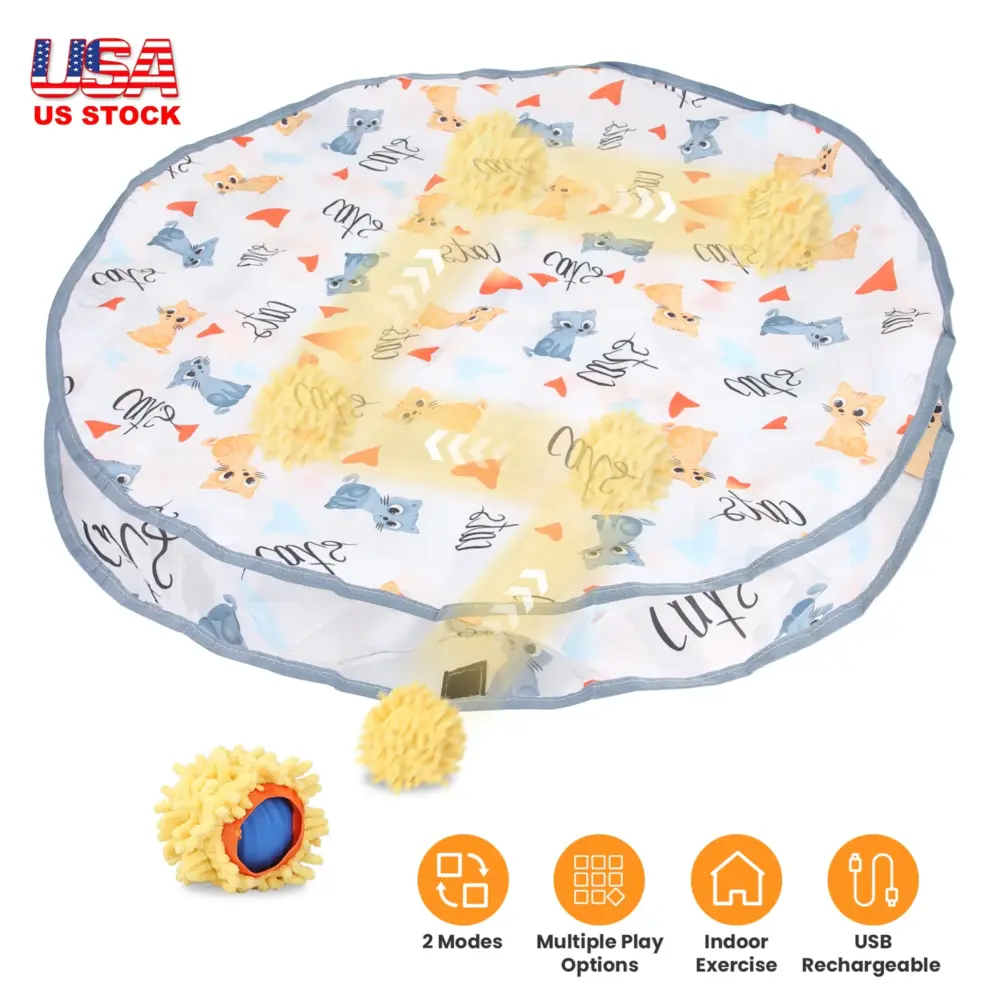
Between sessions, a toy that moves on its own gives your kitten something to chase while you cook or work nearby. It can’t set up a final catch or replace your games, but it can cover the restless stretch that used to end at your feet.
-
Motion-Activated Rolling Cat Toy Ball, View product
$42.95
Why it fits: Wakes when your kitten touches it, then darts, turns and pauses like prey, giving your kitten something to chase besides your ankles while you cook or work nearby.
-
Cat Scratcher Guy
Wooden Cat Scratcher with Reversible Insert, View product
$32.95
Why it fits: A floor-level scratcher with a reversible cardboard insert in a wooden frame. Set it beside the play spot so the last pounce of each game lands claws in cardboard, not your arm.


The rolling ball has two play modes, runs about an hour per charge and works best on hard floors and short-pile rugs. Set it out a few minutes before the restless stretch usually starts, stay in the room while it runs, and check the plush cover for wear afterward.
Giving claws a better target
Claws in your arm and claws in the rug are different problems. Scratches on you are part of the play attack and ease as the plan above takes hold. Scratching carpet and furniture is normal behavior every cat needs, so it can be moved but not stopped. Give both a target:
- Put a scratcher where you play, and drag the wand lure across it near the end of each session, so the last pounces sink claws into cardboard.
- Don’t count on catnip yet. Kittens usually don’t respond to it until they are a few months old, and some cats never do; play and treats work at any age.
- Trim the nail tips regularly, as the CDC recommends. Blunter tips do less damage while your kitten learns.
- Give climbers somewhere to go. A kitten that scales your legs or the curtains wants height. Lift it off gently and set it on a sturdy cat tree or shelf.
To match the angle and texture your kitten prefers and make the sofa less tempting, see how to get a cat to use a scratcher.
The Cat Scratcher Guy scratcher in the picks above measures about 19.5 × 5.5 × 2 inches and suits kittens that dig at rugs and carpet; one that stretches up the sofa arm will also want a tall, stable post, which we don’t sell. The catnip that comes with it may not interest a young kitten yet, so lean on the wand lure for now. Browse more indoor cat essentials.
What not to do: punishment, rough play and hands as toys
- Don’t play with hands or feet, even gently, and even in a glove or sock: it still teaches that hands are prey. The CDC also advises avoiding rough play with cats and kittens, because it makes cats defensive toward people.
- Don’t hit, flick, scruff or tap the nose. VCA warns that pain can cause aggression, so hitting your cat may increase the very behavior you want to stop, and it teaches your kitten to fear your hands.
- Skip the yelling, hissing back and water spray. A startle may interrupt one pounce, but it doesn’t show your kitten what to bite instead, and it can make your kitten wary of you.
- Don’t cut back on play. A kitten with no outlet saves that energy for you. The fix is more toy play, not less.
- Don’t wait for an age when it stops. There isn’t a set one. Play aggression is most common in cats under about two, and many grow gentler, but a kitten that keeps winning the hand game may still play it as a full-grown cat, with bigger teeth.
- Don’t let children play chase-the-fingers. Teach them to use a wand toy and to freeze when the kitten pounces; our guide to cats and kids covers house rules and giving your cat somewhere to escape.
Ankle ambushes and pounces from under the furniture
An ankle attack is a hunt in miniature: hide, wait, pounce on the thing that moves. Take each part away:
- Find the launch pads. Under the bed, behind the sofa, the corner at the end of the hall. VCA suggests blocking access to hiding spots like these; storage boxes or a closed door will do while you retrain.
- Know where your kitten is. VCA also suggests a bell on a quick-release (breakaway) cat collar so you hear your kitten coming; check the fit often, since kittens grow fast.
- Get there first. Toss a small toy past the ambush spot before you reach it, so the pounce lands on the toy. Keep a basket of throw toys by the bedroom door and the couch.
- Walk, don’t dance. Hopping, squealing and running turn your feet into the best toy in the house. Keep a steady pace, or stop and stand still.
- Close the bedroom door at night if your kitten hunts toes under the covers, at least while you work on this. Feet moving under a blanket look exactly like prey.
If your kitten is alone all day and the attacks peak when you walk in, it may simply be short of play. VCA suggests a second kitten as a playmate, provided both have been well socialized to other cats. That is a big commitment in its own right, so weigh it first; our comparison of adopting a kitten or an adult cat lays out the time and supervision a kitten asks of you.
Troubleshooting: when the biting doesn’t ease off
- Your kitten ignores the toy and goes for you anyway. The toy is probably moving too little or too close. Make it flee across the floor or flick it behind a chair leg, and start before your kitten locks on to your feet.
- It got worse for a few days. Some kittens try harder when the hand game suddenly stops working. Stay consistent; if it keeps escalating after a couple of weeks, talk to your veterinarian.
- Your kitten only goes for one person. Usually that person still plays with their hands, or reacts the most. Agree on one set of rules.
- It grabs your arm and kicks with its back legs. That is a wrestling move. Go still, then swap your arm for the kicker toy.
- It bites when picked up or stroked. Keep handling short and pair it with treats, and read the next section: this is often overstimulation, fear or pain rather than play.
When biting isn’t play
Not every bite is a game. Watch the rest of the body:
- Fear. Crouching, flattened ears, hissing, spitting, growling, fur standing up and swatting. The ASPCA’s advice for a defensively aggressive cat is to avoid it until it calms down, so don’t reach in to comfort or move your kitten. Give it a hiding place and time, then look for what frightened it.
- Petting-induced biting. Some kittens nip during stroking, then jump down and run off. Watch for a twitching tail, ears flattening or turning back and dilated pupils, and stop at the first sign; the ASPCA says the best response is simply to stop.
- Pain or illness. A kitten that suddenly starts biting, bites when one area is touched, or is also hiding, eating less or limping needs a checkup. Cornell lists dental disease among the medical problems that may cause aggression, and the ASPCA says cats with aggression problems should always be examined for an underlying medical cause.
Call your veterinarian if bites regularly break the skin, the biting gets worse despite a few weeks of consistent practice, your kitten seems frightened much of the time, or anyone in the house, especially a child, is getting hurt. Your veterinarian can check for pain and, for serious cases, refer you to a veterinary behaviorist.
Tip
Raising a puppy too? Puppy mouthing has its own causes and fixes, from tug toys to calm time-outs; see how to stop a puppy biting.
Related guides
-
How-to
Working From Home With a Cat: Fewer Paws on the Keyboard
A home-office plan for cat owners: a warm bed beside the desk instead of on it, cables and coffee out of reach, play before calls, midday puzzle and lick-mat jobs, a kind fix for keyboard walkers and a gentle switch back to office days.
-
How-to
How to Stop Your Cat From Waking You Up at Night
Cats wake you before dawn because it is hunting time, the gap since dinner is long and waking you has paid off before. Here is a three-step plan: a bedtime hunt and meal, breakfast that doesn’t depend on you, and a firm no-response rule, plus a night setup, troubleshooting and signs to see your vet.
-
How-to
How to Stop a Cat From Running Out the Door
Indoor cats dash for the door because it offers more smells and movement than anything else in the house, and often because that is where they get greeted. Learn a household door routine, how to teach a rewarded spot away from the entry, how to handle guests and moving day, and what to do if your cat gets out.