How Long Should You Play With Your Cat? Daily Sessions and a Hunt-Catch-Eat Routine
Cats play the way they hunt, in short, intense bursts, so the answer to “how long should you play with your cat?” is less than most people expect. Two or three sessions a day of about 10 to 15 minutes each suits most adult cats, and plenty are done sooner. A few minutes of hard chasing that ends in a catch and a small meal beats half an hour of half-hearted dangling.
Short answer: a few short sessions a day, ending with a catch and a snack
- How long: about 10 to 15 minutes, or until your cat walks away.
- How often: two or three times a day for most adults; kittens want more, shorter bursts.
- When: morning and evening, ideally just before a meal.
- How: move the toy like prey, let your cat stalk and chase, then let it make a final catch.
- After: a small meal from the day’s ration, then leave your cat to groom and rest.
How long should you play with your cat, by age
How much playtime a cat needs depends on age, energy and how much else there is to do; an indoor-only cat usually needs more from you.
- Kittens (under a year): several short bursts a day, often just a few minutes each. Use a wand toy, never your hands or feet, so pouncing on people never becomes the game. Our new kitten checklist covers the toys to have ready.
- Adult cats: the sessions above. A lively young indoor cat may want a fourth; a laid-back one may be done in five minutes.
- Senior cats: shorter, gentler sessions, with the toy kept low so your cat can bat at it lying down. Skip games that end in big jumps.
Intensity matters more than minutes. As International Cat Care’s advice on playing with your cat points out, cats play like sprinters, so a minute or two of all-out chasing can be a good session. Stop when your cat walks off. Cats rarely pant, so if yours breathes with its mouth open, stop and let it rest; call your veterinarian if that doesn’t settle within a few minutes or happens after light play.
The best times of day to play
Cats are naturally most active around dawn and dusk, so a morning session before you leave and an evening one suit both your cat and most work schedules. Keep the times roughly the same each day.
- Before meals. A slightly hungry cat is usually keener to chase, and the meal becomes the reward for the catch.
- Before bed. An evening game and a small meal help many cats settle instead of racing down the hallway at 3 a.m.
- When you get home. If your cat ambushes your ankles at the door, give that energy a toy instead.
How to play like prey: stalk, chase, catch, eat
A good session copies a hunt. International Cat Care’s guide to how cats hunt describes searching, approaching, catching and eating, repeated through the day as a series of small meals. Here is how to play with a cat so it feels like the real thing:
- Pick a prey-like toy. A wand with a feather or small fabric toy on the end lets you control the movement and keeps fingers out of reach.
- Start at a distance. Twitch the toy a few feet away, or let it peek out from behind a chair leg or under a towel.
- Move it away, not toward. Drag it away from your cat or across its line of sight. Prey rarely runs at a predator.
- Mix speeds and pauses. Quick dashes and sudden stops give your cat time to crouch, wiggle and plan the pounce.
- Let your cat win now and then. A cat that never catches anything soon gives up. Allow a catch every few pounces, then slide the toy away to start again.
- Slow down near the end. Over the last minute or two, make the toy tired: slower moves, easier catches.
- Finish with a catch and food. Let your cat make one last, solid catch, then serve the snack.
Ending the game so your cat settles
Snatching the toy away mid-chase can leave a cat wound up, and that leftover energy often turns into ankle attacks. Give your cat the finish a real hunt has:
- Catch: the last pounce lands and your cat gets to hold the toy.
- Eat: a small portion of its usual food or a few treats, taken from the day’s ration, not added to it.
- Rest: leave your cat alone to groom and doze.
- Stretch: cats often scratch after a nap, so keep a scratcher between the play spot and the bed.
For the eat step, the SodaPup Jigsaw Enrichment Lick Mat turns a spoonful of smooth wet food into a slower snack: its jigsaw texture holds soft food and slows licking, it suits cats as well as dogs, and it is dishwasher safe. Stay nearby the first few times. For cat-friendly spreads, see what to put on a lick mat for dogs and cats; if your cat gulps its food, our guide to slowing down a cat that eats too fast explains why play before dinner helps.
For the stretch, the Cat Scratcher Guy Wooden Cat Scratcher gives your cat a flat, floor-level spot to dig its claws in after the catch. It suits cats that scratch rugs and carpet, and a wand toy dragged across the insert at the end of a game can draw your cat’s claws to it. To build the habit, see how to get a cat to use a scratcher instead of the sofa.
-
Cat Scratcher Guy
Wooden Cat Scratcher with Reversible Insert
$32.95
-
SodaPup
Jigsaw Enrichment Lick Mat for Dogs & Cats
$25.95


Why won’t my cat play with toys? Prey type, timing and boredom
A cat that ignores toys usually isn’t lazy. More often the toy, the movement or the moment is wrong:
- Wrong kind of prey. Some cats chase toys that fly like birds; others want something that scurries like a mouse or twitches like an insect. Try each style for a few days.
- Wrong movement. A toy dangled in front of the nose is easy to ignore. Make it hide, flee and pause.
- Wrong time. Try morning, evening or just before a meal, not right after one.
- Same old toys. Keep two or three out, store the rest in a closed box and swap them every few days.
- Low confidence or competition. A shy cat may prefer to watch at first, so keep moves small and let the toy slip behind cover. If another pet always gets there first, play in a separate room.
A cat that suddenly stops playing, or seems stiff, reluctant to jump or off its food, may be in pain or unwell, so see your veterinarian rather than buying new toys. For ideas between sessions, see our indoor cat enrichment ideas, or browse more toy and play guides.
Automatic toys: where they fit next to wand play
A self-moving toy is a useful extra for the chase, but it can’t read your cat or set up a final catch, and your cat misses the time with you. Use one as a warm-up before a wand session, or to keep your cat busy while you cook or work in the same room.
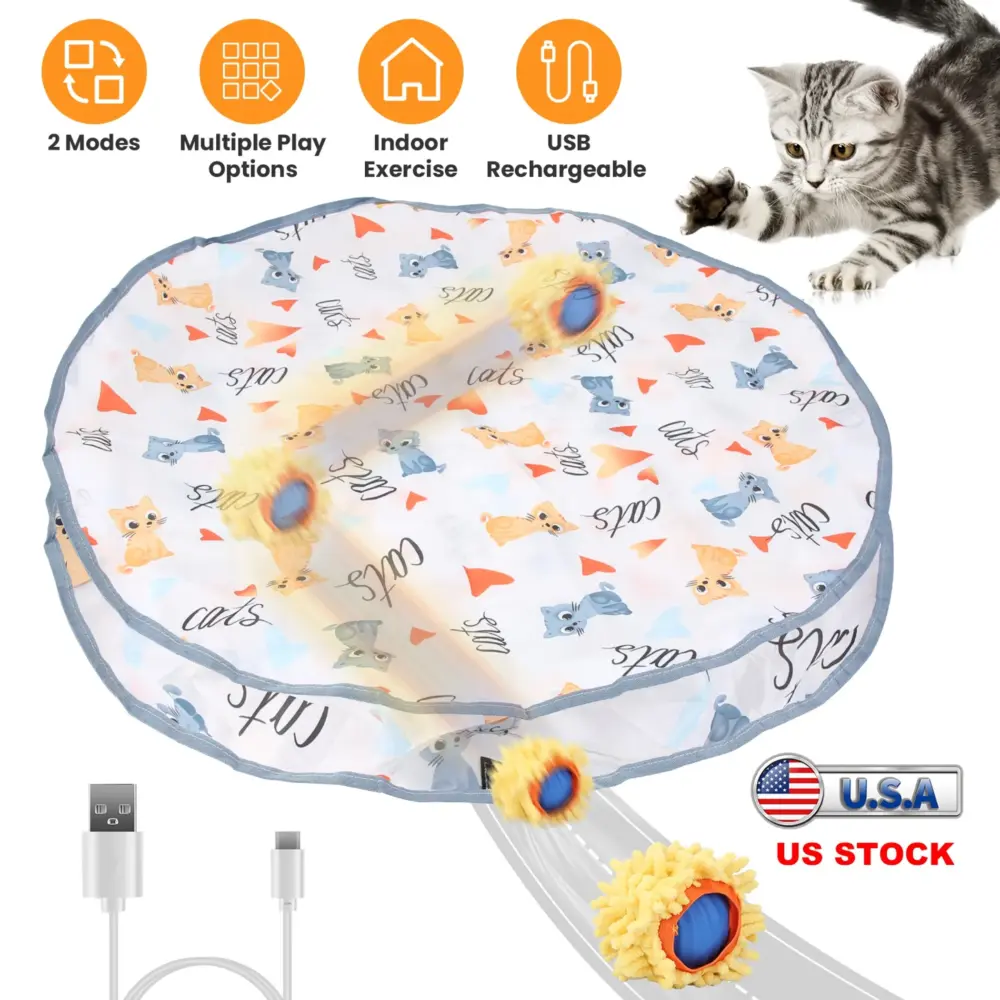
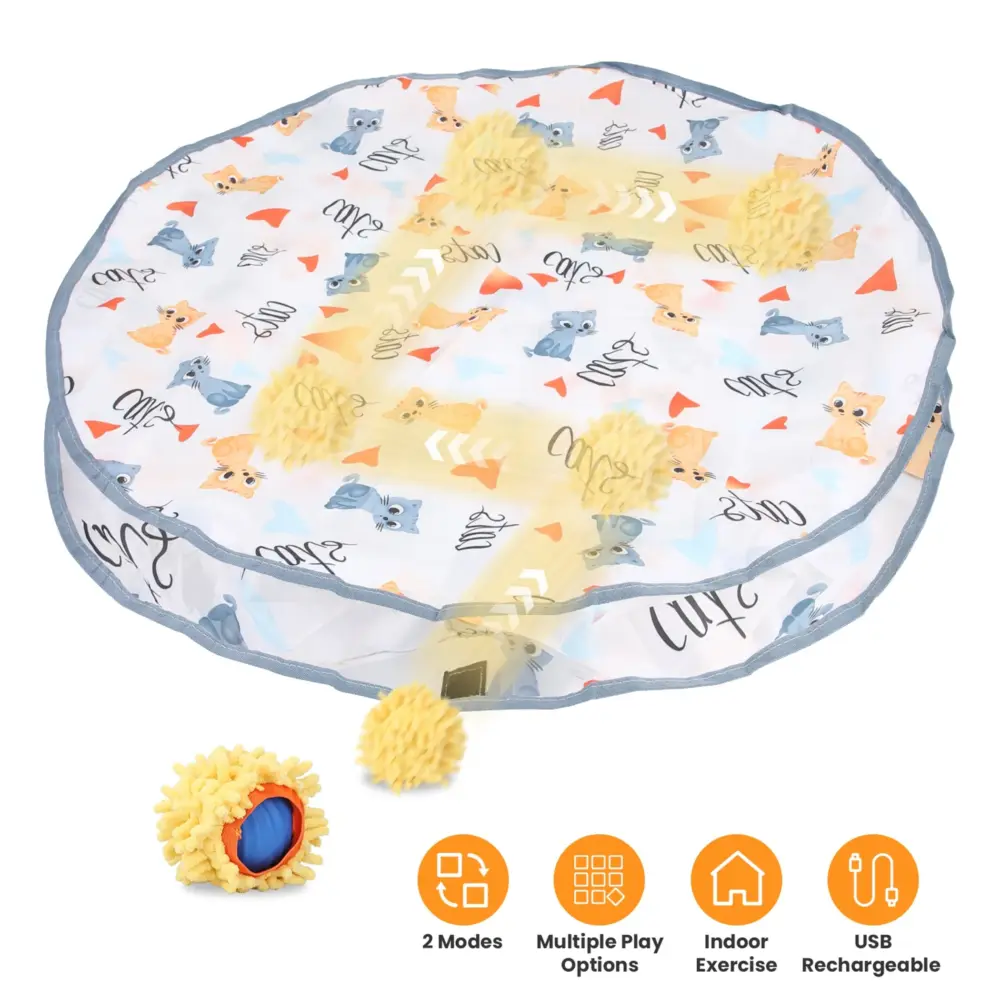
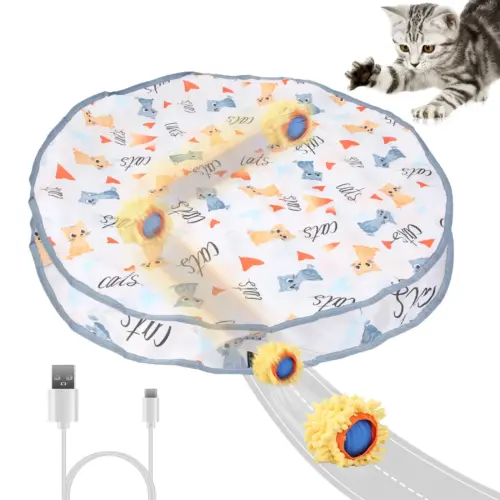
The Motion-Activated Rolling Cat Toy Ball wakes when your cat touches it, then dashes, changes direction and pauses like prey, and sleeps again when the game ends. It has two play modes and a plush pouch cover for an extra texture to catch. A rechargeable 300 mAh battery gives about an hour of active play per USB charge, and it works best on hard floors and short-pile rugs.
Stay nearby while it runs rather than leaving your cat alone with it, then check it for wear, put it away and charge it. To finish, switch to a small toy your cat can grab and carry off, then serve the snack. More cat picks are in our indoor cat essentials.
Are string toys safe for cats? Only while you hold the other end
String, ribbon, yarn, elastic, hair ties and tinsel are tempting to chase and dangerous if swallowed: a strand can bunch up the intestines and cut into them, a life-threatening emergency that usually needs surgery. A corded wand toy is fine while you hold it; the risk comes when it is left lying around.
- Put wand toys away after every session, in a closed drawer or closet.
- Check cords and feathers each time, and replace a toy once it frays or pieces come loose. No toy is indestructible.
If you see string hanging from your cat’s mouth or under its tail, don’t pull it. Call your veterinarian right away.
Cat play FAQ
Is 10 minutes of play enough for a cat?
For many adult cats, 10 minutes two or three times a day is plenty. One 10-minute game a day may not be enough for a young, energetic indoor cat. Watch your cat, not the clock: a cat that ends the game relaxed and grooming has had enough.
What happens if you don’t play with your cat enough?
An under-played indoor cat often finds its own outlets: racing around at night, ambushing ankles, knocking things off shelves or pestering other pets. Rough play aimed at hands and feet is more likely in cats left alone for long hours with nothing to chase. A few short games a day often help; if the change is sudden, see your veterinarian first.
Should I play with my cat before bed?
Yes, it is one of the best times. Play for a few minutes, wind the game down, then offer a small meal from the day’s ration so your cat can groom and settle.
Are automatic cat toys good for cats?
They are a good extra for chase play, but they don’t replace interactive play: your cat also needs a final catch and time with you. Stay nearby while any battery-powered toy runs.
Related guides
-
How-to
Working From Home With a Cat: Fewer Paws on the Keyboard
A home-office plan for cat owners: a warm bed beside the desk instead of on it, cables and coffee out of reach, play before calls, midday puzzle and lick-mat jobs, a kind fix for keyboard walkers and a gentle switch back to office days.
-
Checklist
When to Replace Dog and Cat Gear: A Monthly Wear Check
A five-minute monthly check for everything your dog or cat uses: the wear signs that mean a collar, harness, leash, toy, bowl, lick mat or scratcher insert should go, the fit checks growing and changing pets need, and what only needs a wash.
-
How-to
How to Stop Your Cat From Waking You Up at Night
Cats wake you before dawn because it is hunting time, the gap since dinner is long and waking you has paid off before. Here is a three-step plan: a bedtime hunt and meal, breakfast that doesn’t depend on you, and a firm no-response rule, plus a night setup, troubleshooting and signs to see your vet.