Toys & Play Guide
Why Do Dogs Like Squeaky Toys? And How to Keep Squeaker Play Safe
Short answer
A squeak sounds like small prey and goes off the instant your dog bites, so every chomp pays off, and it often brings you into the game. Long squeaking sessions are usually just play. The danger is swallowing a squeaker or stuffing from a ripped toy, so supervise play and retire any toy that starts to open.

What a squeak means to a dog
Dogs hear high-pitched sounds far better than we do. The AKC’s explainer on how dog hearing compares with ours traces that back to their wolf ancestors, who often hunted mice and other small rodents, so picking up the squeaks of small prey was a real advantage. A squeaky toy plays straight to that ear: a short, sharp, high sound coming from something soft enough to grab.
Timing does the rest. The squeak arrives at the exact moment of the bite, and it arrives every time. That instant, repeatable payoff is why a dog can lie on the rug going chomp, squeak, chomp, squeak long after a silent toy would have been dropped.
Research on play points the same way. Researchers at the University of Bristol’s Anthrozoology Institute describe solo play with toys as derived from predatory behavior: dogs prefer toys they can pull apart, and play tends to fade with objects that resist being changed. In a related study of kennel-housed Labrador retrievers, interest in a toy presented over and over dropped quickly, and a different toy brought the play back.
Playing at hunting
The AKC describes hunting as a chain of steps: orienting, stalking, creeping toward the prey, chasing, grab-biting, kill-biting, possessing, dissecting and consuming. Its guide to channeling prey drive explains that each step is rewarding in itself, and that games let dogs act out parts of the chain safely. With a squeaky toy you can often see it: a pounce, a head shake, a squeeze that sets off the squeak, then a trot away to lie down with the prize. On its own, that is ordinary play.
Does my dog think the toy is alive?
Nobody can ask, and the toy does not need to fool anyone to work: a squeak that answers every bite is rewarding either way. What you can see is the behavior it sets off, and for some dogs that includes the later steps of the chain, taking the toy apart to find where the sound comes from.
You are part of the reward
The same Bristol team notes that dogs usually play more cooperatively with a person than with another dog, and that for most dogs, winning the toy in a game with a human seems simply rewarding rather than a contest for status. Squeaking also gets noticed: you look up, laugh or reach for the toy, and many dogs soon learn that a few squeaks in your direction start a game. The AKC’s article on why dogs prefer some toys over others suggests keeping some toys as play-with-me toys that come out only for a game with you, a role squeaky toys suit well.
Why some dogs squeak nonstop and others ignore it
Two dogs can treat the same toy completely differently, usually for one of these reasons:
- What they were bred to do. Many terriers were bred to hunt rats and other small animals, and plenty of them go at a squeaker with real intensity. Breed is only a tendency, though.
- What the squeak has earned them. If squeaking reliably gets you off the couch, expect more of it.
- How new the toy is. As the Labrador study suggests, a new squeaker gets a burst of attention; a month later the same toy may barely get a chomp until it has spent some time out of sight.
- Age. The AKC notes that many teething puppies prefer rubbery chew toys, and senior dogs often like softer toys that are comfortable to hold and tug. An older dog who stops reacting to squeaks may also be hearing less; mention it to your veterinarian.
- Sound sensitivity. Some dogs startle at a squeak, especially one squeezed close to their face. For them, try a quieter, slower start, like the one in how to spark play in a dog who ignores toys.
- Other priorities. Some dogs would simply rather sniff, chase a ball or eat. That is a preference, not a problem.
Is it a problem when a dog squeaks a toy for hours?
Usually not in itself. A dog who squeaks with a loose, wiggly body, takes breaks and can stop for their name or a treat is playing. Worth changing: frantic squeaking that will not stop for food or a cue, squeaking at you until you give in, or a dog who cannot settle once the toy is gone. Shorter sessions with a planned ending, plus more walks and sniffing time, often help. If the squeaking is new, looks fixated or comes with changes in appetite, energy or behavior, talk to your veterinarian, since a behavior change can have a medical cause.
Why does my dog whine while carrying a squeaky toy?
Plenty of dogs pace the house with a squeaky toy in their mouth, whining softly. There is no single explanation: it can come with excitement, a request for a game or a dog who has not found the right spot to settle with the prize, and it often fades once the toy is put down or put away. A new pattern deserves a closer look. In an unspayed female, nesting, mothering and protectively guarding toys that start four to nine weeks after a heat can be signs of false pregnancy, according to VCA’s guide to pseudopregnancy in dogs. If that fits, or the whining comes with other changes, ask your veterinarian.
Squeaker hunters: dogs who rip toys open
Some dogs are not content to squeak the toy; they want the squeaker itself. They work at a seam, pull out the stuffing and keep digging until the little plastic squeaker is out, then often chew that too. This is the dissecting stage of the hunting chain, and for some dogs it seems to be the best part of the game.
It is also the dangerous part. Squeakers are small, and so are the scraps of fabric and stuffing that come out with them. The AKC warns that swallowing a squeaker or a toy can cause very serious complications that may need surgery, and advises never letting a dog who destroys soft toys have them unsupervised.
Safety note
If you think your dog swallowed a squeaker or pieces of a toy, call your veterinarian promptly, even if your dog seems fine, and do not try to make your dog vomit unless your vet tells you to. VCA lists the signs of a swallowed foreign object as vomiting, diarrhea, belly pain or tenderness, a drop in appetite, straining to pass stool, lethargy, and changes in behavior such as biting or growling when picked up.
Managing a squeaker hunter
- Bring a squeaky toy out for a game, then put it away. One that lives on the floor is a dissecting project waiting for a quiet moment.
- Watch for the switch. When chomping turns into picking at one spot, such as a seam, an ear or the lump where the squeaker sits, your dog has moved on to dissecting. End the game there.
- Trade rather than chase. Offer a treat or a second toy that is just as fun, and pick up the first once it drops. Chasing a dog for a toy can turn into keep-away.
- Move a known shredder to tougher, stuffing-free toys, and see which toys hold up to dogs who destroy them, matched to chewing style.
- Give the urge to dissect a safer job. The AKC’s prey-drive guide mentions giving a dog a bag full of treats to rip apart. A paper bag or small cardboard box works if you stay with your dog and gather the scraps; skip it entirely for a dog who swallows paper or cardboard.
- Account for the squeaker. When a toy opens, find the squeaker and the larger pieces before it goes in the trash. If the squeaker is missing, treat it as possibly swallowed and call your veterinarian.
Should you cut the squeaker out?
It sounds like a quick fix for the noise or the digging, but cutting into a toy leaves an opening, exactly what a squeaker hunter is looking for, and a stitched repair becomes the new weak spot. For a quiet toy, choose one made without a squeaker.
Choosing a squeaky toy
Start with how your dog plays, then look at the toy. The three common types wear in different places:
| Type | Suits | Weak points |
|---|---|---|
| Plush with a squeaker | Carriers, gentle chewers, short tug games | Seams, sewn-on eyes and ears, stuffing |
| Stuffing-free fabric, such as fire hose | Tuggers and dogs who pull plush apart | Seams and edges still wear |
| Rubber or vinyl | Fetch, and dogs who do not bite chunks off | Bitten-off pieces, cracks |
- Size and loose parts. Too big to fit entirely in your dog’s mouth, sized for the biggest dog if toys are shared, and free of plastic eyes, tags or ribbons that chew off easily.
- Where the squeaker sits. Squeeze the toy. A squeaker right under a seam or in a thin leg is one a determined dog is likely to reach sooner.
- How the squeaker holds up. An ordinary squeaker can go quiet once a tooth goes through it. Some toys use squeakers made to keep working after a puncture.
- Pitch and volume. For a sound-sensitive dog or a noise-conscious home, a softer squeak or a squeaker-free toy is kinder.
Nilosi carries two squeaky dog toys, so these picks are limited to our own catalog. Both are for supervised play.
-
Fire Hose Crocodile Dog Toy, View product
$30.95
Why it fits: For dogs who pull plush apart: stuffing-free fire hose with squeakers that keep squeaking after a puncture, about 26 inches long for supervised tug and fetch.
-
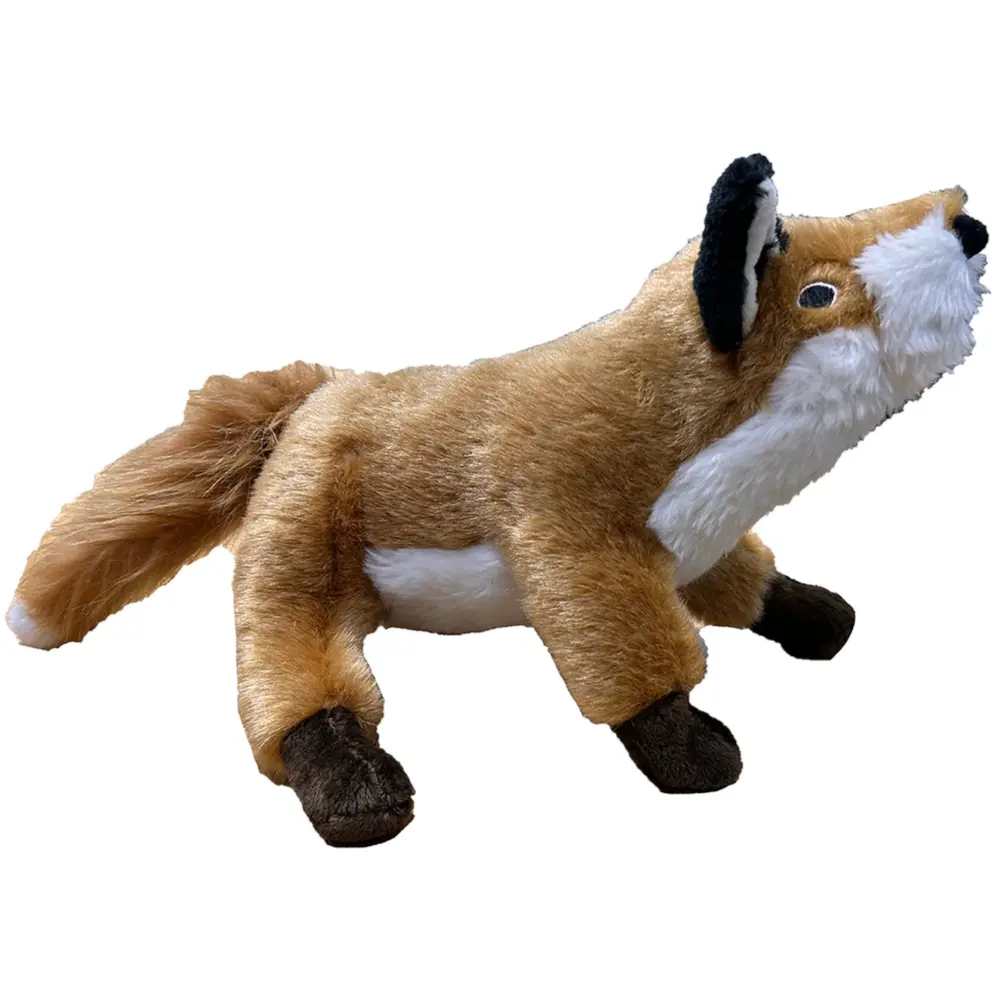
Realistic Plush Fox Dog Toy with Squeaker, View product
$30.95
Why it fits: A soft, realistic plush fox with a squeaker in the body and a 6-inch tail to grab, for carriers and gentle to moderate chewers who squeak a toy rather than shred it.


Neither is a solo chew, and no toy is indestructible, so put either one away when the game ends. Browse the rest of our toys and play gear.
Living with the noise
Make squeaky toys play-together toys
Keep them on a shelf and bring one out for a game: the squeak stays exciting, you are there if a seam gives way, and the noise happens when you choose. A simple toy rotation plan shows how many toys to keep out and how to swap sets each week. Swap day is also the time to wash them: follow the toy’s tag, see how to clean dog toys by material, and let a washed toy dry completely before it goes back on the shelf.
Set quiet hours
Pick squeaky toys up before work calls, a baby’s nap or bedtime, and offer a silent job instead. A thin layer of wet food spread over the SodaPup Jigsaw Enrichment Lick Mat and frozen ahead of time gives your dog a slow, quiet task. Supervise, and take it up if the edge starts getting chewed.
Turn the squeak into a game
- Find the squeak. Hide the toy while your dog waits in another room, give it one squeeze as a clue, and let your dog track it down.
- Tug with rules. A long toy, a drop cue and a clear ending. The AKC suggests letting your dog win sometimes by releasing the toy when they pull.
- A first word. A favorite squeaky toy makes a good first name to teach; see how to teach your dog the names of toys.
When the squeak is aimed at you
A dog who squeaks a toy at you until you play is issuing an invitation. Say yes sometimes, but not every time, or your dog learns that squeaking makes people play. Start games on your own schedule too, and when you are busy, a calm “not now” and a quiet alternative beat giving in after the twentieth squeak. Our guide to why dogs bring you toys covers demand play and keep-away.
When to take a squeaky toy away
Put the toy up, or retire it for good, when:
- It starts to open. A seam gapes, stuffing shows or the squeaker can be felt loose near the surface. A toy that has started to open usually keeps opening, so retire it.
- Play turns frantic. Your dog stops responding to their name or a treat, or gets snappy. End it calmly with a trade and keep the next game shorter.
- Your dog guards it. Freezing over the toy, stiffening, growling or snapping when someone comes near is resource guarding. Do not punish the growl or pull the toy away: the ASPCA’s advice on resource guarding, written around food but covering toys too, warns that punishment can make guarding worse, and points owners to qualified help such as a board-certified veterinary behaviorist.
- You are leaving the room. Squeaky toys do not go into the crate, the car or an empty house with your dog.
- Another dog wants it too. One squeaky toy between two excited dogs can turn a game into a squabble. Give one toy each, in separate spots, or put it away.
Related guides
-
Guide
How Much Playtime Does a Dog Need? By Age, Energy and Health
There's no fixed number of minutes. See how play needs change from puppy to senior and with energy and health, the signs of too little or too much play, and how to fit short games into a busy day.
-
Guide
Can Big and Small Dogs Live Together? Play Rules and Separate Spaces
Big and small dogs can share a home if you plan for the size gap. How to judge the match, set play rules and time-outs, give the small dog a place to escape, keep toys, meals and beds apart, walk both dogs and know when to call a trainer.
-
Guide
Toys for Dogs Who Destroy Toys: Choosing by Chewing Style
Shredder, tugger, carrier or steady chewer? Match toys to your dog's play style, see where fire hose and plush fit, play tug with rules and know when to retire a worn toy.