Car Travel Guide
What Does Airline-Approved Mean on a Pet Carrier? How to Check Fit
Short answer
On a pet carrier, “airline-approved” usually describes a design made to fit under an airplane seat, not a promise that your airline will accept it. Each airline sets its own carrier rules, and under-seat space varies by aircraft, so check your flight’s limits, measure the carrier yourself and make sure your pet can stand and turn around inside.

What airline-approved does and doesn’t mean
Carriers sold under this label tend to share a design: enclosed, often soft-sided, with mesh for airflow, zippers that close fully and a footprint meant to slide under the seat in front of you. That is a fair starting point when you shop. It doesn’t answer the question that matters on travel day: will this airline take this carrier, with this pet inside, on this plane?
In most cases the label is a description from the maker or seller rather than an approval from a particular airline. Here is what it doesn’t tell you:
- That your airline accepts it. Each airline writes its own in-cabin pet rules, and a label on the box isn’t part of them.
- That it fits every plane. AKC’s guide to flying with a dog points out that even when airlines publish general guidelines, restrictions can differ by aircraft type and route.
- That your pet fits. A carrier can meet an airline’s size limit and still be too small for your cat or dog.
- That your pet can fly. Cabin pet spots, fees, age limits and paperwork are separate questions; the guides to flying with a cat and flying with a small dog in the cabin cover booking.
How to check your airline’s under-seat limits
Look up the rules for the flight you plan to book, not for the airline in general. Do this before you buy the carrier if you can, and again before you buy the ticket.
- Open the airline’s pet policy page, not its general carry-on page, and find the section on pets traveling in the cabin.
- Write down the maximum length, width and height. Note whether the airline lists different limits for soft-sided and hard-sided carriers.
- Check whether the size depends on the aircraft. If the page says it varies, ask the airline what applies to your flight number, with your carrier’s measurements in hand.
- Note the other carrier rules: any weight limit for pet and carrier together, how many sides need ventilation, whether it must be leak-proof and how many pets may share one carrier.
- Repeat for every leg. A connection on another airline, or a flight operated by a partner, may follow different rules.
- Check again close to the trip, since airlines update their policies.
Here is why the aircraft matters. As of October 2026, Delta’s pet travel page says its maximum in-cabin kennel size is set by the aircraft on your flight, because under-seat space varies, and it recommends a soft-sided kennel no larger than 18 x 11 x 11 inches because that fits most of its aircraft types. It also asks for a leak-proof kennel with ventilation on three sides for domestic flights and four for international ones, and says your pet must be able to move around without touching or sticking out from the sides. Other airlines word their rules differently, so read the current page for yours.
How to measure a carrier yourself
Don’t rely on the listing alone. Product listings don’t always say whether a size is measured inside or outside, or with an expandable panel open or closed. Measure the carrier when it arrives, well before the trip:
- Outside, at the widest points. Set the carrier up, zip it closed and measure length, width and height across the outside, including end pockets, frame edges and hardware that sticks out.
- Expansions closed. Fold away any expandable canopy or side panel first, since it rides closed under the seat; that extra room is for stretching out while you’re parked or waiting.
- Height with the pad inside. Measure with the floor pad in place and the top sitting flat, not pulled up by the handles.
- How much a soft side gives. Press the top down gently, first empty and then with your pet inside. If the only way the carrier fits is with the roof pressing on your pet’s back, it doesn’t fit.
Don’t count on squeezing an oversized carrier into place unless the airline’s own rules allow it. Keep the three numbers in your phone, too; Delta, for one, asks you to have your kennel’s dimensions ready when you call to book your pet.
Your pet has to fit inside it, too
The airline’s limits describe the carrier. Your pet still has to fit inside it. AKC advises a carrier big enough for your dog to sit, stand, lie down and turn around comfortably, which must also fit beneath the seat in front of you. The same test works for a cat.
Measure your pet
- Height: standing on all four feet, from the floor to the top of the head, or to the ear tips if the ears stand up. Compare it with the carrier’s inside height with the pad in, not the height on the listing.
- Length: standing, from the nose to the base of the tail. Compare it with the inside length.
- The real test: at home, let your pet walk in and watch. It should stand without crouching, turn around without its back pressing the roof and lie curled up without pushing out the sides.
Weigh pet and carrier together
Step on a bathroom scale on your own, then again holding the carrier with your pet zipped inside, and subtract. AKC notes that for cabin travel the combined weight of dog and carrier usually must be under 20 pounds, though many U.S. airlines focus more on whether the carrier fits under the seat than on a strict cutoff. If your airline publishes a number, that is the one that counts.
A carrier’s own weight rating is a different figure: the most it is made to hold. A pet near that rating can still be over a combined cabin limit once the carrier itself is added.
Tip
If your pet only fits by crouching, or the carrier that fits your pet is too big for the seat, the cabin may not suit this trip. Our comparison of driving vs flying with a pet weighs the options, and a flat-faced breed, a senior or a pet with a heart or breathing condition should see a veterinarian before any flight.
Soft-sided or hard-sided carriers in the cabin
VCA’s guide to flying with a dog in the cabin suggests a relatively soft-sided carrier, because it is more forgiving under the seat, but not one that will collapse on your pet. Here is how the two types compare for cabin travel:
| Feature | Soft-sided | Hard-sided |
|---|---|---|
| Under the seat | Some give if space is tight | No give: must fit as measured |
| Inside room | Sides and roof can sag inward | Holds its shape |
| Airflow | Mesh panels, often several sides | Vents or grilles; count the sides |
| Cleaning | Harder to clean after accidents | Easier to wipe clean |
| Storage | Often folds flat | Bulky between trips |
Start with what your airline accepts for your flight, then choose the type your pet rides in calmly. If the airline lists separate hard-sided limits and that is what you own, check those numbers closely: a rigid carrier that is half an inch over has nowhere to go. Backpack carriers are a third design, built to be worn on short outings; whether a backpack is safe for your cat depends on fit, heat and trip length, and one still has to meet the airline’s limits like any other carrier.
Trains and buses have their own carrier rules
A carrier that suits a flight won’t automatically suit a train. As of October 2026, Amtrak’s pets page lists these rules:
- Dogs and cats only, one pet per customer and one pet per carrier.
- 20 lb for pet and carrier combined.
- A leak-proof, well-ventilated carrier no larger than 19 inches long, 14 inches wide and 10.5 inches high, with room for your pet to sit and lie down without touching the sides.
- Trips of up to seven hours’ total travel time, on most routes.
- Your pet stays inside the closed carrier in stations and on board, and the carrier goes under your own seat, not the one in front of you (Amtrak Cascades trains are the exception).
Pets ride in Coach and Acela Business Class, not in other classes or private rooms, and fees vary by route, so read Amtrak’s current pets page for your trip before you book. The height limit is the one to watch: a carrier listed at 12 inches tall, like ours, is over it.
Intercity bus lines and city transit agencies write their own rules, and they differ from one system to the next. Our guide to taking a dog on public transit covers buses and subways, from checking the agency’s rules to practice rides.
Our carrier’s published size, against your limits
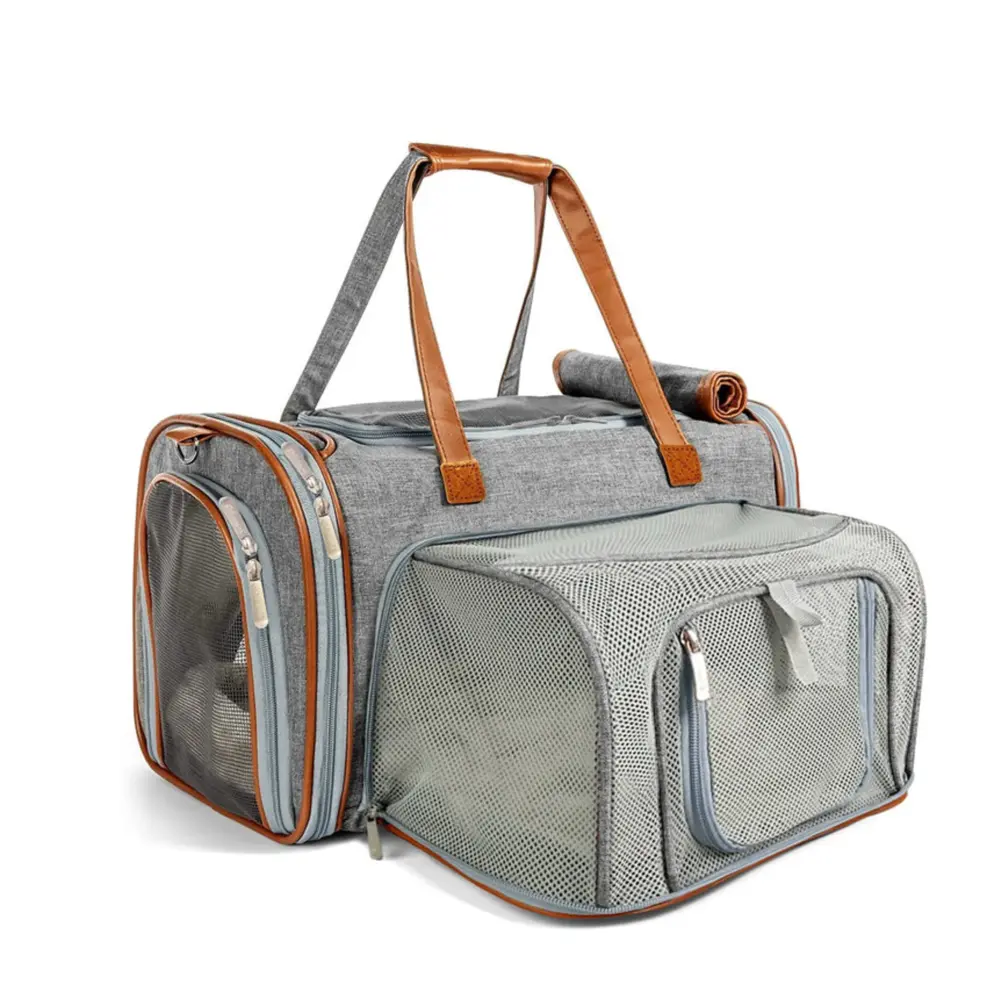
The carrier we stock for this kind of travel is the Armarkat soft-sided carrier (model PC102R). Like many carriers, it is sold as airline-approved, and that means only what it means above: a design for under-seat travel, not acceptance by any particular airline. Armarkat’s own listing gives its size as 19 x 12 x 12 inches (length, width, height) and says it holds up to 22 lb, without saying whether the size is measured inside or out, or with the canopy folded.
| Check | Published figure | Armarkat listing |
|---|---|---|
| Delta | Suggests 18 x 11 x 11 in, soft-sided | 19 x 12 x 12 in |
| Amtrak size | Up to 19 x 14 x 10.5 in | 19 x 12 x 12 in |
| Amtrak weight | 20 lb, pet and carrier | Rated to hold 22 lb |
| Your flight | Look it up for your flight number | Measure it yourself |
As listed, it is larger in every dimension than Delta’s suggested size and taller than Amtrak’s limit. That doesn’t settle every flight, since Delta sets its actual maximum by aircraft and other airlines publish their own numbers, but it does mean you shouldn’t buy it on the strength of the label for a specific trip. Compare your airline’s limit with the listing, measure the carrier when it arrives and count its mesh sides against any ventilation rule.
What it does offer: three zip openings, so you can lift your pet out through the top at security or the vet, mesh panels for air and a view out, a lounge pad, and a canopy that expands for room to stretch while you’re parked or waiting. It folds flat and stores in a small bag between trips, and you’ll find it with the rest of our travel and car accessories. If it turns out too big for your flight, a change-of-mind return costs you postage and a restocking fee (see our returns policy), so check your airline’s numbers before you order rather than after.
A zip-out side panel is a separate feature from any airline claim. Expandable pet carriers explained covers where the extra room helps and why it is useless in a footwell.
Once the carrier fits
- Practice first. A carrier that fits on paper still needs a pet who rests in it calmly. Start with the plan to get a cat used to a carrier; for a dog, the small-dog flying guide has a settle routine for under a chair.
- Booking. Reserve your pet’s cabin spot when you book your own seat; the cat and small-dog flying guides above cover fees and paperwork.
- Security. Your pet comes out and the empty carrier goes through the X-ray, as TSA’s small pets guidance explains; the flying guides cover doing that without an escape.
Related guides
-
Guide
Expandable Pet Carriers Explained: When the Extra Room Is Worth It
Expandable carriers add a zip-out side panel so a cat or small dog can stretch. This explains the two states and when to use each, why the feature is worth little in an aircraft footwell, how stability changes when the sides are open, and who should skip it.
-
Guide
RV Travel With a Cat: Carrier, Litter Box and Escape Routes
Make an RV a safe home for your cat: where the carrier rides on driving days, where the litter box goes, how to close off slide-outs, screen doors and windows, what to do if the power fails, and an arrival routine for every new site.
-
How-to
How to Measure a Pet for a Carrier So It Actually Fits
Carrier sizing catches people out because the weight limit and the internal dimensions are separate constraints and a pet can fail either. This covers the three measurements that matter, the height mistake almost everyone makes, and how to test the fit before a journey.