Car Travel How-to
How to Fly With a Small Dog in the Cabin: From Booking to Landing
Short answer
Reserve your dog’s cabin spot and check your carrier against the airline’s limits. Weeks ahead, practice quiet time in the zipped carrier and work on barking at home. At the airport, leash your dog before it leaves the carrier at security, use a relief area close to boarding, and keep the carrier zipped under the seat all flight.
Before you book: cabin limits, fees and paperwork
Each airline writes its own cabin pet rules and updates them, so read the current policy and reserve your dog’s spot, a separate booking, before you buy a ticket you can’t change. Airlines limit the number of pets in each cabin, so book early, especially around holidays. Then settle these questions:
- What are the carrier limits? The under-seat dimensions, whether a soft-sided carrier may be a little larger, and any weight limit for dog and carrier together. Measuring both is covered in what “airline-approved” means on a pet carrier: the label describes a design made for under-seat travel, not a promise from your airline.
- What’s the fee, and does the carrier count as your carry-on or your personal item? The answer decides what else you can bring on board.
- Any route, aircraft or age limits? Some airlines don’t take cabin pets on certain routes or aircraft. Puppies have to be at least 8 weeks old to fly, AKC notes, and your airline may set an older minimum.
- Which paperwork? Ask your airline, and your destination if you’re crossing state or national borders, whether your dog needs a health certificate from your veterinarian and how recently it must be issued. A pre-trip vet visit is worth it either way; carry proof of rabies vaccination too.
Choose a nonstop flight when you can, and consider a window seat, which AKC suggests because it keeps the carrier out of aisle traffic. Bulkhead and exit rows are off the table: the carrier needs a seat in front of you. Flying abroad, or bringing your dog back into the U.S.? Start with USDA APHIS pet travel and read CDC’s dog import rules well before you go.
Is your dog a good cabin flyer?
Cabin travel means your dog stays zipped in the carrier from boarding to landing. VCA notes that FAA rules keep cabin pets in their carriers for the entire flight, so there is no lap time and no stroll up the aisle. Count from the last relief stop before boarding to the first one after landing, including boarding, taxiing and getting off: a two-hour flight can mean three or more hours zipped in.
- Size. Your dog needs room to stand, turn around and lie down in a carrier that still fits under the seat, and an airline can refuse a pet that doesn’t meet its rules.
- Temperament. Good candidates already rest in a carrier at home, nap in the car and shrug off strangers and noise. A dog who panics when confined or reacts to other dogs will struggle at a crowded gate, where other pets may be flying too.
- Barking. A few whines at takeoff are manageable. A dog who barks nonstop whenever it’s shut in will likely do the same on the plane, so work on that at home first or consider another way to travel.
- Health and age. Flat-faced breeds, seniors, young puppies and dogs with heart, breathing or other medical conditions need a veterinarian’s opinion before you book.
Safety note
Don’t give a sedative or calming medication unless your veterinarian prescribes it for the trip. The ASPCA cautions that sedating pets for travel is generally not advised because of possible breathing and heart problems with altitude changes, and AKC adds that airlines generally don’t allow tranquilizers or sedatives. If your vet does prescribe anti-anxiety medication, VCA suggests testing it at home before the trip, so you know how your dog responds.
If the cabin looks like a poor fit, compare the options in driving vs flying with a dog or cat. For some dogs, a long drive with stops is easier than a short flight.
Practice at home: carrier time and a settle cue
Start a few weeks out. AKC suggests treating the carrier as your dog’s home base for at least a week before travel; a dog new to carriers needs longer. Move to the next step only once the current one is boring.
- Make the carrier furniture. Leave it open in the living room with a familiar towel or pad inside, toss treats in, and feed a few meals there. Let your dog walk in and out freely.
- Close it for short spells. Zip it while your dog eats or chews, and open it again before any fuss. Build toward the length of your door-to-door day in small jumps.
- Teach a settle cue. Reward your dog for lying down calmly inside, then name it with a word such as “settle.” Practice with the carrier on the floor under a dining chair and your feet beside it, the way it will sit under an airplane seat.
- Pick it up and go. Carry it around the house, then outside, then on short drives. If car rides are still a struggle, work through getting a dog used to car rides first, because the drive to the airport comes before the flight.
- Add noise and people. Practice the settle cue at an outdoor café or a pet-friendly store, and roll a suitcase past the carrier at home.
- Rehearse the checkpoint. With the harness on, open the top, clip the leash on, lift or call your dog out and walk a few steps, then back in, zip and treat. Fit the harness first using how to measure a dog for a harness: snug enough that your dog can’t back out of it.
- Try a new potty surface. Airport relief areas are often small patches of artificial turf or gravel. If your dog only goes on grass, practice on other surfaces with your usual cue word.
What to pack in the carrier and your personal item
- A carrier lined with an absorbent pad. VCA suggests a puppy potty pad in case your dog needs to go during the trip. Pack two or three spares, more for a connection or a likely delay, so a soiled pad can be swapped after landing.
- Harness, leash and ID, on your dog from the moment you leave home. The ASPCA’s travel list includes a collar with an ID tag, a microchip and a photo of your pet; check that the microchip record has your current phone number.
- Poop bags, zip bags, paper towels and wipes, for relief stops, paws after the turf and sealing a used pad.
- An empty water bottle and a way to serve it. Liquids over 3.4 ounces can’t go through the checkpoint, so fill the bottle airside.
- A safe chew or a few small treats. AKC notes a safe chew may help your dog relax and ease discomfort from pressure changes at takeoff and landing.
- Papers and medication: the rabies certificate, a health certificate if required, the pet confirmation, your vet’s number and anything your vet prescribed.
- A light cloth or a worn T-shirt, to drape over part of the carrier on board.
These picks are limited to Nilosi’s own catalog and chosen for the airport and the cabin. Check every size against your airline and your dog; more carriers and travel gear are in travel and car accessories.
-
Armarkat
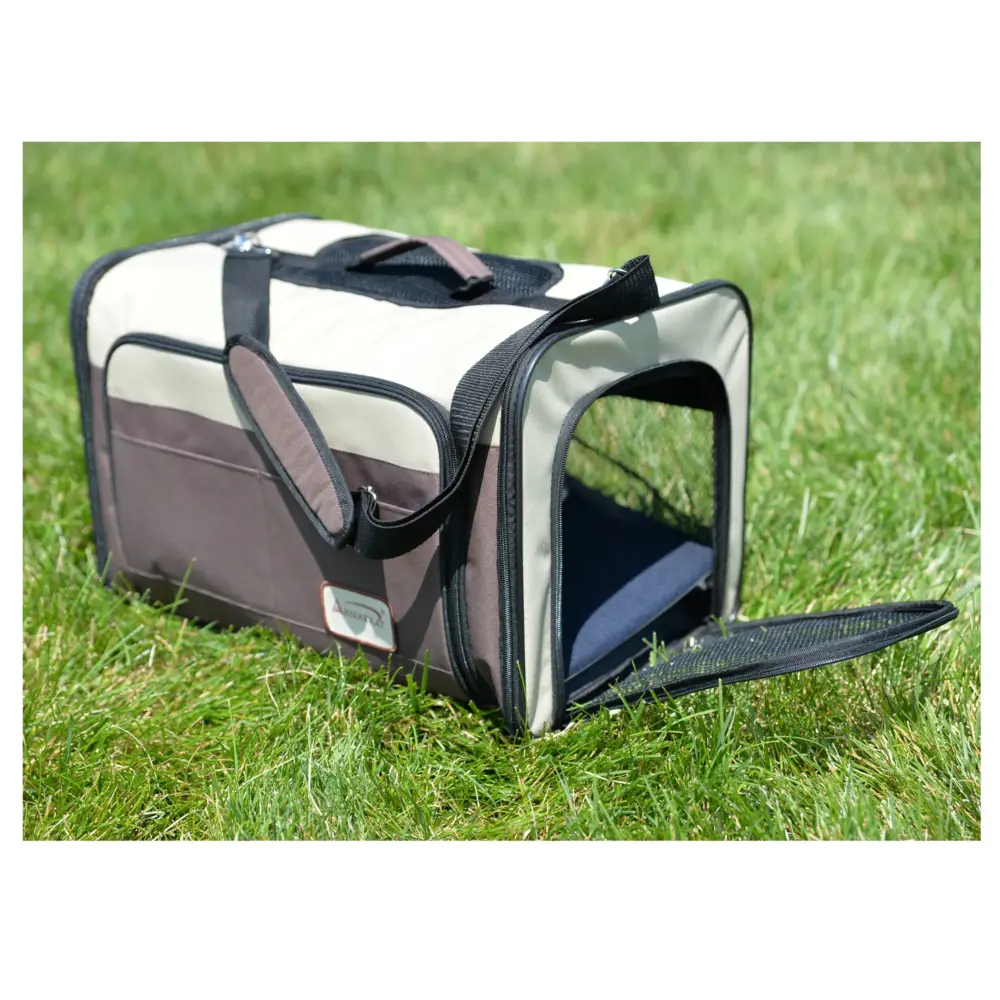
Soft-Sided Pet Carrier, View product
$65.95
Why it fits: Top and side zip openings let you clip the leash on before your dog steps out at screening. 19 x 12 x 12 in, up to 22 lb, per Armarkat: compare both with your airline limits before you book.
-
Mr. Peanut’s
PetTrek Padded Harness and Leash Set, Choose size & color
Price range: $24.95 through $26.95
Why it fits: Padded harness and matching leash in XS to L. Your dog wears it from home, so the leash clips on through the top of the carrier at the checkpoint. Measure the chest against the size chart first.
-
Flipo
Fold-A-Bowl Dog Water Bottle with Fold-Out Bowl, Choose color
$28.95
Why it fits: Goes through security empty, then fill it airside: the cover folds out into a bowl for a drink at the relief area, and the wrist strap leaves a hand for the leash. Holds 26 oz.
-
Mr. Peanut’s
Naturals Pet Wipes
$26.95
Why it fits: Large 6 x 10 in wipes for paws after a turf relief area and for cleaning up your dog after a small accident. Pack a few in a zip bag in your personal item.
Currently out of stock
-
Yucky Puppy
Waterproof Poop Bag Holder, Choose size
Price range: $23.95 through $24.95
Why it fits: Clips to the leash or your bag and zips a used poop bag into a waterproof pouch, so a curbside stop on arrival does not mean carrying it in hand to the next bin.





Airport day: relief areas, water and timing
Look up the relief areas at your departure, connecting and arrival airports before you leave. AKC notes that most airports have designated pet relief areas after security. Some also have one outside the terminal, and the airport’s website or terminal map shows where. Flying with a puppy that hasn’t finished its vaccinations? AKC advises skipping shared relief areas, where many dogs go, and using a pee pad in a family restroom instead.
- Plan the last meal. VCA suggests skipping breakfast on travel day, since an empty stomach lowers the risk of nausea and vomiting. Ask your vet first if your dog is a young puppy, a toy breed or has a medical condition, since some dogs shouldn’t go long without food.
- Walk, then arrive early. A long sniffing walk and a relief stop before you leave help your dog settle. Your airline may want to see your dog at the check-in counter, and rushing the checkpoint makes a slip more likely.
- Use the outdoor relief area before security if the line looks long, then the one inside security as close to boarding as you can manage.
- Offer small drinks. Give water in sips at the relief area rather than a big bowl just before you board.
- Keep the gate calm. Leave the carrier zipped, sit away from the boarding crowd and other pets, and use the settle cue until your group is called.
Security: out of the carrier on a harness and leash
Tell the officer you have a dog. Unzip the top just enough to clip the leash to the harness, lift your dog out, and put the empty carrier on the belt to be X-rayed; your dog never goes through the X-ray machine. TSA’s tips for traveling with pets say to carry your pet through the metal detector if possible, or walk it through on a leash, and its small pets page asks you to remove the leash when you carry your pet through. With a small dog, carry it through with the harness still on and clip the leash back on right after. An officer will swab your hands, and officers will inspect the carrier.
Put your dog back in the carrier at the re-composure area away from the lanes, not at the busy end of the belt. If your dog is likely to struggle or bolt, ask to be screened in a private room; TSA escorts you there with your dog still in the carrier. If a TSA working dog is at your checkpoint, TSA suggests moving to another one, which also spares a reactive dog the encounter.
On the plane: a barking or restless dog under the seat
Slide the carrier under the seat in front of you with a mesh side facing you, and keep it zipped for the whole flight, including taxiing and any delay at the gate. If your carrier’s canopy expands, keep it folded away; the extra room is for waiting areas, not the footwell.
- Stay close and quiet. Your feet beside the carrier and a low voice recreate the settle practice at home. Fingers against the mesh are fine; opening the top to reach in is how dogs slip out.
- Offer the chew for takeoff and landing, and save treats for quiet moments rather than handing them out to stop barking.
- Cover part of the view. Drape the cloth over the side facing the aisle so feet and carts are out of sight, and leave the other mesh panels uncovered for air.
- When barking starts, wait for a pause, then praise softly and give the settle cue. Scolding adds to the stress.
- If your dog seems distressed, panting hard, crying without letup or digging at the mesh, tell a flight attendant rather than opening the carrier.
Arriving: the first relief stop and walk
Your dog has probably been holding it for hours, so the relief stop comes before bags, coffee or the rental car. If there is a relief area inside security near your arrival gate, use it on the way out; otherwise head for the nearest one outside the terminal.
- Leash first. Clip the leash through the top opening before your dog steps out, and keep it short near the curb, where cars and crowds meet.
- Relief, then water. Give your dog time to sniff and go, then offer a drink.
- Clean up, reset and walk. Wipe the paws, bag the waste, swap in a fresh pad if the old one is damp, and take a short walk before the next leg. Driving on from the airport? The road trip with a dog checklist covers setting up the car.
- Ease back into meals. Stick to your dog’s regular feeding schedule, adjusting it gradually across time zones, as AKC suggests.
In the day or two after the trip, call a veterinarian if your dog vomits repeatedly, has diarrhea, won’t eat, seems unusually tired or is breathing with effort; breathing trouble needs a vet right away.
Mistakes to avoid and troubleshooting
- Buying the carrier the week of the flight, which leaves no time for practice.
- A loose harness, or a collar alone, when your dog comes out at the checkpoint.
- A full meal on the way out the door, instead of the timing your vet suggests.
Your dog won’t go on the turf
Give it time and use your cue word. Walk a slow loop, and try the outdoor area before security, which may have grass. A pad from your bag, laid on the turf, gives a pad-trained dog a familiar target.
An accident in the carrier
Leave the carrier zipped on board; the pad is there for this. After landing, lift the soiled pad into a zip bag, clean up your dog at the first relief stop and add a fresh pad.
Flying with a cat as well, or instead? Litter, food timing and checkpoint escapes are covered in how to fly with a cat in the cabin.
Related guides
-
How-to
Taking a Dog on Public Transit: Rules, Carriers and Practice Rides
How to get a small dog onto the bus or subway calmly: what to look for in your transit agency’s pet policy, choosing a carrier by your dog’s size and your own back, carrier training at home, short off-peak practice rides, stairs, crowds and heat, and how service animal rules differ.
-
Checklist
Pet Emergency Kit Checklist: What Your Dog or Cat Needs to Evacuate
Everything your dog or cat needs to evacuate with you: records and ID, two weeks of food, water and medicine, a carrier or harness per pet, sanitation and first aid, plus where pets can stay and when to refresh the kit.
-
Checklist
What to Tell Your Dog Walker: A Handover Checklist
Everything a new dog walker needs on one page: where the gear lives and how it goes on, how your dog walks, leash and route rules, medications and treats, emergency contacts, the door routine, weather rules and a first walk together.