Car Travel Guide
Expandable Pet Carriers Explained: When the Extra Room Is Worth It
Short answer
An expandable carrier has a zip-out panel that extends one or both sides, turning a compact bag into a larger space. It is genuinely useful in a waiting room, a hotel, a car footwell or at home, where the pet may be in the bag for an hour or more. It is close to useless on an aircraft, where the bag has to stay inside the under-seat dimensions for the whole flight. Expect more bulk, more zips and slightly less rigidity than a fixed carrier.
What expandable means
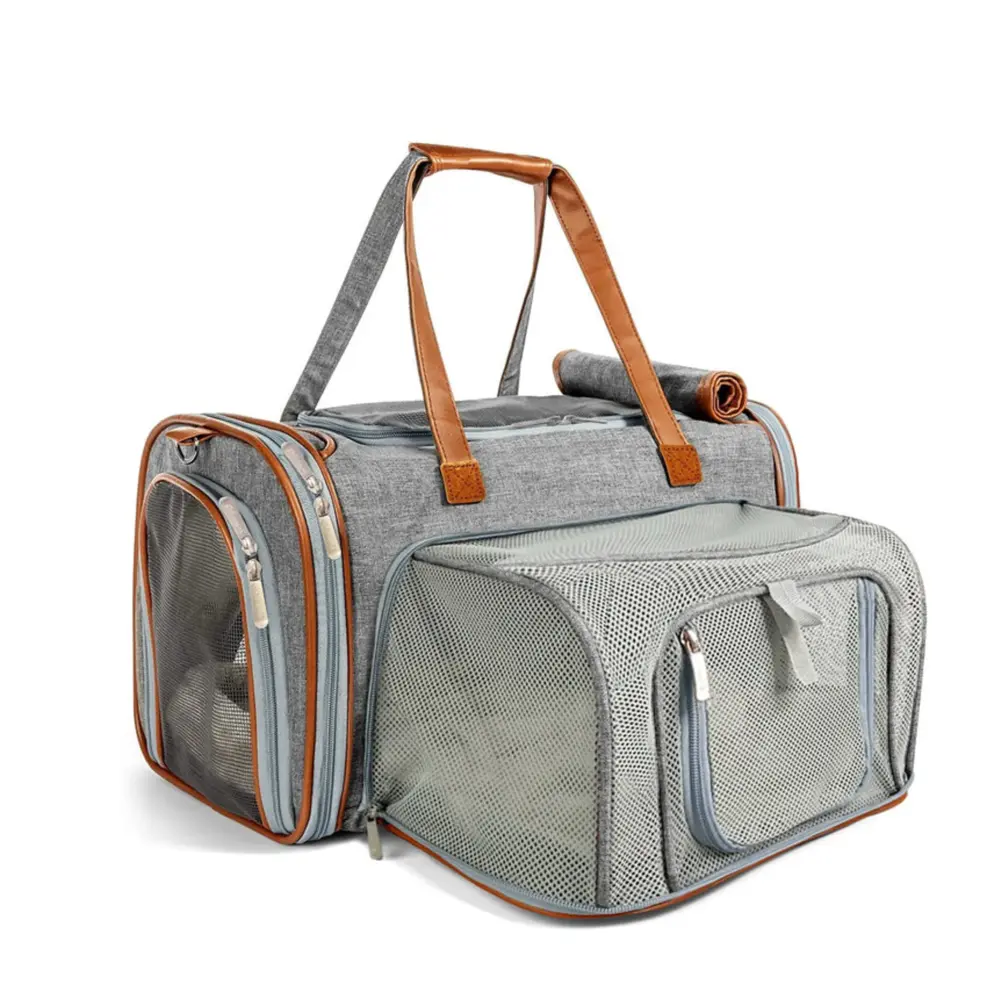
The mechanism is simple. A panel of mesh and fabric is folded and zipped flat against the side of the bag. Unzip it and the panel opens out, usually supported by a built-in frame or a flap that folds down to make a floor, adding a pocket of space the pet can move into.
Designs vary in how much they add and on how many sides. Some extend one side only; some extend both, roughly doubling the floor area. Some add a canopy upward rather than outward, which gives height for a cat to sit up rather than length to stretch out.
The important point is that the carrier is the same compact object when closed. You are not buying a bigger carrier; you are buying a carrier that can briefly become bigger.
The two states and when to use each
| State | Use it | Do not use it |
|---|---|---|
| Closed | Walking, stairs, public transport, aircraft cabin | Long waits where the pet cannot move |
| Expanded | Waiting rooms, hotel rooms, car footwell, at home | Anywhere you are carrying the bag |
| Expanded, unattended | Never; the extended panel is the weak point |
Never carry a bag with the side open. The extended panel is supported by light structure that is not designed to take the weight of an animal shifting while the bag swings, and the contents are suddenly much less secure.
Where the extra room genuinely helps
- Veterinary waiting rooms. Twenty minutes in a closed bag is a long time for a stressed cat; opening a side gives them room to reposition.
- Hotels and staying away. The carrier becomes a familiar den rather than a box, which helps a cat settle in a strange room.
- Car journeys. With the carrier secured in a footwell or strapped on a seat, an open side gives space on a long drive.
- Carrier training at home. An open carrier left out with bedding inside is far more inviting than a closed one.
- Two short pets or a pet and bedding. The extra width stops a cat being pressed against the side.
- Recovery. A pet on restricted movement after surgery sometimes needs confinement with a little more room.
Where it does not
The expansion is worth nothing on an aircraft. The reason people buy these for flying is a misunderstanding: the bag must fit the under-seat space for the entire flight, so the panel stays zipped shut the whole time and you have carried a heavier, bulkier bag for no benefit.
It is also not useful on public transport, on an escalator, in a crowd, or anywhere you need the bag in one hand. Those are all closed-state situations.
Safety note
No carrier is accepted by every airline. Rules differ by airline, aircraft and route, and they change. Some expandable models are deliberately built larger than the common under-seat allowance, which makes them excellent for the car and a risk at the gate. Measure the space under the seat you have actually booked and confirm the current limits with your airline before you travel. A gate agent can refuse any bag.
Stability when the sides are open
A closed soft carrier is a reasonably rigid box, held square by its panels. Open one side and that structure is weakened, which is why the base matters so much on this type of bag.
Look for a rigid base insert, usually plywood or a thick plastic board, under the padding. Without one the floor sags under the animal and the whole bag distorts when expanded, which is both unpleasant for the pet and the reason cheap expandable carriers collapse inward.
Self-locking zips are the other feature worth paying for. A frightened cat pushing at a zip from the inside can open an ordinary one; a self-locking design cannot be pushed apart. On a bag with four or five zips rather than two, that matters more rather than less.
Weight, bulk and carrying
Expandable carriers are heavier than fixed ones of the same closed size, because of the extra panels, zips and the structure that supports them. The bag itself can weigh several pounds before the animal is in it, and that counts against any airline weight limit that includes the carrier.
They are also bulkier to store. A fixed soft carrier often folds flat; an expandable one with a rigid base does not fold as small. If storage space is the constraint, a simpler carrier that collapses flat may suit you better.
Check the strap arrangement too. A padded shoulder strap and a top handle are both necessary, and a trolley sleeve that slides over a suitcase handle is worth having if you travel.
Cleaning a carrier with more panels
More panels means more seams, more mesh and more places for hair and worse to collect. Pick a model with a removable, washable pad rather than fixed padding, and check whether the mesh panels can be wiped without damaging them.
After any journey where the pet was sick or had an accident, the whole bag needs cleaning rather than just the pad, because the smell will sit in the seams and make the next trip worse. How to clean a cat carrier covers the method and the products to avoid. For the covers that protect the vehicle itself, see how to clean a dog car seat cover.
Our picks
-
Mr. Peanut’s
Gold Series Big Apple Expandable Pet Carrier, Choose color
$150.95
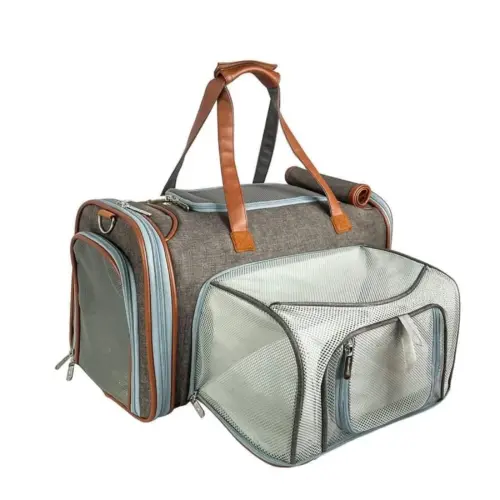
Why it fits: The longest in its range, two inches longer than most under-seat allowances, with self-locking zips. Built for pets who are long rather than large, and better suited to the car than the gate.
-
Mr. Peanut’s
Gold Series Mini Expandable Pet Carrier, View product
$130.95
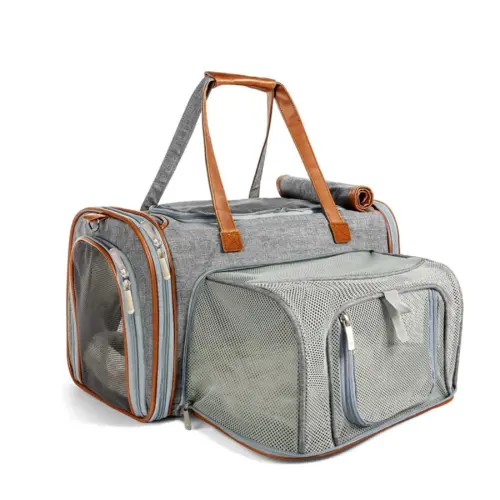
Why it fits: A compact expandable with self-locking zips, a plywood base insert under the padding and roll-away privacy covers for a nervous animal. Sized for pets up to twelve pounds.
-
Armarkat
Soft-Sided Pet Carrier, View product
$65.95
Why it fits: A soft-sided carrier with three zip openings, an expandable canopy for stretching between stops and a removable lounge pad. Folds flat into its own bag for storage.

Who should skip the feature
- Anyone buying primarily to fly. Choose a model inside your airline’s stated dimensions instead.
- Short trips only. A ten-minute drive to the vet does not need expansion.
- Dogs who will not be carried. A crate or a car restraint is the right product.
- Storage-limited homes. A flat-folding fixed carrier is far easier to live with.
- Very large or heavy pets. Soft carriers have weight limits for structural reasons, and expanding one does not raise them.
Whatever you buy, size it properly first: how to measure a pet for a carrier covers the measurements and the stand-and-turn test, and getting a cat used to a carrier is the part that decides whether any of it works.
What to check before you buy one
Expandable carriers vary more than fixed ones, because the expansion mechanism is where makers cut costs. These are the specific things to look at rather than the general features every listing mentions.
- Is there a rigid base insert, or just padding over fabric?
- Do the zips self-lock, so a cat cannot push them open from inside?
- Does the expanded panel have a floor, or does the pet step onto bare mesh?
- How does the bag behave when expanded on a soft surface such as a bed?
- Is the pad removable and washable, or sewn in?
- Are the external dimensions quoted closed, expanded, or both?
- Does the strap attach to the frame or only to the fabric?
The base insert is the one to insist on. Without it, the floor sags under the animal, the sides pull inward, and the expansion feature becomes unusable precisely when there is a pet in the bag.
Using one as a den at home
The most underused application is not travel at all. A carrier left open in the living room, with familiar bedding inside and the expansion panel out, stops being a trap and becomes furniture.
That matters because the usual pattern is a carrier that appears twice a year and goes to the vet both times, which teaches a cat exactly what it means. A carrier that is simply part of the room, that the cat naps in by choice, removes most of the fight from the journeys that do happen.
Feed meals in it, put a worn t-shirt inside, and leave it somewhere the cat already spends time rather than in a corridor. Expect this to take weeks rather than days with a cat who already distrusts it.
Common questions
Can my cat travel with the side open in the car?
Only if the carrier is itself secured, with a seatbelt through the designated straps or wedged in a footwell. An unrestrained carrier is dangerous in a crash whether it is open or closed, and an open one offers no containment at all.
Are expandable carriers safe for two cats?
Generally no. Two cats in one carrier is stressful even when they live together, because neither can move away, and in an emergency you cannot handle them separately. Use two carriers.
Does the extra space make a nervous cat calmer?
Sometimes the opposite. Many frightened cats prefer a small, dark, enclosed space, which is why privacy covers exist. Try the expansion at home before assuming your cat wants it.
Related guides
-
How-to
How to Measure a Pet for a Carrier So It Actually Fits
Carrier sizing catches people out because the weight limit and the internal dimensions are separate constraints and a pet can fail either. This covers the three measurements that matter, the height mistake almost everyone makes, and how to test the fit before a journey.
-
Guide
What Does Airline-Approved Mean on a Pet Carrier? How to Check Fit
The airline-approved label describes a carrier made to fit under a seat, not your airline’s acceptance. Here’s how to find your flight’s under-seat limits, measure and weigh the carrier with your cat or small dog inside, choose soft- or hard-sided, and check Amtrak’s different rules.
-
Guide
RV Travel With a Cat: Carrier, Litter Box and Escape Routes
Make an RV a safe home for your cat: where the carrier rides on driving days, where the litter box goes, how to close off slide-outs, screen doors and windows, what to do if the power fails, and an arrival routine for every new site.