Outdoors & Adventure Guide
Hiking With a Small Dog: How Far, What to Bring and When to Carry Them
Short answer
Yes. Most healthy small dogs can hike if the trail suits short legs. Plan by time and climb rather than miles, keep the first hike no longer than your dog’s longest comfortable walk, clip the leash to a snug small harness, and bring a backpack carrier your dog already knows for steep steps, hot rock or the last mile.
How far can a small dog hike?
There’s no standard mileage for a small dog, because size is only part of the answer. Fitness, age, build and breathing matter as much: a fit terrier who walks an hour a day may cover a trail that would wear out a less active dog twice their size, while a flat-faced or older dog may be done after a short loop.
Short legs change the math, too. A small dog takes far more strides per mile than you do, and a grade that feels gentle to you is a steady climb for them, so plan by time and effort rather than distance. Keep the first trail about as long as your dog’s longest comfortable walk at home, mostly flat and shaded, and on later outings add a little time or a little climb, not both at once. Our plan for training a dog for hiking sets out the steps in between, and the hiking with a dog checklist covers turnaround times and what to pack for any dog.
Small dogs often show they’re done in their own ways: drifting behind your heels, sitting down at every stop or pawing at your legs to be lifted. Turn back at the first of these, even if the viewpoint is just around the bend, because the way back still has to be walked or carried.
Tip
Ask your veterinarian before the first trail day if your dog is a puppy or a senior, carries extra weight, has a flat face, or has had knee, back or breathing trouble. Several of these problems are common in small breeds, and your vet can tell you how much your dog can safely take on.
Choosing a trail for short legs
The trail matters more for a small dog than for a big one. A rock step you take without thinking can be shoulder-high to a Chihuahua, and every hop down from a ledge lands on short front legs. At home, the AKC’s guide to caring for toy breeds suggests ramps or dog stairs for beds and couches because big jumps may lead to injuries. On the trail, the equivalent is lifting your dog down large drops instead of letting them leap.
| Trail feature | Easier for small dogs | Harder for small dogs |
|---|---|---|
| Surface | Packed dirt, forest paths | Sharp scree, sun-baked rock |
| Steps | Gentle grades, low steps | Boulder hops, high ledges, ladders |
| Shade | Tree cover | Exposed ridges, open desert |
| Water | Bridges, shallow still water | Fast or deep stream crossings |
| Traffic | Quiet, hiker-only trails | Busy bike and horse routes |
| Route | Short loops or out-and-backs | Long loops with no shortcut back |
Knees and backs matter on rocky routes. VCA Animal Hospitals notes that small breeds such as the Maltese, Chihuahua, Poodle and Bichon Frise are predisposed to a luxating patella, a kneecap that slips out of place; you may notice a skip in the step or a few strides on three legs. If you’ve seen either, ask your veterinarian before you hike. Long-backed dogs such as Dachshunds need the same care on big steps: lift them over with one hand under the chest and the other under the rump, keeping the back level.
Water that barely reaches a big dog’s elbows can be belly-deep on a small one and strong enough to push them off their feet, so carry your dog across fast or deep stream crossings.
Harness, collar and leash for a small dog
Clip the leash to a harness and keep ID on a collar. On a trail, a small dog hits the end of the leash more often than on a sidewalk: a lunge at a squirrel, a slip on loose rock, a sudden stop when you step up and they don’t. A harness spreads that tug across the chest instead of the throat.
That matters most for the breeds VCA says tracheal collapse commonly affects, among them Chihuahuas, Pomeranians, Shih Tzus, Lhasa Apsos, toy Poodles and Yorkshire Terriers. For affected dogs, VCA advises using a harness rather than a collar. Call your veterinarian about a dry, honking cough during or after a hike.
- Measure, don’t guess. Wrap the tape around the chest at its widest point, just behind the front legs, and compare it with the maker’s chart, since XS sizes vary a lot between brands. Our guide on how to measure a dog for a harness shows where the tape goes.
- Check the fit. Two fingers should slide flat under each strap, since a loose harness can slip off backward when a small dog balks at a step. At your first long break, look under the front legs for rubbing.
- Keep the leash light and short. A fixed leash of 6 feet or less meets the national park limit, and a light leash with a small clip suits a tiny dog better than a heavy trail lead.
- Put ID on the collar: a tag with the cell number you’ll carry on the trail, and a current microchip registration.
Both picks are from Nilosi’s own catalog, and both come in small-dog sizes.
-
Mr. Peanut’s
PetTrek Padded Harness and Leash Set, Choose size & color
Price range: $24.95 through $26.95
Why it fits: Puts trail tugs on a padded chest instead of the throat, in sizes from XS, with a matching leash and reflective trim. Check the size chart.
-
Lupine Pet
Reflective Dog Collar, Choose size & design
Price range: $22.95 through $28.95
Why it fits: Keeps ID tags on your dog even if the harness slips off; sizes start at 6 to 9 in, with reflective threads woven into the pattern.


Water and snacks in small amounts
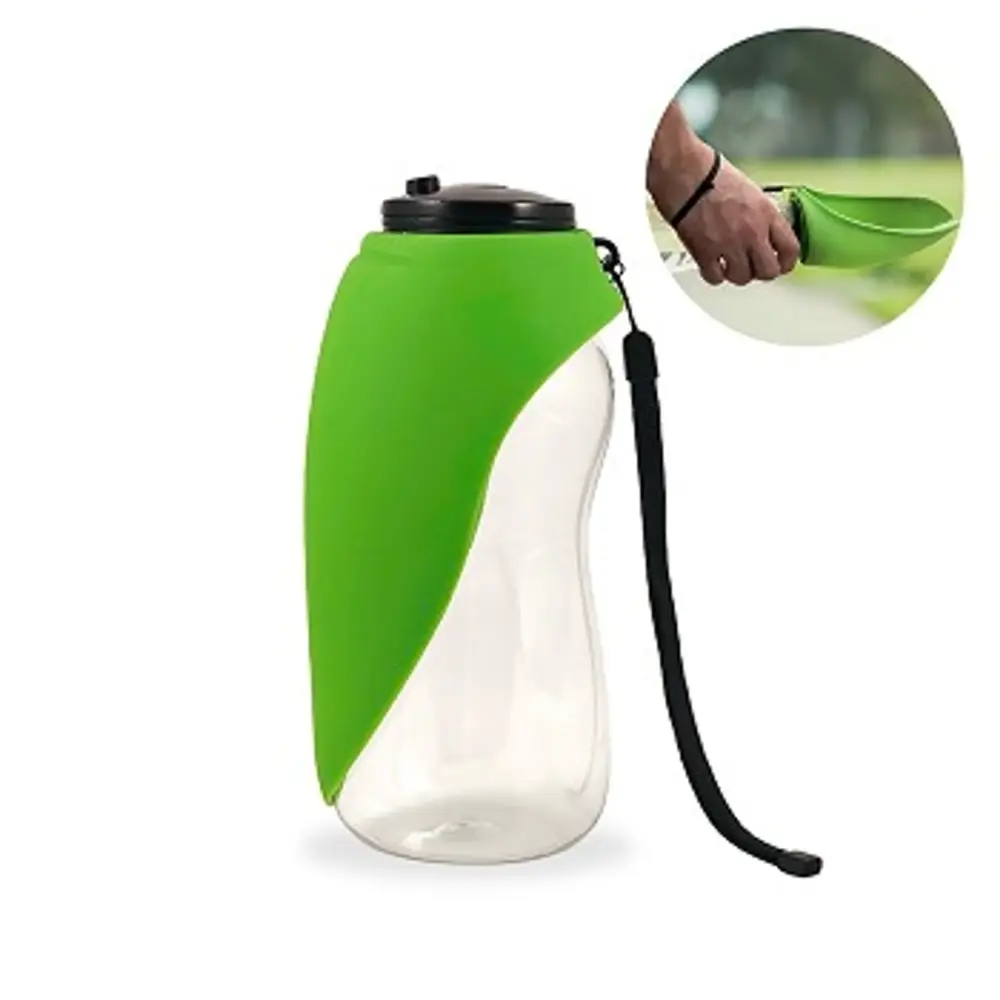
A tiny dog may lap only a few mouthfuls at a time, so offer water at every rest rather than one big drink at the halfway point; on a warm or steep day, those small drinks add up. A bottle with a fold-out bowl, such as the Flipo Fold-A-Bowl, makes that easy: pour a little, let your dog drink, and close it with the push button. Its wrist strap keeps a hand free for the leash, which helps when your other arm may soon be holding your dog.
Snacks need the same scaling down. The AKC’s guide to how many treats a dog can have keeps treats to no more than 10% of daily calories and gives the example of a small dog eating about 182 calories a day, which leaves only around 18 for extras; one large biscuit can use that up. On the trail, reward with pieces of your dog’s regular kibble, measured out of their daily food, or with treats broken into tiny pieces. For a long day out, ask your veterinarian whether your dog needs extra food and when to give it.
Heat and cold hit small dogs first
Heat and hot ground
Heat is the bigger risk on most summer trails. The AKC’s guide to hot pavement and paws points out that small and short-legged dogs overheat more easily because their bodies are so close to the hot ground, and its 10-second hand test works on sand as well as pavement. Sun-baked rock can be far hotter than the air, so start early, choose shaded trails and take your breaks in the shade.
Flat-faced breeds need the most caution. The ASPCA’s hot weather safety tips note that pets with flat faces, like Pugs, are more susceptible to heat stroke because they can’t pant as effectively. Keep a Pug, French Bulldog or Shih Tzu to short, cool, shaded outings in warm weather, and ask your veterinarian what’s safe.
Safety note
Heavy panting that doesn’t settle with rest, drooling, weakness, stumbling or vomiting on a warm day can mean heatstroke, which is an emergency. Move into shade, wet your dog’s body with cool water, offer a little to drink if they’re alert, and call your veterinarian or the nearest emergency clinic right away. Carry your dog out rather than making them walk.
Cold and wind
The AKC says dogs are at risk of frostbite once the temperature falls below 32°F and names small dogs among those at the biggest risk. On a windy ridge or a damp, gray day, a small dog can be chilled well above freezing. Watch the still moments most: rest stops, lunch and any stretch in a carrier, when your dog isn’t moving to keep warm. Shivering, lifted paws or curling into a tight ball mean it’s time to head down. Our guide to how cold is too cold to walk a dog covers limits and coat fit.
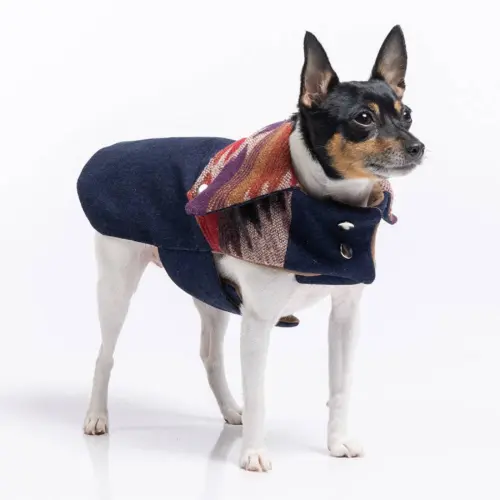
On cool days, a coat helps a small or short-coated dog. The DCNY Ranch Dog Coat comes in XXS to Medium, with wide hook-and-loop closures at the chest and belly for quick dressing at the trailhead. XXS and XS have a built-in leash clip, while Small and Medium have a harness opening, so check which suits your leash setup. On a sunny climb, carry it rather than starting out in it.
Wet grass, mud and streams
Dewy grass and shallow water soak a small dog’s belly and legs quickly, and a wet coat holds little warmth once you stop moving. On cool days, pack a small towel to dry your dog at breaks and again before the drive home.
Meeting big dogs, bikes and wildlife
On a narrow trail, a small dog has nowhere to go, so the job is to see things first and make room early.
- Big dogs. Step off at a wide spot, put yourself between the dogs and let the other dog and hiker pass. If an off-leash dog is heading your way, pick your dog up while it’s still some distance off; once a big dog is close and worked up, lifting can backfire. Our guide on when to pick up a small dog covers the timing and a safe hold.
- Bikes and horses. A small dog sits below a rider’s line of sight, especially on a blind bend. Shorten the leash and step off the trail with your dog on your far side, on the downhill side for a horse, until the rider has passed.
- Coyotes. In its coyote guidance for Golden Gate National Recreation Area, the National Park Service says the single most important thing you can do to protect your dog is to keep them on a short leash, within arm’s reach. Pack out food scraps, too.
- Snakes and burrows. Keep your dog on the trail and out of rock piles, logs and thick brush, where small noses tend to go first. If a snake bites your dog, carry them to the car and go straight to a veterinarian.
Carrying your dog when they’re done
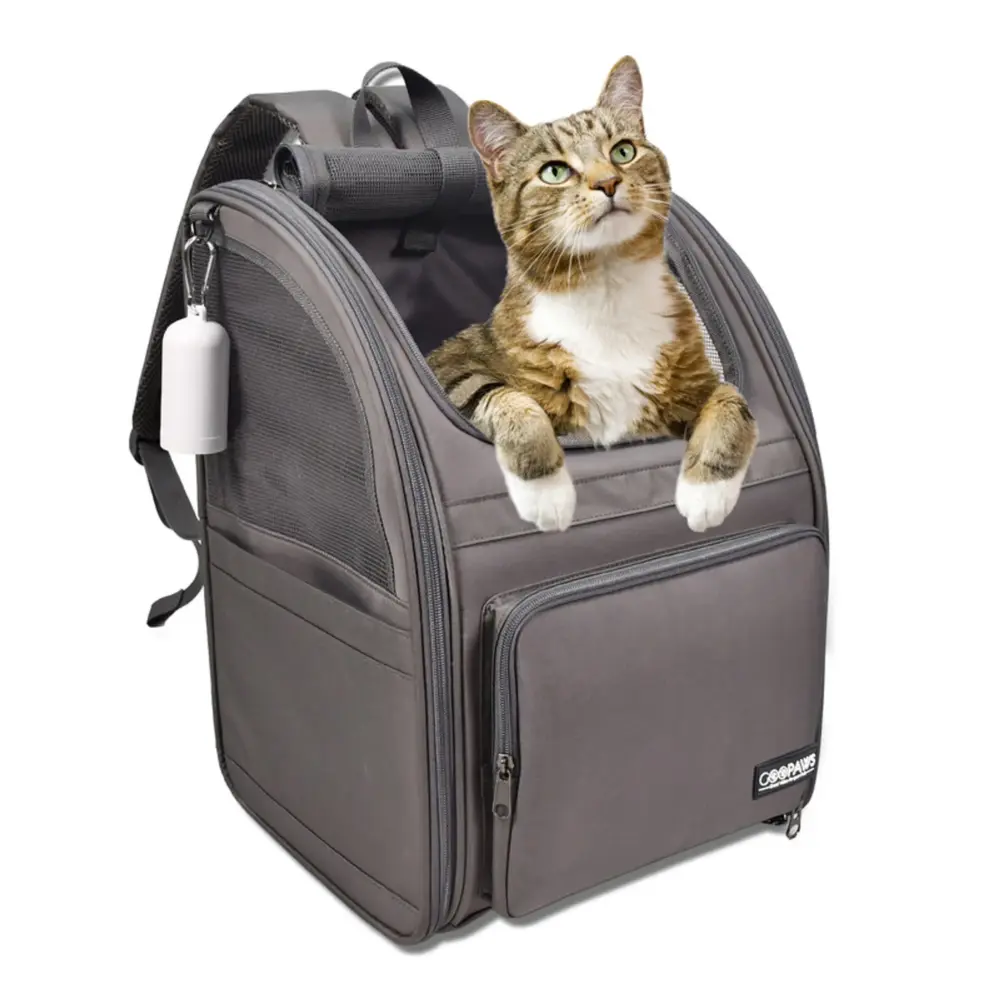
Even a keen small hiker may need a lift: for a scramble, a stream, a stretch of hot rock, a big dog coming the other way or simply the last mile. Your arms work for a few steps, but a carrier is easier on both of you over a longer stretch and leaves your hands free for poles and rocks.
- Weight and room. Weigh your dog against the carrier’s stated limit, check they can sit and lie down inside, and clip the inside strap to the harness, never the collar.
- Your back, too. Your dog plus the pack rides on your shoulders, often up the steepest part of the trail, so walk your neighborhood with the loaded pack before you rely on it miles from the car.
- Check often. A dog in a pack can’t move into the shade or out of the wind. On warm days, stop in the shade and let your dog out; on cool days, add a coat.
Introduce the carrier at home, long before the trail: a dog who first meets a backpack on a hot, tired afternoon may well refuse it. Our guide to getting a dog used to a backpack carrier goes step by step from an open pack on the floor to the first short outing.
These picks are limited to Nilosi’s own catalog. The GOOPAWS pack measures about 12.5 × 10.5 × 16.5 in, has a fleece-lined pad and comes with a poop bag dispenser; our other backpack, the K9 Sport Sack Kolossus, is made for medium to large dogs.
-
GOOPAWS
Cat and Small-Dog Carrier Backpack
$51.95
Why it fits: Carries small dogs up to 25 lb when their legs give out, with top and side openings for airflow and a safety strap inside.
Currently out of stock
-
Doggie Couture NY
DCNY Ranch Dog Coat, Choose size & color
$72.95
Why it fits: Adds a layer for a small dog riding in the pack on cool days, with quick hook-and-loop chest and belly closures. Sizes XXS to M.
Safety note
A backpack carrier is for carrying your dog on foot while you watch them. Never leave your dog in it unattended, and don’t treat it as a car restraint on the drive home.
Related guides
-
Checklist
Winter Hiking With a Dog: Checklist for Cold, Ice and Short Days
A winter trail-day checklist: plan a shorter, sheltered route around daylight, keep your dog leashed and off frozen water, pack water that won't freeze and a coat for dogs who feel the cold, check paws for ice balls and salt, and know when to turn back.
-
Guide
How Long Should You Walk a Senior Dog? Pace, Routes and Signs to Stop
Older dogs usually do best on shorter, slower walks spread through the day. Here's how to find your dog's comfortable length, pick easier routes and a harness, adjust for heat, ice and dark evenings, and spot the signs that mean head home or call your veterinarian.
-
Checklist
What to Tell Your Dog Walker: A Handover Checklist
Everything a new dog walker needs on one page: where the gear lives and how it goes on, how your dog walks, leash and route rules, medications and treats, emergency contacts, the door routine, weather rules and a first walk together.