Car Travel How-to
How to Get a Dog Used to a Backpack Carrier, From Home to Trail
Short answer
Start with the backpack open on the floor and treats inside, and reward your dog for stepping in and sitting. Over several short sessions, add fastening, lifting and wearing it around the house, moving on only while your dog stays relaxed. Then go outdoors for a few minutes on a cool day, close to home.
Which carrier style you have: legs-out or enclosed
Dog backpack carriers come in two styles, and each asks your dog to accept something different.
| Style | How your dog rides | What to practice most |
|---|---|---|
| Legs out | Head and front legs out, rear inside | Paws through openings, neck closure |
| Enclosed | Fully inside, tethered to a harness | Being closed in, sway, less to see |
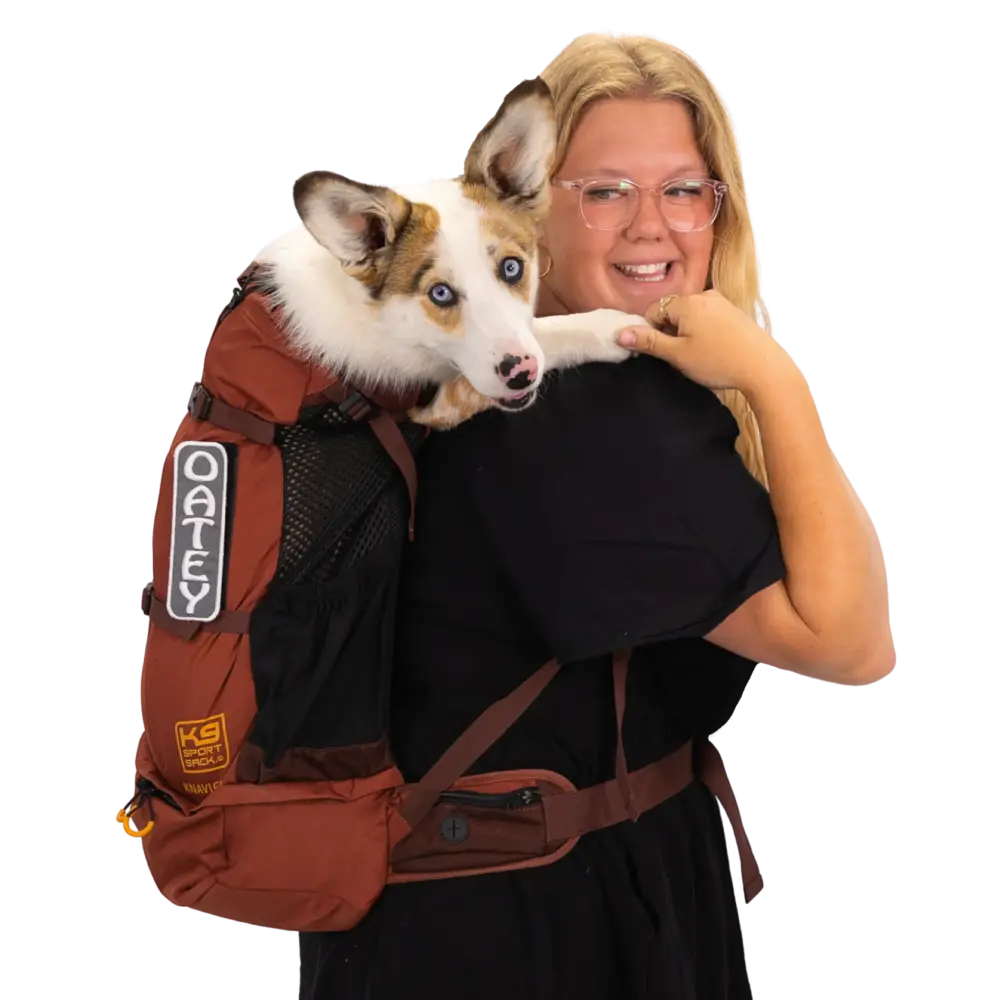
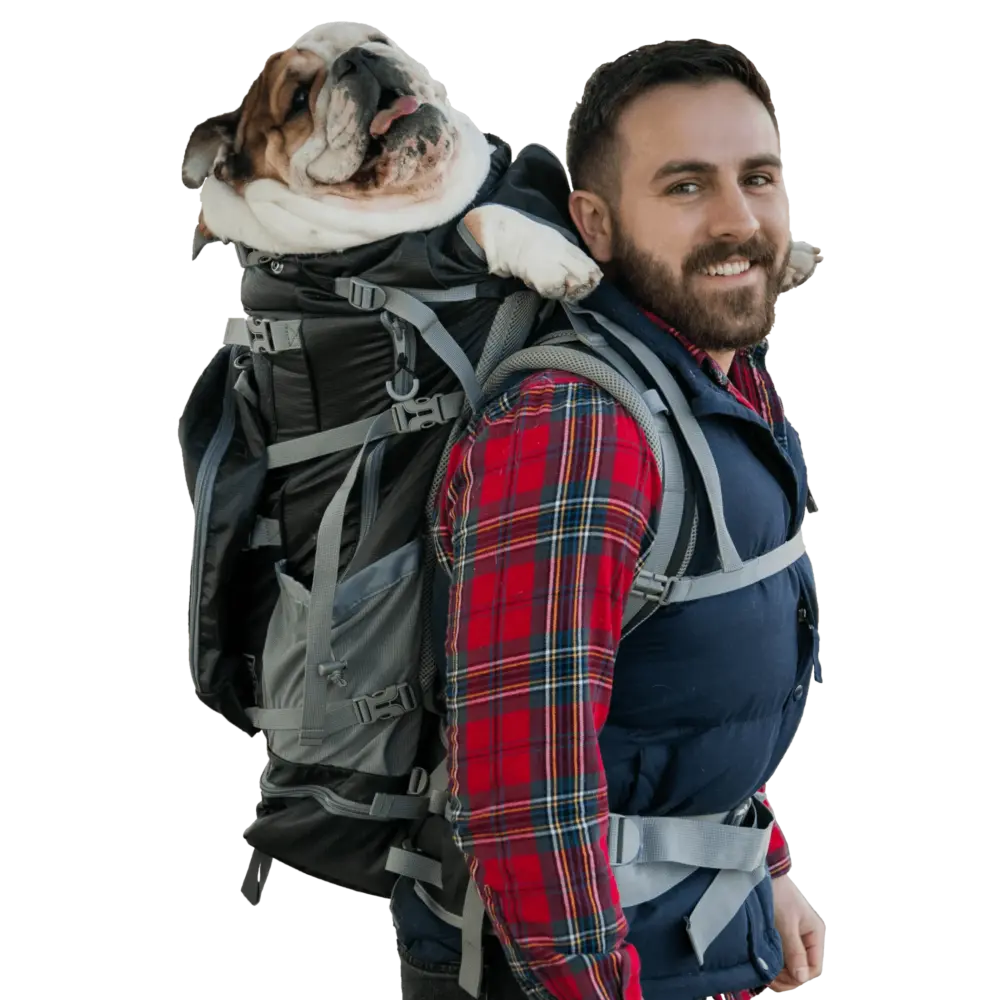
Legs-out packs hold your dog upright against your back, with the head and front legs out. K9 Sport Sack, the maker of the Kolossus, sets out the loading order in its how-to-use guide: your dog sits on or beside the open pack, the front paws go through the leg openings, a carabiner clips to the collar or harness and the collar enclosure is secured, then the bag is zipped and the straps tightened. Paw guiding and a closure around the neck are both new to a dog, so practice each on its own.
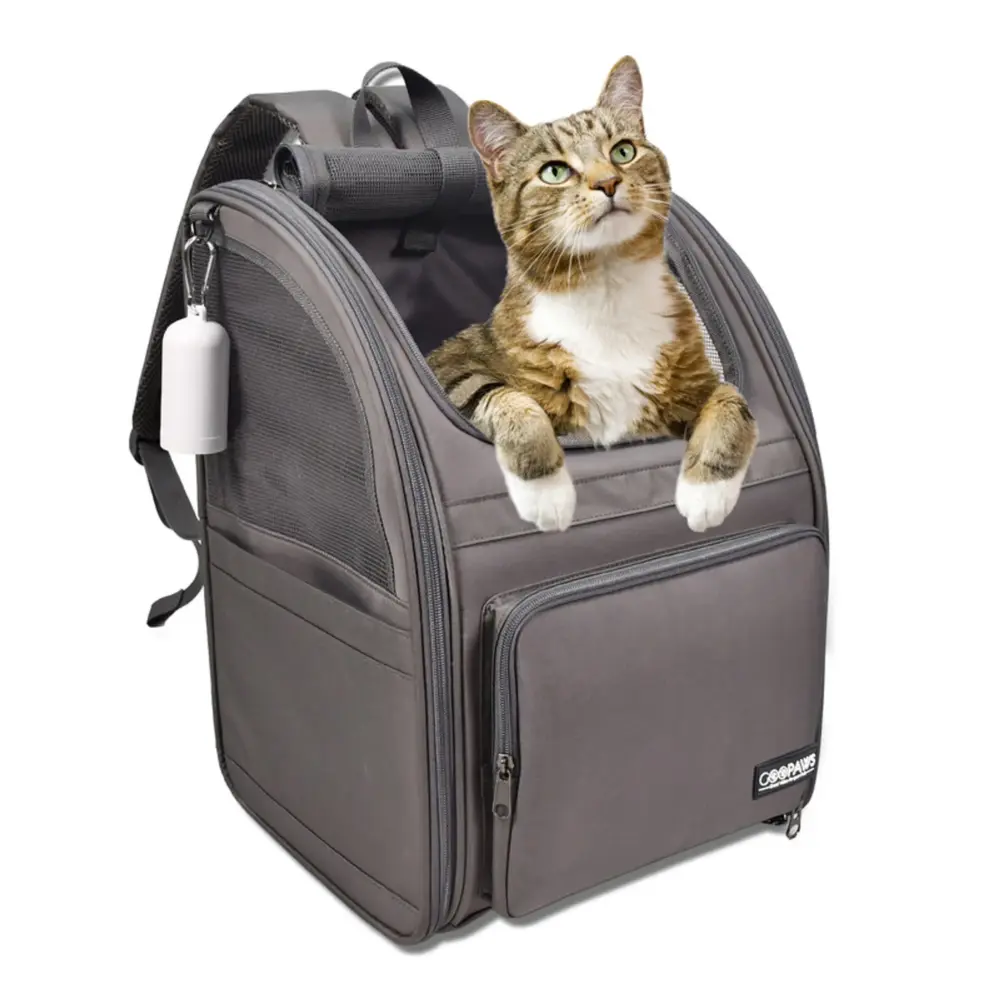
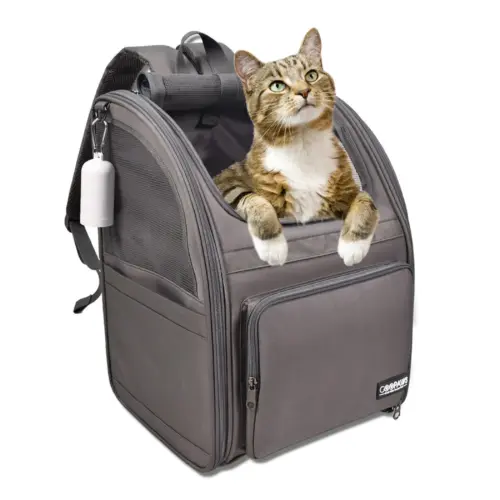
Enclosed packs, such as the GOOPAWS backpack, carry your dog inside the bag, in this case on a fleece-lined pad with top and side openings for air. Nothing goes through a leg hole, but your dog has to settle while closed in, with the bag moving and less to see. Clip the safety strap inside to the harness as a backup, and keep the bag closed while you walk.
Size and weight: fitting your dog and your back
A dog who is cramped or sliding around in the pack won’t relax, however many treats you offer.
Legs-out pack: measure collar to tail
The Kolossus is designed for medium to large dogs and sized by body length. With your dog standing, run a soft tape along the spine from the collar to where the tail begins: Large fits 20 to 22 inches, XL 23 to 25 and XXL 26 to 29. The manufacturer lists an 80 lb (36 kg) maximum for the range, but weight alone doesn’t determine fit, so go by the measurement and the manufacturer’s fitting instructions. If your dog falls between sizes, ask us before you order.
Enclosed pack: check room, not just weight
The GOOPAWS backpack takes cats and small dogs up to 25 lb and measures 12.5 x 10.5 x 16.5 inches. That weight is a load limit, not a fit check: measure your dog’s height sitting (floor to top of the head) and length lying curled up, and compare both with the bag. Your dog should be able to sit and settle without being folded up.
Your side of the fit
The pack’s limit isn’t yours. Add your dog’s weight to the pack and anything else you carry, and ask whether you could manage that for the whole outing, uphill included. The Kolossus adjusts at the shoulders and torso, so set it up empty, then fine-tune with your dog inside; where a pack has a waist belt, buckling it snugly takes some load off your shoulders. With a back, shoulder or knee problem, ask your doctor before carrying a heavy dog.
These are the two backpacks we stock, so the picks are limited to Nilosi’s catalog. More trip gear is in travel and car accessories.
-
K9 Sport Sack
Kolossus Dog Carrier Backpack, Choose size & color
$264.95
Why it fits: For medium to large dogs learning to ride on your back: sized Large to XXL by collar to tail length, with an 80 lb manufacturer maximum.
-
GOOPAWS
Cat and Small-Dog Carrier Backpack
$51.95
Why it fits: For a small dog up to 25 lb learning to ride inside a bag: top and side openings for air and checking in, plus a safety strap inside.
Currently out of stock
What you need before the first session
- The backpack, unzipped, with every strap loosened so it lies open.
- A harness your dog already wears happily. Clip the pack’s inside strap or carabiner to it rather than a collar, so a sudden jump pulls on the chest, not the throat. The Mr. Peanut’s PetTrek harness and leash set comes in XS to Large.
- Small, soft treats. You’ll use a lot of them.
- A quiet room with a non-slip floor, and a sofa, bed or sturdy bench at seat height for loading.
- A helper for a medium or large dog, at least for the first lifts.
- A few minutes, once or twice a day. End each session while your dog is still eager.
The method is gradual exposure paired with rewards. VCA Animal Hospitals’ introduction to desensitization and counterconditioning sets out the rule that matters most: start at an intensity so low that any reaction is minimal, and if you see signs of distress, end the session and make the next one easier.
Step by step: getting your dog into the backpack
K9 Sport Sack’s own FAQ says there is no one perfect method for training a dog to use its packs, so treat these steps as a sequence, not a schedule. Move on after two or three relaxed sessions at a step. Some dogs get through the early steps in a day or two; others need a few weeks.
- Leave it out, open. Lay the pack flat where your dog spends time and scatter a few treats on and around it. Let your dog sniff it, step on it and ignore it for a day or two.
- Reward stepping in. Toss a treat into the open pack. When your dog steps in, treat again; when they sit there, give a few in a row. Keep the pack on the floor.
- Practice the handling. In a legs-out pack, guide one front paw through its opening, treat and let go, then try both. In an enclosed pack, clip the inside strap to the harness, treat and unclip.
- Fasten for a few seconds. Secure the neck closure, or close the enclosed bag most of the way, feed a treat, then open it again. Build to a minute of calm with everything fastened, still on the floor.
- Lift a few inches. With your dog fastened in, raise the pack slightly off the floor or sofa, treat and set it down. Build to holding it steady against your body for a slow count of ten.
- Wear it around the house. Put the pack on (methods below), walk a few steps, stop and hand back a treat, then take it off. Build to a few minutes, room to room.
- Step outside. Stand on the doorstep, then walk to the end of the block and back. Unload at home while your dog is still relaxed, and give one last reward.
Tip
Give loading a word of its own. Say the same cue, such as “pack,” every time your dog goes in, and another before every lift. Our guide on when to pick up a small dog shows how to teach a lift cue, so being raised off the ground is never a surprise.
Lifting it: one-person and two-person methods
Many dogs mind the lift more than the pack, because it’s the moment the ground disappears. A smooth, practiced lift settles your dog and protects your back.
On your own: load at seat height
For a small dog, or a lighter dog you can manage alone:
- Set the open pack on a sofa, bed or bench, with the shoulder straps facing out at the edge.
- Load and fasten your dog there, as in steps 2 to 4.
- Sit on the edge with your back to the pack, slide your arms into the straps and fasten any chest or waist buckles.
- Lean forward a little and stand up with your legs, back straight, then tighten the shoulder straps so the pack sits close against you.
With a helper: for bigger dogs
For a medium or large dog in a legs-out pack, load on a bench as above. Your helper steadies the pack and takes some of its weight while you put your arms through the straps and stand, then checks from behind that the neck closure is secure and every strap is snug. K9 Sport Sack’s guide says to tighten the lumbar and shoulder straps as snug as possible and adjust and buckle the sternum strap and waist buckle if needed. A loose pack swings, and a swaying ride unsettles most dogs.
Taking it off
Reverse the order: back up to the bench, sit and slip out of the straps. Clip on the leash before you unclip the inside strap or open the neck closure, so a dog who hops out is still attached. With your dog on your back, never bend at the waist; crouch with a straight back, or sit.
Safety note
If your dog struggles to climb out while you’re standing, don’t hold on and keep walking. Crouch or sit right away so the pack is close to the ground, then unload. A fall from shoulder height can injure a dog, and a twisting load can injure you.
First outings: short, cool and close to home
Once your dog rides calmly around the house for several minutes, take the practice outdoors and change one thing at a time: the place, then the length, then the noise and bustle.
- Keep it short. Five minutes on a quiet street is plenty at first. Add a few minutes at a time while your dog stays relaxed.
- Go when it’s cool. A riding dog can’t move into shade or lie on cool ground, and it rides against your warm back. In summer, go early or late.
- Mix walking and riding. Let your dog walk part of the way, ride a stretch, then get down to sniff and pee. While your dog walks, the Kolossus converts to a gear pack with up to 60 liters of space.
- Set your own time limit. Neither of our listings gives a maximum riding time, so unload at every rest for a stretch, a sniff and a drink, and keep rides shorter in warm weather.
- Give other dogs room. A dog on your shoulders can’t back away from one that comes to sniff, so step aside early.
- Walk smoothly and check in. No jogging, take stairs with a hand on the rail, and look back or in through the top opening every few minutes.
Safety note
On warm outings, watch for the signs in the AKC’s guide to overheating in dogs: panting that turns frantic, thick saliva, a bright-red tongue or gums, labored breathing, weakness or vomiting. Unload your dog in the shade, wet the coat right down to the skin with cool (not cold) water and call your veterinarian or the nearest emergency clinic right away; the AKC advises a vet check even if your dog seems to recover.
Treat a trail day as its own step: first wear the loaded pack on a longer local walk with a hill, then use our hiking with a dog checklist for water, waste and turnaround times. For an older dog who is slowing down, our comparison of shorter walks vs a backpack carrier for senior dogs helps you decide whether a pack is the right answer at all.
For the drive, take your dog out of the pack and use their usual crate or restraint; neither of our backpacks is a vehicle restraint. Our dog booster seat vs carrier comparison shows how to wedge a small dog’s carrier on the floor behind a front seat, and if your dog dreads the car itself, work through how to get a dog used to car rides separately. Buses and trains set their own pet rules; see taking a dog on public transit.
Signs to stop, and dogs who never take to it
Watch your dog’s face and body, not just whether they stay put: a dog who has frozen in place isn’t necessarily calm. Signs in the AKC’s guide to how to tell if your dog is stressed include whining or growling, lip licking, yawning, panting when it isn’t warm, ears pinned back, the whites of the eyes showing, and freezing or going stiff. In a backpack, add scrabbling at the openings, pushing off your shoulders or turning down a treat your dog would normally grab.
When you see them, finish calmly: crouch or sit, unload, and start the next session a step earlier. Scolding or pressing on only adds to the worry.
When it may be pain
Yelping, growling or snapping as you lift, or a dog who used to ride happily and now resists, can mean something hurts. VCA’s guide to signs of pain in dogs also lists reluctance to use stairs or jump onto furniture, trembling in the rear legs and lashing out when handled. Stop the practice and ask your veterinarian before you carry your dog again.
If your dog never relaxes
Some dogs stay tense after weeks of patient practice, and that’s an answer worth respecting: pushing on can make a dog warier of being handled at all. Stop at the step your dog is happy with, since a dog who rides calmly for a minute across a parking lot has still learned something useful, and plan longer outings around routes with an easy way back.
Mistakes and troubleshooting
- Saving the first ride for the day you need it. A tired dog far from the car is the hardest pupil there is. Start weeks ahead.
- Holding your dog down to fasten the pack. One forced loading can undo days of practice; if you have to hold on, you’ve moved too fast.
- Swinging the loaded pack onto one shoulder like a school bag. Load at seat height or with a helper.
Your dog won’t step in
Go back to treats around the open pack, and move it to a spot where your dog already likes to lie, with some of their bedding inside an enclosed pack. A small dog can be lifted in gently with your lift cue and rewarded right away.
Your dog pulls a paw back
Practice paw handling away from the pack: hold a front paw for a second, treat, let go. Then guide the paw through the opening with the pack held wide open. If the openings feel tight, or your dog slumps or sits crooked once fastened, remeasure and compare with the sizes above.
Your dog settles until you stand
Go back to step 5 and raise the pack a few inches at a time. Once you’re standing, check that the straps are snug enough to stop the pack shifting.
Related guides
-
Checklist
Winter Hiking With a Dog: Checklist for Cold, Ice and Short Days
A winter trail-day checklist: plan a shorter, sheltered route around daylight, keep your dog leashed and off frozen water, pack water that won't freeze and a coat for dogs who feel the cold, check paws for ice balls and salt, and know when to turn back.
-
How-to
Taking a Dog on Public Transit: Rules, Carriers and Practice Rides
How to get a small dog onto the bus or subway calmly: what to look for in your transit agency’s pet policy, choosing a carrier by your dog’s size and your own back, carrier training at home, short off-peak practice rides, stairs, crowds and heat, and how service animal rules differ.
-
Comparison
Framed vs Unframed Pet Carrier Backpacks
A frame changes where the weight sits, not how much there is. This comparison covers shoulder load versus hip load, when a simple pack is genuinely enough, and the dog size at which the question answers itself.