Walking & Training Comparison
Dog Water Bottle vs Collapsible Bowl: Which Works Better on Walks?
Short answer
For most walks with one dog, a bottle with a built-in bowl is the easier carry: you pour with one hand, keep the leash in the other and pack only one thing. Choose a collapsible bowl and your own bottle when you need more water or a wider bowl: big dogs, two dogs, long hikes and hot days.
Water bottle vs collapsible bowl: side by side
Most dog water gear comes in one of three designs:
- Attached bowl: a bottle whose lid, cover or clip-on cup becomes the bowl. Open it, pour, and fold or snap it shut again.
- Squeeze trough: a bottle with a narrow trough or dish on top. Squeeze it or press a button to fill the trough, then release to let what’s left drain back.
- Folding bowl: a collapsible silicone or fabric bowl, filled from any bottle you already carry, from a sports bottle in your pocket to a gallon jug in the car.
Handling on the walk
| Option | One hand? | Leftover water | In your bag | Best for |
|---|---|---|---|---|
| Attached bowl | Yes; a wrist strap helps | Tipped out, so pour a little | One item; seal depends on the lock | City walks, quick stops |
| Squeeze trough | Yes: squeeze to fill | Drains back into the bottle | One item; look for a lock | Short walks, small sips |
| Folding bowl | No: set it down, then pour | Tipped out after each drink | Folds flat; leaks depend on the bottle | Big dogs, two dogs, long days |
Capacity, sharing and cleaning
| Option | Capacity | Two dogs | Cleaning |
|---|---|---|---|
| Attached bowl | Fixed by the bottle | Take turns at one bowl | Lid, seal and bowl to wash |
| Squeeze trough | Fixed by the bottle | Take turns at a narrow trough | Trough, valve and seal to wash |
| Folding bowl | Whatever you carry | One bowl each | Rinses easily; check the folds |
Bottles with a built-in or fold-out bowl
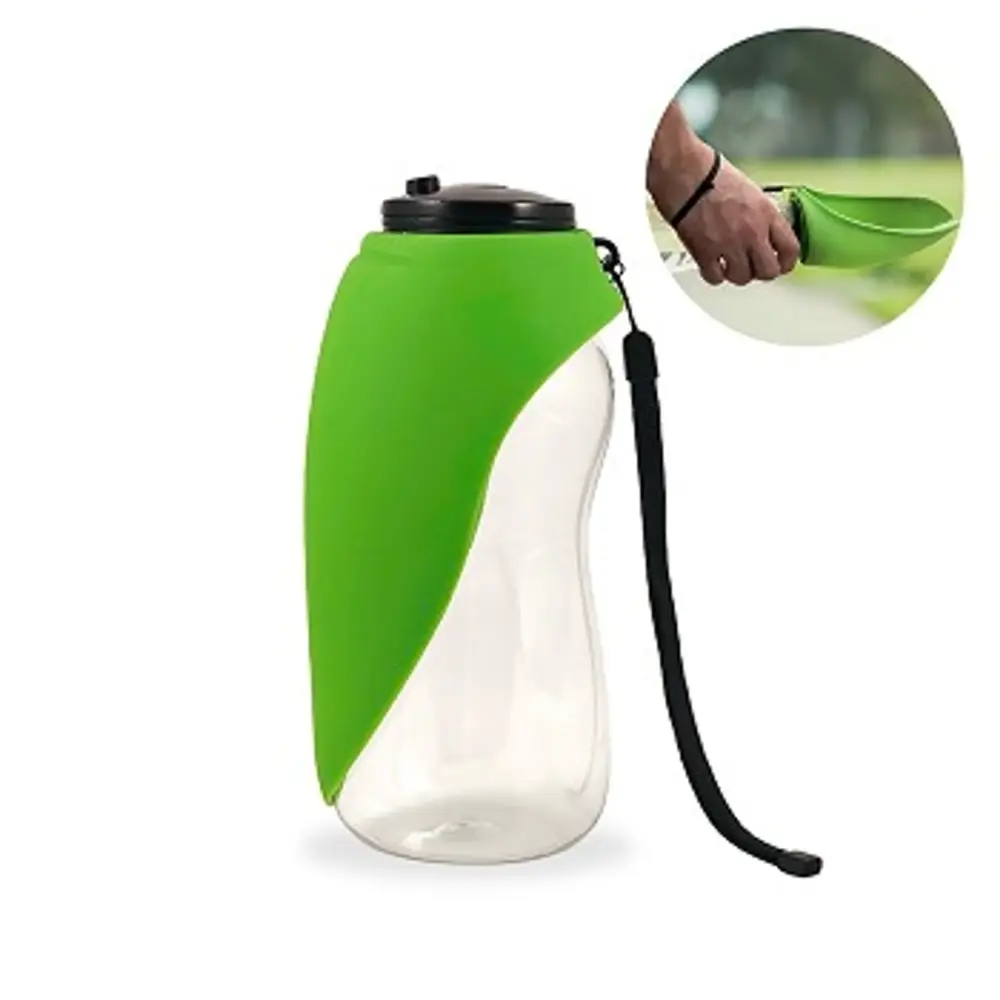
The appeal is speed. Water and bowl travel as one piece, so a drink takes seconds and the bowl never touches a dirty sidewalk. Pouring takes one hand, so the leash stays in the other, and a wrist strap keeps the bottle on you between drinks. That matters at a busy corner, or with a dog who lunges at squirrels.
The tradeoff is capacity. You get what the bottle holds, and when the bottle is empty, so is the bowl.
Fold-out and cup-style bowls
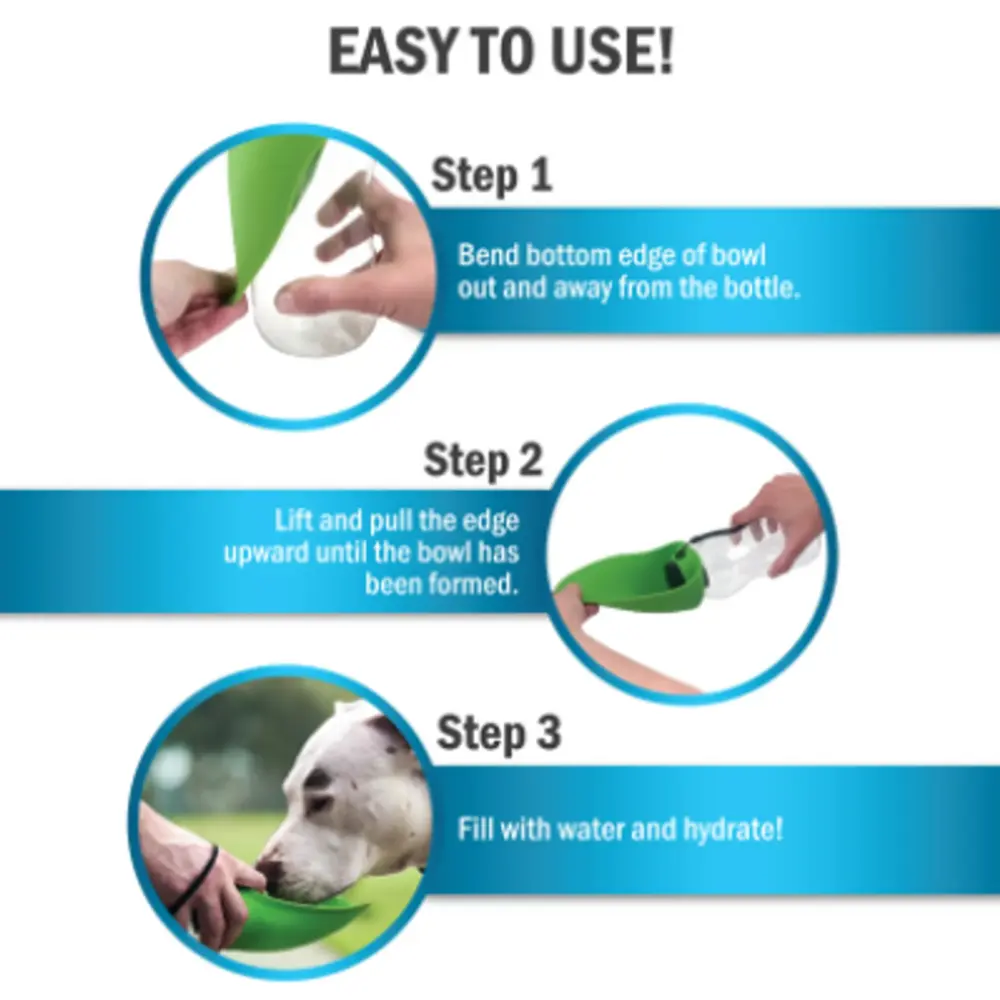
Here the bowl is part of the cap or cover: open the closure, pour, let your dog drink, then tip out what’s left and close it. Since leftovers usually end up on the ground, pour a little at a time and top up rather than filling the bowl to the brim. Before you buy one, check:
- The closure. A latch, lock or push-button keeps the bottle shut in a bag; a loose flip cap may not.
- The bowl’s size. Compare it with your dog’s muzzle, especially if your dog is large.
- How it comes apart. Every hinge and seal is a place for grime to collect, and parts that separate are easier to wash and dry.
- A strap or clip. It keeps the bottle from hitting the ground at the moment your dog decides to pull.
Squeeze and trough bottles
A trough bottle usually wastes the least water. You squeeze, or press a button, to raise water into the trough, and whatever your dog doesn’t drink drains back into the bottle. When you’re rationing water on a long walk, that counts.
Two things to know. The water that drains back carries your dog’s saliva, so make it a dog-only bottle, never one you drink from, and empty and wash it after every outing. And many troughs are narrow, which suits small and medium dogs better than a big dog with a wide muzzle or a dog who laps hard and splashes.
Collapsible bowls with your own bottle
A folding bowl separates the bowl from the water supply, and that is its strength. The bowl can be as wide as your dog needs, and the water is limited only by what you’re willing to carry: a liter bottle in a jacket pocket, a hydration bladder in a daypack or a jug in the car. The same bowl works for meals at a campsite or hotel, and two of them fold flat together for two dogs.
Most are one of two kinds:
- Silicone bowls pop up from flat, often around a stiffer rim with a clip for a pack strap or belt loop. They rinse clean easily, and many are dishwasher safe if the label says so. Choose one sold as food-grade silicone, and pick it up once your dog has finished, since the soft walls can tear if chewed.
- Fabric bowls fold like a pouch and rely on a waterproof lining. They’re light and soft but slower to dry, so unpack them when you get home.
The cost is convenience. You have to stop, set the bowl on the ground, then open and pour from a second container, all with one hand while the other holds the leash. With an excited dog, keep the leash short and wait for a calm moment before you pour. A light bowl can tip on uneven ground or get nosed across the grass, and you carry a damp bowl home. Leaks depend entirely on your own bottle, since a folded bowl holds nothing, so a screw cap is a safer bet in a bag than a pop-up sports top.
Which suits your outing
| Outing | Better choice | Why |
|---|---|---|
| City walk | Attached bowl | One hand, nothing set on the sidewalk |
| Day hike | Folding bowl, more water | Capacity, and a bowl that fits your dog |
| Road trip | Both | Bottle at stops, bowl for long breaks |
| Dog park | Attached bowl | A bowl on the ground draws other dogs |
City and neighborhood walks
An attached bowl wins. Drinks on a city walk are short and frequent, often at a corner or outside a shop, with traffic, other dogs and a leash to manage. On a short loop in cool weather many dogs drink little or nothing, but carry water on warm days and longer routes. For the rest of the kit, see our list of dog walking essentials.
Hikes and long trail days
Capacity decides it. The AKC’s tips for hiking with your dog stress bringing water for your dog, since a dog without it may drink from ponds, streams or standing water that can carry parasites or bacteria such as leptospirosis. That means carrying all of it, and a single bottle may not last a big dog through a long, warm hike. A folding bowl scales to the day, because the water can ride in your pack in a bladder or extra bottles. Water weighs about a pound per pint, so plan the load along with the route.
Carrying both works well too: the attached bowl on the wrist for quick sips on the move, and a folding bowl for a proper drink at each rest. Our hiking with a dog checklist covers the rest of the pack, including what to try when a dog won’t drink on the trail.
Road trips
Bring both if you have room. At a quick rest-stop break, with traffic nearby and the leash in one hand, the bottle with a built-in bowl is easier to manage. For longer breaks, meals and the night away, a folding bowl and a jug of water from home do more. VCA’s guide to road trips with your dog suggests taking water from home, because mineral content varies around the country and the switch can upset some dogs’ stomachs. The road trip with a dog checklist has the full packing list.
Dog parks
Bring your own water and keep it for your dog. Many parks have a shared bowl, and whether that’s a health risk is its own question, answered in are communal water bowls safe for dogs. As for gear, a folding bowl set down in a busy park can quickly become everyone’s bowl. An attached bowl stays in your hand: offer a drink at the edge of the play area, tip out the rest and close it.
Two dogs, big dogs and hot days
Two dogs
One attached bowl means taking turns, and some dogs won’t drink with another dog waiting at their shoulder. For two dogs, a folding bowl each is simpler. If either dog guards food or water, set the bowls a few feet apart or offer water one dog at a time. And plan on about twice the water: a second bowl doesn’t help if the bottle runs dry.
Big dogs
A big dog drinks more at each stop and needs room for its muzzle. With a small fold-out bowl or a narrow trough, expect several refills per drink and some splashing. For a large or giant breed, a folding bowl in a size that fits is usually less fuss.
Whatever you carry, let a big dog drink in a few rounds at each rest rather than gulping a lot just before you set off again. VCA’s page on bloat in dogs notes that exercise after drinking large amounts of water may increase the risk, and that large, deep-chested dogs are affected most often. Retching without bringing anything up, a swollen belly or sudden restlessness is an emergency: go to a veterinarian immediately.
Hot days
The ASPCA’s hot weather safety tips warn that pets can dehydrate quickly in hot or humid weather, so keep fresh, clean water coming. Offer water at every shady stop rather than waiting for your dog to ask, and carry more than usual: a bottle that lasts a spring walk can run dry halfway through a July one. Refill with fresh, cool water before you set out, since a bottle left in a hot car warms up. If your dog barely drinks even when it’s warm, see how to get a dog to drink more water for ideas at home and on walks.
Safety note
Excessive panting or difficulty breathing, drooling, mild weakness and collapse are among the overheating signs the ASPCA lists. If you see them, stop in the shade, wet your dog with cool (not cold) water, offer a drink and call your veterinarian right away. On a hot day, a shorter walk at a cooler hour does more than any bottle.
Keeping either one clean
A bowl your dog drinks from on walks needs the same daily wash as the one at home; how often to wash dog bowls covers the schedule and how to scrub off the slimy film. For travel gear:
- Empty it the same day. A half-full bottle left in the car until the next walk is how musty smells start.
- Bottles with a built-in bowl: take off every part that comes off, wash with warm, soapy water and a bottle brush, and leave it open to air-dry. Look under the seal, where grime collects, and replace the bottle if the seal cracks or it starts to drip.
- Trough bottles: after every outing, work a small brush into the trough and around the valve, where saliva and grime collect.
- Silicone bowls: pop them fully open before washing so grit and slime can’t hide in the folds, and use the dishwasher only if the label allows.
- Fabric bowls: rinse, turn them inside out if the design allows, and let them dry completely before you fold them away.
The verdict
- Choose a bottle with a built-in bowl if you mostly walk one dog on sidewalks or short trails, want a hand free for the leash and like grabbing one thing on the way out.
- Choose a collapsible bowl and your own bottle if you have a big dog or two dogs, hike for hours, or already carry plenty of water in a pack or the car.
- Consider a trough bottle if wasted water is your main worry and your dog is small or medium.
- Carry both for road trips and long, hot days: the bottle for quick sips, the bowl for proper drinks.
Where the Flipo Fold-A-Bowl fits
We carry one item for water on the go, so this part is limited to our own catalog: the Flipo Fold-A-Bowl Dog Water Bottle, an attached-bowl design. It holds 26 oz (770 ml), and its cover folds out into a bowl made of food-grade TPU. Open the push-button closure, which is designed not to leak in a bag, pour and let your dog drink. The wrist strap lets you hold the bottle and the leash at once. Wash it by hand; it comes in several colors.
It suits city walks, the dog park and quick rest stops with one dog. The listing gives the bottle’s capacity but not the bowl’s dimensions, so for a large or giant breed, two dogs or a long hike, pair it with a collapsible bowl and extra water. We don’t sell collapsible bowls or trough bottles, so use the comparison above to choose one wherever you shop. You’ll find the Flipo in our travel and car accessories and feeding and enrichment collections.
Related guides
-
Comparison
The Best Time to Walk a Dog: Morning, Midday or Evening?
A morning walk suits most dogs: a full bladder, fresh energy and the coolest air of a summer day. Compare morning, midday and evening walks, shift the schedule for summer heat and winter cold, and fit walks around office hours, shifts and working from home.
-
Checklist
What to Tell Your Dog Walker: A Handover Checklist
Everything a new dog walker needs on one page: where the gear lives and how it goes on, how your dog walks, leash and route rules, medications and treats, emergency contacts, the door routine, weather rules and a first walk together.
-
How-to
Taking Your Dog to a Restaurant Patio: Manners and What to Bring
How to take your dog to a restaurant or brewery patio: practice a settle at home, check that day’s dog policy, pick a table out of the servers’ path, keep the leash off the table, bring your own water and leave while your dog is still calm.