
Outdoors & Adventure Checklist
Dog Camping Essentials: A Packing Checklist for Tent and Car Camping
Short answer
The dog camping essentials are a collar with ID worn day and night, a harness and fixed-length leash, meals in a sealed container, water, a pad off the cold ground, and poop bags and wipes. Check the campground’s pet rules and pack vaccination records. Leave the retractable leash, toy box and untried gear at home.
Dog camping essentials at a glance
Tick items off as they go in the car; each group is explained below. If the trip includes a long hike, add the trail items from our hiking with a dog checklist.
Paperwork and planning
- The campground’s pet policy, read before you book
- Copies of vaccination records, including rabies
- Your veterinarian’s number and the nearest emergency clinic, written down, not only in your phone
- Flea, tick and heartworm prevention, given before you leave on your veterinarian’s advice
- A pet first-aid kit with tweezers or a tick remover
On your dog
- A flat collar with ID tags, on for the whole trip
- A microchip with current registration details
- A harness your dog has already worn
- A fixed-length leash within the campground’s limit, plus a spare
- A small clip-on light for after dark
Food and water
- Meals measured into bags inside a sealed container, plus an extra day’s worth
- Treats and a long-lasting chew for quiet time at the site
- Food and water bowls
- A jug of water from home, and a bottle with a bowl for walks
- Any medications your dog takes
Bedtime
- A pad or bed that keeps your dog off the cold ground
- A familiar blanket or towel that smells like home
- A coat for a small or thin-coated dog if nights turn cold
Clean-up
- More poop bags than you expect to use, and a pouch for full ones
- Large pet wipes
- Two old towels: one for drying, one as a doormat at the tent
- A brush or comb for the evening coat check
- An old sheet to cover sleeping bags
At the site
- A tie-out with a stake or anchor, if the campground allows one
- A collapsible crate or pen, only if your dog already settles in one
Campground pet rules and your dog’s readiness
Pet rules vary between campgrounds, and sometimes between loops in one. Before you reserve, check:
- Whether dogs are allowed at the site you want. Some campgrounds keep pets to certain loops, and some cabins, yurts and backcountry sites don’t take them.
- The leash limit. Six feet is common, and it is the rule in national parks.
- Whether a dog may be left at the site. Many campgrounds don’t allow a pet to be left unattended, so plan who stays with the dog while others shower or swim.
- Limits and paperwork. Some private campgrounds cap the number of pets, restrict certain breeds or ask for proof of rabies vaccination.
- Quiet hours. They cover barking too.
Safety note
Neither the car nor the tent is a kennel. The AKC says never to leave your dog in a closed vehicle, and the ASPCA’s hot weather safety tips warn that a parked car can lead to fatal heatstroke. A tent in the sun heats up fast too, and a worried dog can dig or chew through the mesh. If your dog can’t come along to the showers, the beach or the trail, someone stays behind with them.
Camping in a national park? Where your dog may go outside the campground is often more limited than people expect; our guide to visiting a national park with your dog explains the rules.
Is your dog ready to camp?
A campground puts a dog close to strangers, other dogs, wildlife and unfamiliar night sounds, with no room to retreat to. The AKC’s guide to camping with dogs suggests thinking twice about a dog who barks a lot, doesn’t reliably listen, is afraid of strangers or tends to be anxious. For a first trip, choose a campground close to home, so you can pack up and leave if it isn’t working.
A vet check and a few jobs before you go
A few weeks ahead, ask your veterinarian whether your dog’s vaccinations and flea, tick and heartworm prevention suit the area you’re visiting, and get a copy of the vaccination records. Trim long nails, which the AKC notes can be tough on tent material. Look up the emergency veterinary clinic nearest the campground and write down its address and number, because cell coverage at camp can be patchy.
Leash, harness and ID, including after dark
At camp, a leash and a tent zipper are all that stand between your dog and the woods, so ID matters more than usual. Keep a flat collar with tags on for the whole trip, nights included: a dog who slips out of the tent at 2 a.m. still needs to be identified. Put a second contact who isn’t on the trip on the tag or the microchip record, since your own phone may have no signal.
For walks around the loop, clip a fixed-length leash to a harness and leave the collar for the tags. Pack a spare leash; at camp, one tends to get left at the picnic table or chewed.
Campgrounds get properly dark, and cars still use the loop road after sunset. Reflective trim shows up only when a beam hits it, so add a small clip-on light to spot your dog at a glance (we don’t sell lights). Our dog walking essentials cover more gear for walking after dark.
-
Mr. Peanut’s
PetTrek Padded Harness and Leash Set, Choose size & color
Price range: $24.95 through $26.95
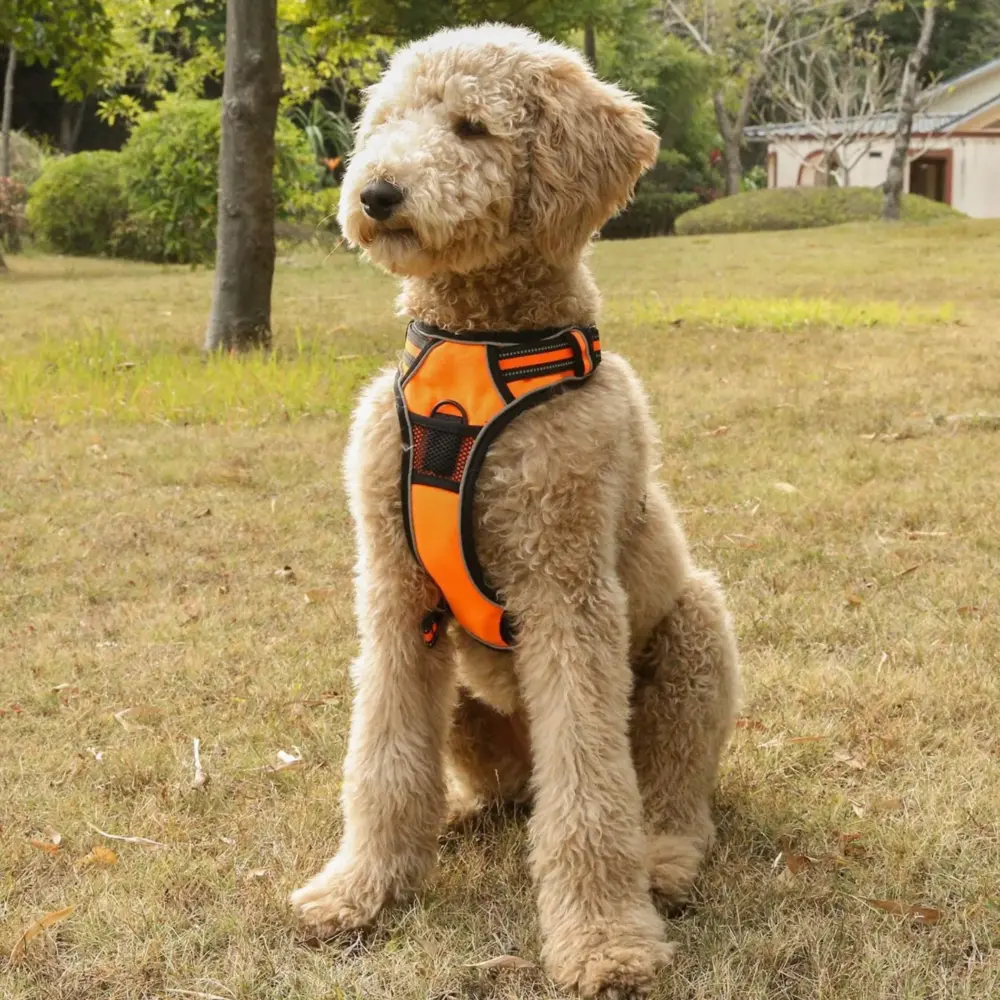
Why it fits: A padded harness and matching leash with reflective stitching on both, so your dog shows up in a headlamp beam around camp. Four sizes, XS to Large: measure the chest first.
-
Lupine Pet
Reflective Dog Collar, Choose size & design
Price range: $22.95 through $28.95
Why it fits: A flat collar to carry ID tags through the whole trip, with reflective threads woven into the pattern and a strong D-ring. Neck sizes run from 6 in up to 31 in.


More harnesses, including a no-pull style for medium and large dogs, are in our walking and training gear. If your dog does get loose, tell the campground host or ranger straight away and follow our first-hour plan for a lost dog or cat.
Food, water and storing it away from wildlife
Bring your dog’s usual food; a trip is a bad time to switch, and an upset stomach is harder to manage from a tent. Pre-measured meals make feeding quick at a dark campsite, and the extra day’s worth covers a longer stay or a meal that ends up in the dirt.
Campground spigots can be far from your site, shut off out of season or missing at primitive sites, so bring a jug of water from home. The AKC advises keeping fresh drinking water available at all times. Don’t let your dog drink from lakes, streams or puddles, which can carry parasites and bacteria.
For walks to the lake, the bathhouse or the trailhead, the Flipo Fold-A-Bowl water bottle holds 26 oz and has a cover that folds out into a bowl, plus a wrist strap that leaves a hand free for the leash.
Storing dog food at a campsite
Wildlife can’t tell kibble from your groceries. Rocky Mountain National Park’s food storage rules, for example, count pet food and bowls as food items, alongside your own food, drinks and toiletries. Depending on the campground, that means a food locker, a bear-resistant container or a closed vehicle where it’s allowed, and rules can be strict: Yosemite doesn’t allow food in cars or trucks after dark. Ask at check-in and follow the posted rules. In practice:
- Feed at set mealtimes instead of leaving food out.
- Pick up the bowl as soon as your dog finishes, rinse it and store it with the food.
- Keep dog food and treats out of the tent overnight.
- Put leftovers and empty food bags in wildlife-resistant bins where there are any.
Safety note
Camp menus are full of things dogs shouldn’t eat. The ASPCA’s list of people foods to avoid feeding pets includes chocolate (s’mores included), grapes, raisins and macadamia nuts (all common in trail mix), onions and garlic, and xylitol, a sweetener in some gum and candy. Keep plates, skewers and the cooler out of reach, and call your veterinarian or a pet poison control line if your dog gets into something.
Sleeping gear: what your dog needs at night
The AKC’s advice is simple: when you go into the tent to sleep, your dog comes with you. What your dog lies on matters more than anything on top, because the ground draws heat away all night. Start with a camping pad or a closed-cell foam mat cut to size (we don’t sell those), then add a familiar bed, blanket or towel. A small or thin-coated dog may need a coat on a cold night.
Tent, car or camper, and how to tell if your dog is too cold, are covered in where your dog should sleep when camping.
For a small dog in the tent, set the Armarkat plush cuddler bed on top of the pad: it has a raised rim and a water-resistant, skid-free base, and it is machine washable on a gentle cycle. The Small size is 22 x 22 x 8 in; it isn’t made for medium or large dogs.
Clean-up kit: poop bags, wipes and a towel
At a shared campground, whatever your dog leaves, someone else walks through, so pick up every time, including in the brush at the edge of your site. Bins can be a long walk away and primitive sites may have none, so seal full bags in a zippered pouch until you reach one. Use a wildlife-resistant bin where there is one, and never leave bags out overnight.
Keeping the tent clean
A routine at the tent door keeps most of the dirt outside:
- Lay an old towel outside the door as a doormat.
- Wipe each paw, and the belly after a muddy walk, before your dog steps in.
- Towel off a wet dog under the vestibule or in the car, not on the sleeping bags.
- Spread an old sheet over any sleeping bag your dog lies on or next to.
The evening coat check
The AKC recommends a nose-to-tail check at the end of each day for ticks, foxtails and mats. By headlamp before bed, run your fingers through the coat and check between the toes, around the ears and under the collar and harness. Remove an attached tick promptly with tweezers or a tick remover; a grass seed lodged in an ear, eye, nose or the skin is a job for your veterinarian.
-
Yucky Puppy
Waterproof Poop Bag Holder, Choose size
Price range: $23.95 through $24.95
Why it fits: Two zippered, waterproof pouches, one on the leash and one at the site, so full bags stay sealed until you reach a campground bin. The XL size suits long stays or two dogs.
-
Mr. Peanut’s
Naturals Pet Wipes
$26.95
Why it fits: 150 large, thick 6 x 10 in wipes for paws and belly at the tent door, so less mud and grit ends up on the tent floor and the sleeping bags.
Currently out of stock


Our clean-up supplies also include a paw cleaner cup for muddy paws back at the car.
Keeping the campsite calm: tie-outs, barking and neighbors
Using a tie-out safely
A tie-out lets your dog lounge at the site while you cook or pitch the tent. Ask the campground first: some don’t allow them, and where a park requires a leash no longer than 6 feet, a long cable may not meet the rule. We don’t sell tie-outs. If you use one:
- Clip it to a well-fitted harness, not the collar, so a lunge or a tangle pulls on the chest rather than the neck.
- Place the anchor so your dog can’t reach the fire ring, the stove, tent lines, the road or the next site.
- Make sure shade, water and somewhere to lie down are within reach.
- Stay at the site and keep watch. A dog tied up alone can tangle, chew the line or be cornered by another animal, and many campgrounds forbid it.
- Unclip at bedtime; your dog sleeps inside with you.
Barking and neighbors
The AKC asks campers to keep their dogs quiet and away from other campers, their food and strange dogs. A few things make that easier:
- A long walk before dusk, so your dog is ready to settle when the campground goes quiet.
- A spot that faces your own site rather than the path, with you in view.
- A chew to work on during quiet time, packed away with the food afterward.
- A treat for looking back at you when someone walks past, before the barking starts.
- Asking before dogs meet, and keeping yours out of other sites, however friendly.
If barking carries on into quiet hours, bring your dog into the tent or take a short walk together.
The fire ring and bug spray
Keep your dog well back from the stove and the fire ring, which can stay hot long after the flames die down. On your dog, use only insect repellent and sunscreen labeled for animals, and keep citronella candles, tiki torch products and insect coils out of reach, as the ASPCA advises.
What to leave at home
Some dog gear makes camp harder, not easier. Skip these:
- A retractable leash. It runs past a 6-foot limit, wraps around tent stakes and chair legs, and is slow to reel in when a squirrel or another dog appears.
- Gear your dog hasn’t used. Camp is the wrong place to find out a new harness rubs or slips off, and an unfamiliar crate is one more strange thing at night. Try new gear at home first.
- The toy box. One or two quiet toys are plenty. Squeakers carry at night, and fetch at a busy campground sends your dog through other people’s sites.
- A bed you’d hate to see muddy. Bring something washable, or cover it.
Sometimes the thing to leave at home is the dog: one who is unwell, recovering from surgery or very anxious around strangers may be happier with a trusted sitter this time.
Bringing the cat as well? Cats need a different setup, with litter, a carrier and a plan if they slip away; see camping with a cat.
Related guides
-
Checklist
What to Tell Your Dog Walker: A Handover Checklist
Everything a new dog walker needs on one page: where the gear lives and how it goes on, how your dog walks, leash and route rules, medications and treats, emergency contacts, the door routine, weather rules and a first walk together.
-
Checklist
Pet Emergency Kit Checklist: What Your Dog or Cat Needs to Evacuate
Everything your dog or cat needs to evacuate with you: records and ID, two weeks of food, water and medicine, a carrier or harness per pet, sanitation and first aid, plus where pets can stay and when to refresh the kit.
-
Checklist
Winter Hiking With a Dog: Checklist for Cold, Ice and Short Days
A winter trail-day checklist: plan a shorter, sheltered route around daylight, keep your dog leashed and off frozen water, pack water that won't freeze and a coat for dogs who feel the cold, check paws for ice balls and salt, and know when to turn back.


