Outdoors & Adventure Comparison
Where Should Your Dog Sleep When Camping? Tent, Car or Camper
Short answer
For most dogs, the best place to sleep when camping is inside the tent beside you, on a closed-cell foam or insulated camping pad that keeps them off the cold ground, with a familiar blanket on top. A camper is warmest; a car works only if you sleep in it too. Never leave a dog tied up outside overnight.
Tent, car, camper or outside: compared
Each spot trades warmth, room and supervision a little differently. One thing doesn’t change: wherever your dog sleeps, you sleep there too.
| Option | Works best for | Main risks | On a cold night |
|---|---|---|---|
| Tent | Most dogs on most trips | Cold ground, claws on the floor | Pad underneath, you alongside |
| Camper or RV | Freezing, wet or stormy nights | Heat or AC failure if left alone | Easiest to keep warm |
| Car | A storm or a dog who won’t settle | Morning heat, idling for warmth | Cools fast once the engine is off |
| Tied outside | Not suitable overnight | Wildlife, tangles, escape, rules | No way to move somewhere warmer |
Sleeping in the tent
The tent works because you’re right there: you’ll notice if your dog shivers, paces or needs to go out at 3 a.m., and a dog who can lean against you often settles faster in a strange place. It’s also what the AKC’s guide to camping with dogs advises: keep your dog with you day and night, and when you go into the tent to sleep, they come too.
Room to stretch out
Tent capacity ratings assume adults lying shoulder to shoulder, so count a medium or large dog as one more person. Your dog should be able to turn and lie flat without sprawling across your gear or pressing against the wall all night, since a damp tent wall against fur makes for a cold dog.
A pad first, then a bed
The ground pulls heat out of anything lying on it, so a dog curled on a thin tent floor keeps losing warmth even when the air feels mild. Give your dog what you sleep on yourself: a camping pad long enough for them to stretch out (we don’t sell camping pads). Closed-cell foam is the safer choice, because claws can puncture an inflatable pad. On top, add something that smells like home: their usual blanket, a towel or their own bed, with an old sheet underneath to protect the tent floor and your sleeping bag from claws and wet paws.
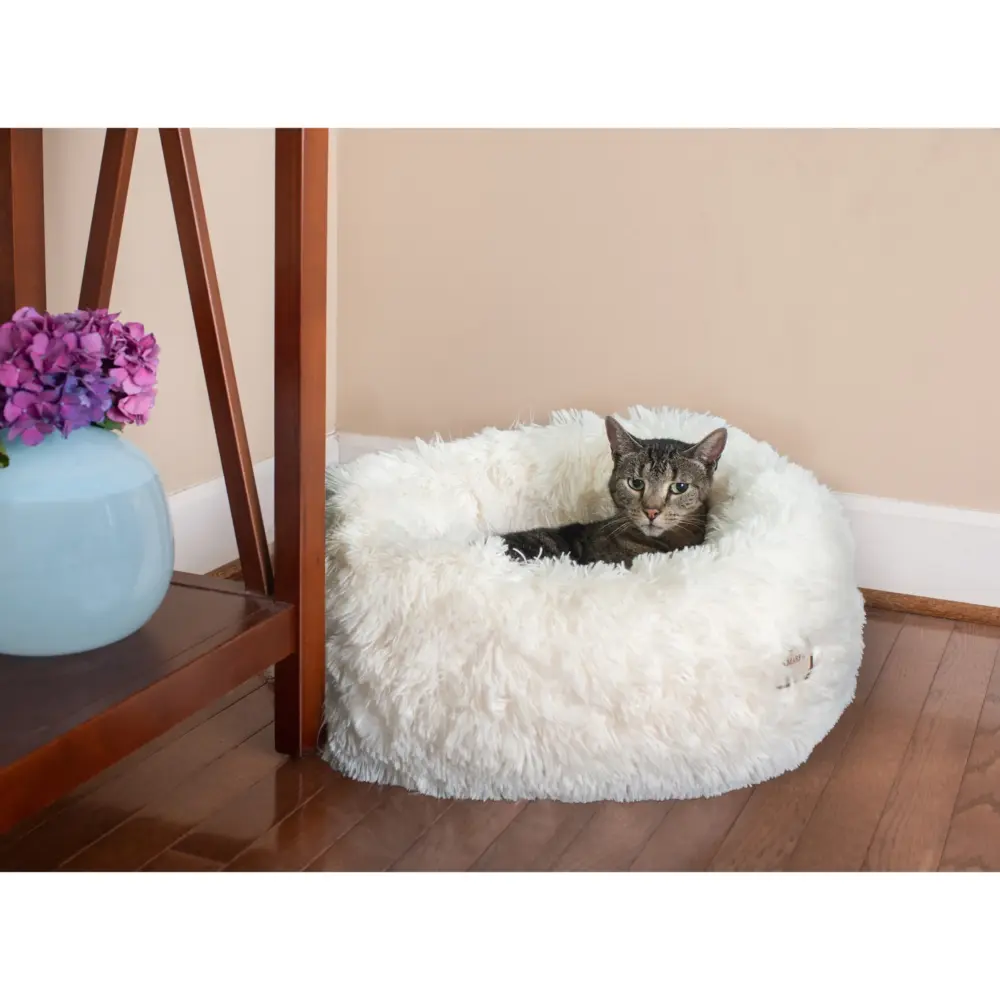
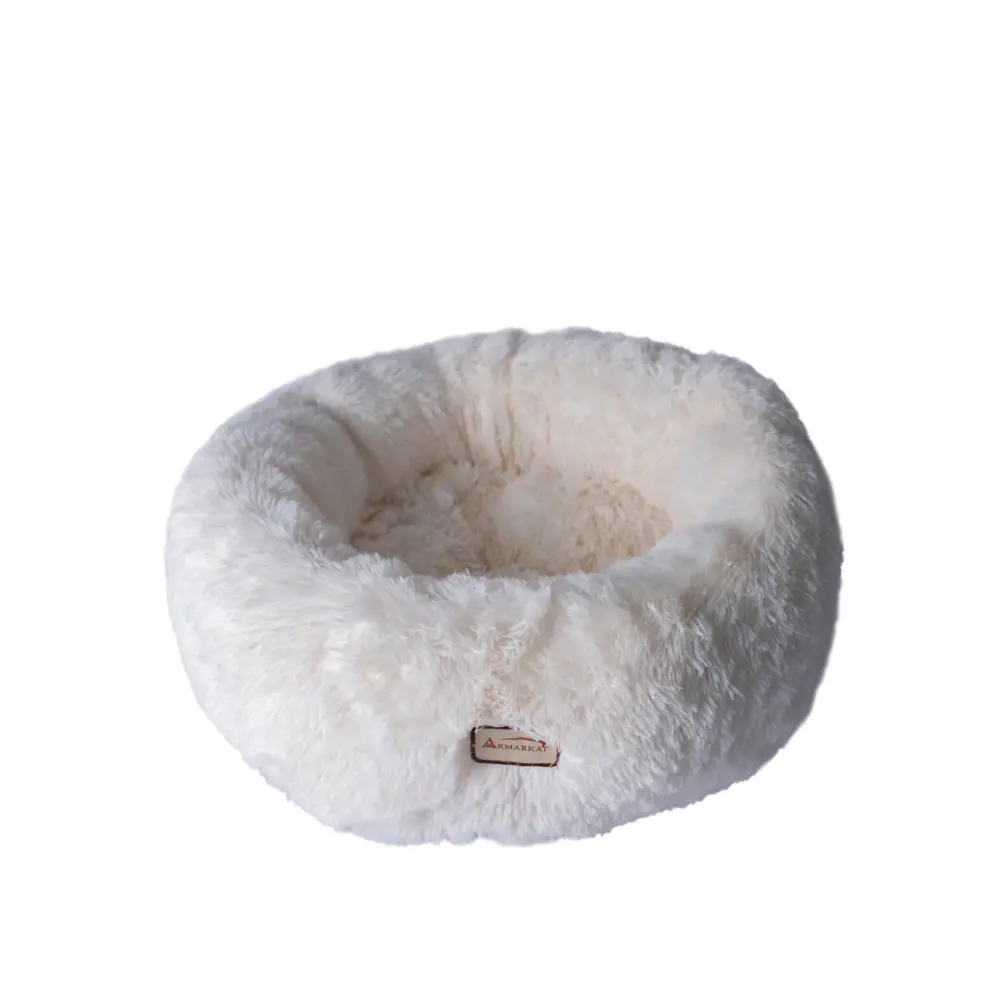
If your dog is small, their bed from home can go on top of the pad. The Armarkat Ultra-Plush Cuddler Bed is one option: a round plush bed with a raised rim to curl against and a water-resistant, skid-free base. It’s an indoor bed, not insulation, so the pad still goes underneath. Both sizes are for cats and small dogs (the Small is 22 x 22 x 8 in), and it’s machine washable on a gentle cycle after a muddy weekend.
Inner tent, door zipped
A vestibule feels like part of the tent, but it’s open to the ground and the night air, and a dog can push out under its edge. Keep your dog in the inner tent with the door zipped and their collar and ID tags on. Don’t tie them to anything inside, because a leash can wrap around a leg in the dark. A small dog who burrows into your sleeping bag is fine as long as the bag stays open enough to come and go; never zip a dog inside.
Sleeping in the car or a camper
A vehicle with you inside it is a sound plan B; without you, it’s no plan at all. A thunderstorm, a leaking tent or a dog who paces at every rustle is a good reason to move to the car together. The AKC’s camping guide says never to leave your dog in a closed vehicle, and cold counts as well as heat: the ASPCA’s cold weather safety tips warn that a car can act like a refrigerator, holding in the cold.
A car on a cold night
- Lay the pad and bed on a flat surface, such as folded-down rear seats or the cargo area, not the footwell.
- Crack two windows slightly, on opposite sides, for fresh air and less condensation; mesh window covers keep insects out.
- Don’t sleep with the engine idling for heat. The CDC warns that when snow blocks a tailpipe, carbon monoxide can build up quickly inside the vehicle. Dress the bed for the cold instead.
A car on a warm night
A car that feels comfortable at midnight heats quickly once the morning sun reaches it, so park where the early sun won’t hit and be up and out with your dog by sunrise. If a night is too warm for the tent, it’s too warm for a closed car; our guide to keeping a dog cool in the car explains why a parked car is never a safe place to wait.
A camper, trailer or RV
Hard walls make a camper the warmest and quietest option, which helps a dog who startles at night sounds and a large dog who would fill a tent. Bring the same pad and bedding so the space smells familiar, keep the camper’s carbon monoxide alarm working, and never bring a camp stove, grill or portable fuel-burning heater inside (see the caution below).
Leaving your dog in the camper while you go out is a separate question. Many campgrounds don’t allow pets to be left unattended, so check first. Where it is allowed, the AKC’s RV travel advice is to have a backup for keeping your dog cool if the power or air conditioning fails, and to disable vent fans with rain sensors that would otherwise close the vents automatically.
Why not tied up outside overnight
Some dogs sleep outdoors at home, so a tie-out under the stars can seem natural. At a campsite it’s the riskiest choice of the four:
- Wildlife. A tied dog can’t get away from a coyote, skunk or porcupine, or from a bear drawn in by food smells.
- Tangles and escapes. A line can wrap around a leg or a tent stake, and a dog who chews through it or slips a collar is loose in country they don’t know.
- Weather. The temperature keeps falling until dawn, dew soaks the coat, and a tied dog can’t move somewhere warmer or drier.
- Neighbors. A dog alone outside tends to bark, and quiet hours apply to dogs.
- The rules. Yosemite’s campground regulations, for example, say pets must not be left unattended while tied to an object, and many campgrounds have similar rules.
A tie-out is fine for daytime lounging while you’re at the site and watching. When you turn in, unclip it and bring your dog inside.
Keeping a dog warm on a cold camping night
Most of the warmth comes from what’s under your dog, not what’s on top. In order of importance:
- Insulate from the ground. Pad underneath, bedding on top. On frozen or wet ground, double up: a closed-cell foam pad on top of an inflatable one, which also shields it from claws, or a folded blanket under the pad.
- Go to bed dry. Wet fur loses much of its insulation, so wipe the paws and towel the back and belly after an evening swim or a walk through dewy grass, and let the coat dry before lights out.
- Share your warmth. Let your dog sleep against you, with a spare blanket or an old sleeping bag they can burrow under or push off.
- Add a layer if your dog needs one. On a near-freezing night, a small, short-coated, young or senior dog may sleep better in a soft, close-fitting layer while you’re right beside them. Pick one with no dangling straps, check they can still curl up, and take it off if they pant or feel warm underneath.
- A warm bottle, with care. Warm, not hot, water in a leak-proof bottle wrapped in a towel at the foot of the bed takes the chill off. Skip it for dogs who chew.
Safety note
Never bring a camp stove, fuel-burning lantern, grill or heater into a tent, camper or car to warm your dog. Carbon monoxide has no smell, and opening a flap or window isn’t enough. In one camping case described by the CDC, a propane stove brought into a zipped tent for warmth killed four people and a pet dog during the night.
How cold is too cold to camp with a dog?
There’s no single number, but freezing is the point to plan carefully: the AKC says dogs are at risk of frostbite once the temperature falls below 32°F, with small, short-haired dogs, puppies and seniors at the biggest risk. A healthy dog with a thick double coat copes with a cold night far better, and wind and wet make any temperature harder. The AKC’s camping guide is blunt: in extreme heat or cold, your dog may be safer and happier at home. If the forecast drops well below freezing and your dog feels the cold, book a camper or cabin, or leave them with a sitter. For cold limits on daytime outings, see how cold is too cold to walk a dog.
Signs your dog is too cold, or too warm
Check on your dog whenever you wake. A hand on the ears, paws and belly tells you more than any thermometer.
Too cold
- Shivering, or curling into a tight ball. The AKC lists both among the first signs of mild hypothermia.
- Restlessness: getting up, circling and resettling, or burrowing deep into your sleeping bag.
- Ears and paws that feel cold to your touch.
These are the same signs to watch for at home (see keeping a dog warm at night), but at camp you have fewer ways to fix them, so act early. Warm your dog with dry bedding, an extra blanket and your own body heat, or run the car’s heater for a while with a window cracked and the tailpipe clear, staying awake while the engine runs. If your dog seems weak, unusually sleepy, confused or unsteady, or keeps shivering once warm and dry, get them somewhere warm and call a veterinarian right away.
Too warm
- Panting while lying still.
- Moving from spot to spot, or stretching out flat away from you and the bedding.
- Pawing at the door to get out.
On warm nights, open the windows and the outer door (keep the mesh zipped), leave the rainfly off if the forecast is clear, pitch where the morning sun won’t hit the tent, and keep water within reach. A cooling mat that needs no power suits a campsite: the Chillz Cooling Gel Mat cools when your dog lies on it, recharges on its own after a few minutes unused and folds up for the car. Swap it for the insulating pad on cold nights.
Safety note
Watch for the signs listed in the AKC’s guide to overheating in dogs: frantic panting, thick saliva, gums or tongue turning bright red, labored breathing and weakness. If you see them, get your dog somewhere cooler and call a veterinarian, even if they seem to bounce back.
A practice night at home first
The first time your dog hears a tent zipper at 2 a.m. shouldn’t be at a campsite. A week or two before the trip:
- Pitch the tent in the yard or living room with the door open, toss treats inside and let your dog explore and nap there.
- Lay out the pad and bedding as you will at camp, and see how much room your dog really takes.
- Zip the door with your dog inside and you beside them, with a chew to work on.
- Sleep a whole night in it, in the backyard if you can, to learn what wakes your dog and whether they settle.
A dog who already sleeps beside you may take to a shared tent quickly; one used to a room of their own may need a few more practice evenings (should your dog sleep in your bed weighs up both at home). For the first trip, pick a campground close to home, so a bad night ends with a short drive.
Verdict: where your dog should sleep
- Choose the tent for most dogs on most trips: inner tent, door zipped, on a pad with their own bedding, right beside you.
- Choose a camper for nights near or below freezing, storms, large dogs and dogs unsettled by night noises.
- Use the car as a fallback, with you inside, windows cracked and the engine off while you sleep.
- Never tie your dog up outside overnight, or leave them alone in a tent or car.
Still packing? Our dog camping essentials checklist covers ID, food storage and the clean-up kit, and if the cat is coming too, see camping with a cat.
Related guides
-
Comparison
Should Your Dog Sleep in Your Bed? Pros, Cons and Alternatives
Sharing a bed is fine for many healthy dogs and people, but not for everyone. Weigh the pros and cons, see which people and dogs should sleep apart, and compare your bed, its foot, a bed beside yours, a crate and another room, plus house rules for sharing.
-
Buying guide
Gifts for Senior Dogs and Cats: Warmth, Gentle Care and Easy Outings
Gifts that make life a little easier for an older dog or cat, chosen from our catalog: warm beds for cats and small dogs, a gentle brush for older coats, a lick mat, a cooling mat for warm sleepers and a backpack for small seniors who tire, plus what to skip and what needs a vet.
-
Guide
Why Do Dogs Dig in Their Beds? Normal Nesting and When It’s a Problem
Digging, scratching and circling before lying down is normal nesting. Learn why dogs do it, how to tell a normal routine from a frantic one, what extra digging says about the bed, how to handle a bed shredder and when to call your veterinarian.