Grooming & Shedding Buying guide
Best Brush for Cats: Choosing by Coat, Undercoat and Temperament
Short answer
For a short, sleek coat, soft silicone or rubber pins are enough. Medium and long coats need a slicker brush, used with a very light hand, plus a comb to check that you reached the skin. Add a de-shedding tool only for a dense, plush undercoat, and give a touchy cat the softest tool that works.
Our picks at a glance
- 3-in-1 Steam Grooming Brush for Cats & DogsAn everyday brush with soft silicone pins for short coats
- Curved Slicker BrushThe main tool for medium and long coats
- De-Shedding Tool for Dogs & CatsAn extra for plush or woolly double coats only
- Jigsaw Enrichment Lick Mat for Dogs & CatsA distraction for cats who will hold still for food
Which brush for which coat, at a glance
Start with the coat, then adjust for your cat’s skin, age and patience. Most cats need one main brush. A second tool earns its place only when the coat calls for it.
| Coat | Main tool | Add only if needed |
|---|---|---|
| Short, sleek | Soft silicone or rubber pins | A fine-toothed comb |
| Short, plush | Soft silicone or rubber pins | De-shedding tool in heavy sheds |
| Medium | Slicker, light pressure | A comb for the ears and legs |
| Long, silky | Slicker plus wide-toothed comb | No de-shedding tool |
| Long, woolly | Slicker plus wide-toothed comb | De-shedding tool, after the slicker |
Two kinds of coat break the pattern. A Devon Rex’s wavy coat is so fragile that Hill’s Pet Nutrition’s breed profile says not to brush it at all and suggests a gentle rub with a soft cloth instead; other rex coats also need a very soft touch. Hairless cats need skin care rather than a brush, so ask your veterinarian what suits yours.
Once you know which tool you need, our guide to how often to brush a cat sets the schedule for each coat length.
What to check before you buy
Coat length and undercoat decide the type of tool. Skin and temperament decide how firm it can be. Age matters too, and kittens and seniors get their own section below.
Coat length
Short hair lies flat and rarely tangles, so the job is lifting out loose hair. Medium and long hair knots wherever it rubs or folds, so the job becomes detangling, and that takes pins long and firm enough to reach down through the coat. Judge by the longest fur, not the average: a cat with a short back but a full ruff or fluffy hind legs needs a long-coat tool for those areas.
Undercoat density
The undercoat is the soft, crimped layer beneath the longer guard hairs, and it sheds the most. Part a patch of fur on the flank with two fingers and look at the base. A pale, cottony layer there means a dense undercoat; hair that looks the same from root to tip means little or none. A plush coat that springs back when you stroke it the wrong way, like a British Shorthair’s, is dense. A sleek coat that stays close to the body, like a Siamese’s, is not.
Undercoat decides one thing above all: whether a de-shedding tool is worth having. Without a real undercoat to catch, its edge works on the topcoat and skin instead.
Skin
Cat skin is thin and moves easily under the hand, so firm wire pins and steel edges need the lightest pressure of any tool you own. Skin that already looks pink, flaky or scabbed is not a brushing problem. Leave that area alone and ask your veterinarian.
Temperament
A cat who leans into your hand but leaves at the sight of a brush may simply prefer softer pins, or a rubber mitt that feels like petting. A cat who allows only a dozen strokes is better served by a tool that does more per stroke, such as a curved slicker on a long coat. If your cat dislikes being sprayed, a mist brush can be used dry. And for a cat who fights any brush, the method matters more than the tool: start with our two-week plan for brushing a cat that hates being brushed.
Silicone and rubber brushes for short coats
Soft, flexible pins grip loose hair and lift it gently out of a short coat, and many cats take the strokes as a massage. The ASPCA’s cat grooming tips note that a rubber brush can be especially effective at removing dead hair from cats with short fur.
What soft pins can’t do is reach through a long coat or work out tangles. On medium or long fur they skim the top layer and leave the knots underneath.
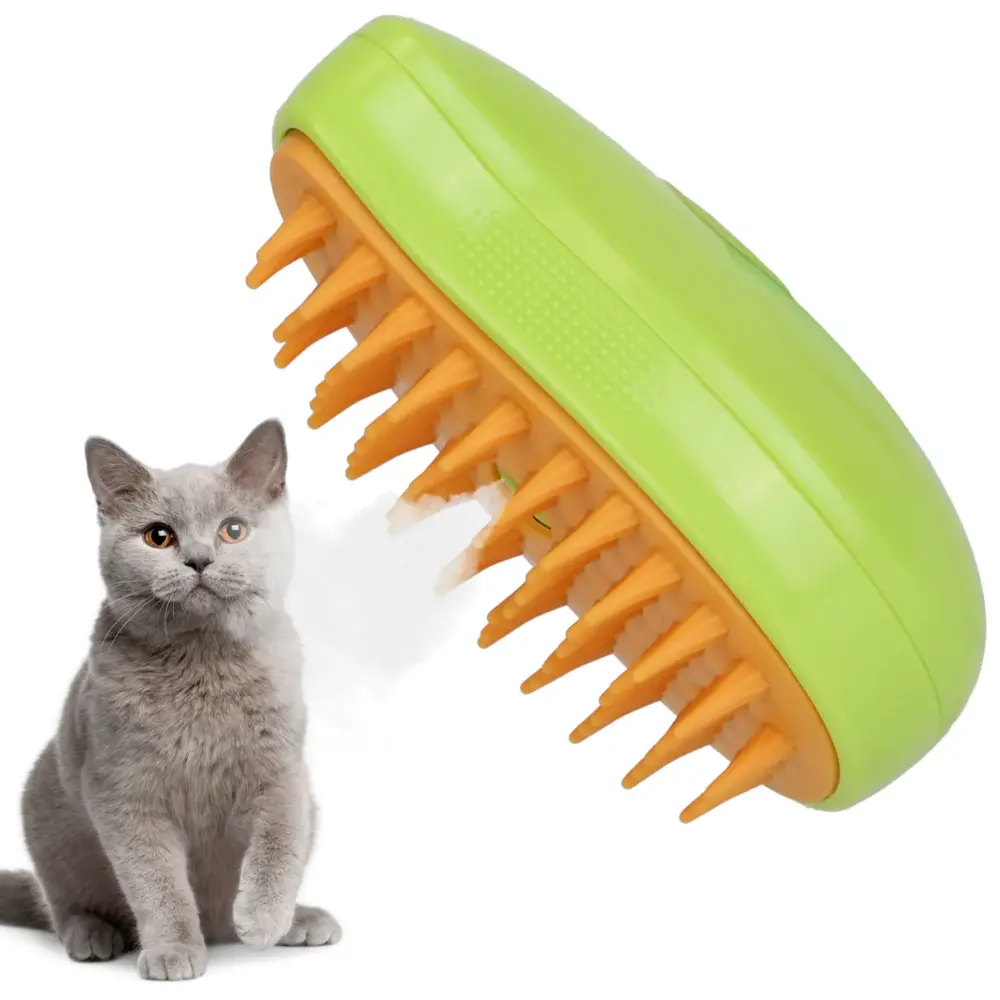
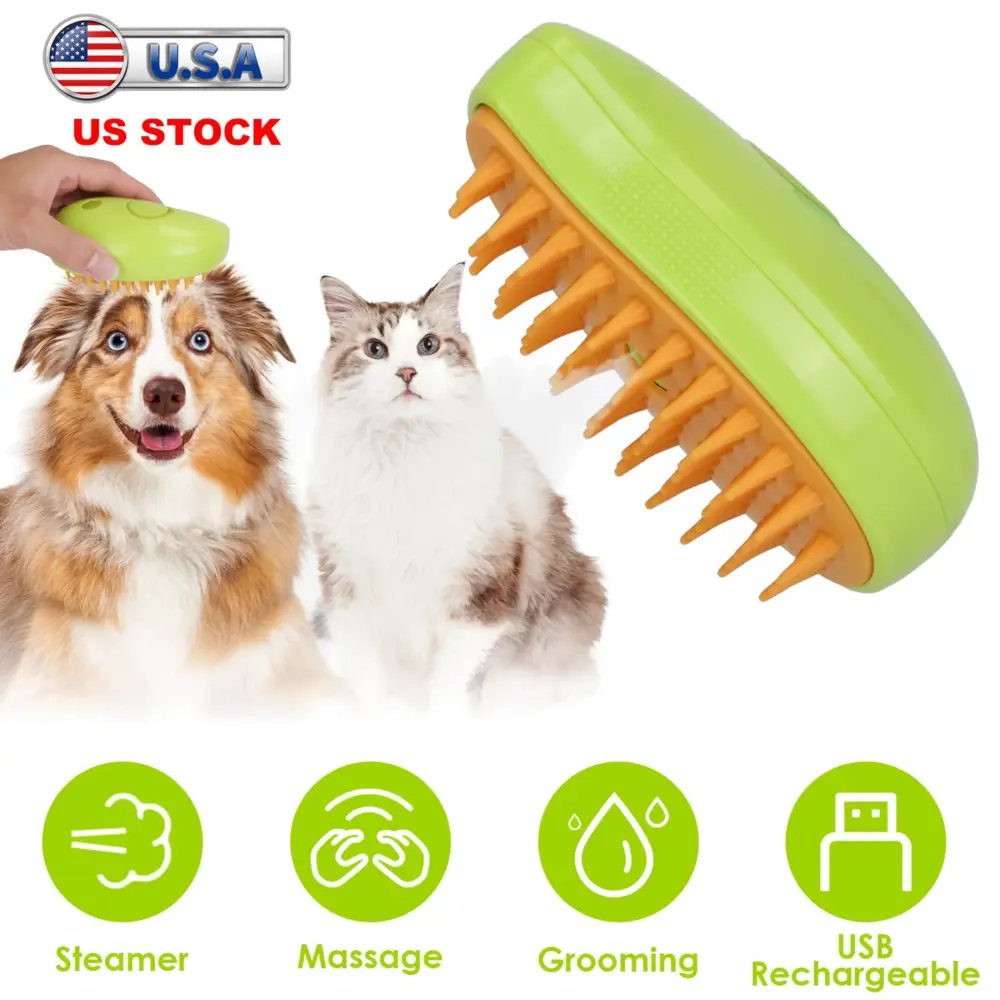
Our short-coat option is the rechargeable 3-in-1 Steam Grooming Brush, whose soft silicone pins remove dead hair. Despite the name, its small refillable tank releases a fine mist, not steam, which settles loose hair onto the pins instead of letting it float off. It mists only when you press, so you can brush dry until your cat is relaxed. Whether the mist is worth having for your cat, and how to introduce it, is covered in do steam brushes work for cats.
Good fit: domestic shorthairs, sleek Siamese-type coats and short-haired seniors who need a gentle touch. Poor fit: any cat with medium or long fur, as the only brush.
Slicker brushes for medium and long fur
On a long coat, the work happens next to the skin, where loose undercoat collects and knots begin. A slicker’s fine wire pins reach that layer and ease out small tangles while they gather loose hair, which soft pins can’t do.
The tradeoff is firmness. The pins that work through a knot will scratch thin skin if you press, so on a cat a slicker is a light-touch tool: let the pins glide through the hair rather than drag across the skin. On a sleek short coat it has little to do and can feel scratchy.
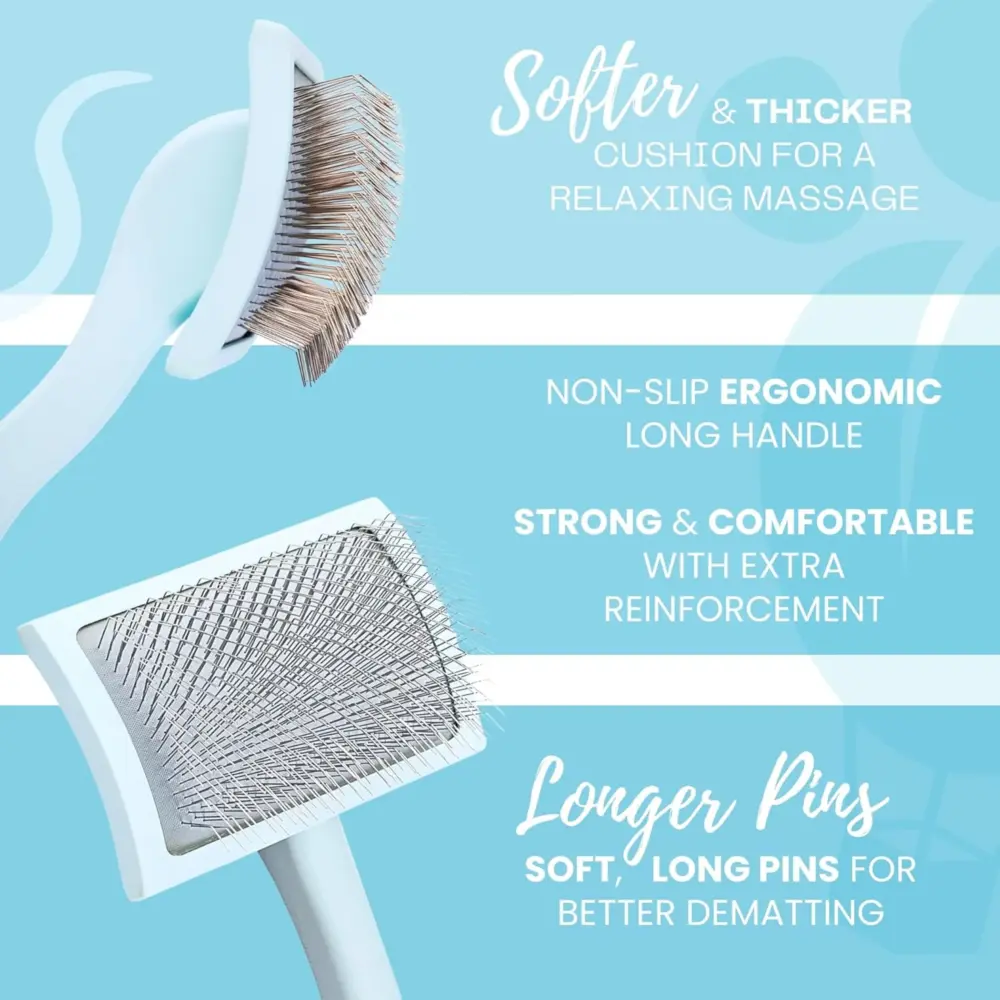
We stock the Sakabase Curved Slicker Brush. Its curved head follows the shape of the body, so more pins meet the coat with each stroke, which helps when your cat allows only a few minutes. Its fine, firm pins reach the undercoat on long and thick coats. Pair it with a wide-toothed metal comb: the slicker does the work, and the comb tells you whether it reached the skin. The full technique, including small mats, is in how to groom a long-haired cat.
Good fit: semi-long and long-haired cats, including Maine Coon and Persian-type coats, and any cat whose fur knots. Poor fit: sleek short coats, and very thin-skinned cats unless you can keep the pressure feather-light.
De-shedding tools for dense undercoats
Instead of pins, a de-shedding tool has a fine stainless-steel edge. It reaches through the guard hairs and collects undercoat that has already come loose, the soft fluff that otherwise turns up in tufts on the sofa.
It is also the most limited tool on this page. Treat it as an add-on, never as a cat’s only brush. Use it only on a coat you have already brushed out, because the edge catches on knots and pulls, and keep to a few light strokes at a time. Pressed hard or used too often, it can irritate the skin and thin the topcoat. On a sleek single coat or a long, silky coat with little undercoat, it has almost nothing to catch.
Our option is the JESPET De-Shedding Tool, made for dogs and cats with a double coat and sold in Small and Large. If loose hair around the house is your main complaint, how to reduce cat shedding puts this tool into a wider plan, including what shedding is normal.
Good fit: plush short coats in heavy shedding, and long-haired cats with a thick, woolly undercoat. Poor fit: kittens, sleek or silky coats, and any area with mats or sore skin.
Combs and grooming mitts we don’t stock
Two simple tools come up in cat-welfare grooming advice, and we sell neither. International Cat Care lists a fine-toothed comb, a bristle brush and a rubber grooming pad or mitten for shorthaired cats, and a wide-toothed comb with a rubber pad or mitten for longhaired ones.
- A metal comb is the quickest check on a long coat: if a wide-toothed comb runs from skin to tip without catching, that section is done. On a short coat, a fine-toothed comb lifts loose hair and gives you a clear look at the skin.
- A rubber grooming mitt sits on your hand, so brushing feels like petting. It can win over a cat who distrusts anything held in your hand, and it picks up loose hair from short coats, but it won’t detangle a long one.
Any sturdy metal comb with smooth, rounded teeth and any mitt that fits your hand will work alongside the brushes below.
Kittens, seniors and sensitive cats
Kittens
A kitten’s coat rarely needs much, so the real aim is an adult cat who accepts brushing. International Cat Care suggests getting kittens used to grooming early and building the time up gradually. Use your softest brush for a few strokes at a time, when your kitten is sleepy rather than playful, and stop before the wriggling starts. A long-haired kitten can move to a slicker as the coat grows in, introduced the same way.
Senior cats
Older cats often groom less thoroughly, and the ASPCA notes that regular brushing becomes especially helpful as cats age. Many seniors are bonier along the spine and hips, where firm pins land harder. Choose soft pins where they do the job, lighten up with the slicker over bony areas, keep the de-shedding tool off a thinning coat and brush while your cat lies on a favorite bed. A cat who suddenly stops grooming, or whose coat turns greasy or matted, should see a veterinarian first. Our guide to grooming a senior cat covers the routine.
Touch-sensitive cats
Rank the tools by feel: soft pins and a mitt are the gentlest, a slicker needs a feather-light hand, and a de-shedding edge is the least forgiving. A cat who flinches at one spot, or who has recently started to dislike being touched, may be in pain, so ask your veterinarian before you try a different brush.
Tip
Before the first session, draw the brush along the inside of your own forearm with the pressure you plan to use. If it scratches or stings, it is too firm or too heavy for your cat’s thin skin, so lighten your hand or choose a softer tool.
Our cat brush picks, and who each suits
These picks are limited to Nilosi’s own catalog, and we haven’t compared them with every cat brush on the market. Each brush matches a coat described above. The fourth pick isn’t a brush: it’s for the cat who holds still only when food is involved.
-
3-in-1 Steam Grooming Brush for Cats & Dogs, View product
$36.95
Why it fits: An everyday brush with soft silicone pins for short coats; the mist settles loose hair onto the pins, and you can brush dry at first.
-
Sakabase
Curved Slicker Brush, View product
$39.95
Why it fits: The main tool for medium and long coats; the curved head and fine, firm pins reach the undercoat, so keep your hand very light.
-
JESPET
De-Shedding Tool for Dogs & Cats, Choose size
Price range: $27.95 through $29.95
Why it fits: An extra for plush or woolly double coats only; use a few light strokes after the regular brush, and leave it out for sleek or silky fur.
-
SodaPup
Jigsaw Enrichment Lick Mat for Dogs & Cats, Choose color
$25.95
Why it fits: A distraction for cats who will hold still for food; spread wet food thinly and brush a few strokes at a time while your cat licks.




Most cats need just one of these brushes; the table at the top shows which coats earn a second. Browse the full grooming range or other cat essentials.
Signs a brush is wrong for your cat
Give a new brush a few sessions, then look for these:
- Pink or scratched skin afterward. The pins are too firm for that spot, or the pressure is too heavy. Lighten your hand, or use soft pins there.
- Knots under a smooth top layer. The brush isn’t reaching. Soft pins on a long coat do this; switch to a slicker and check with a comb.
- A thinner topcoat. If you use a de-shedding tool, you may be using it too often or on the wrong coat. Put it away for a few weeks; bare or patchy skin needs your veterinarian.
- A snag on every stroke. There are tangles to work out from the ends first, or mats that need a groomer. Don’t force any tool through them.
- An empty brush on a heavy shedder. It is skimming the topcoat. On a plush or woolly coat, a few light strokes of a de-shedding tool after the regular brush reach the undercoat.
- A cat who leaves when the brush appears. If petting is still welcome, the feel may be the problem. Try softer pins or a mitt, and shorter sessions.
Safety note
Some signs have nothing to do with the brush. Bald patches, scabs, red or flaky skin that doesn’t settle, constant licking or scratching, or a sudden change in how much your cat sheds or grooms call for your veterinarian before another tool. Leave tight mats to a groomer or veterinarian: VCA Animal Hospitals advises removing mats with clippers only, never scissors.
Related guides
-
How-to
How to Brush a Dog That Hates Being Brushed, One Stroke at a Time
For the dog who runs, squirms or mouths the brush: rule out mats and pain, choose a gentler brush for the coat, set up non-slip footing and a lick mat, then build from one rewarded stroke to a full brush-out, stopping at the first sign of stress.
-
Guide
How Often Should You Brush Your Dog? A Schedule by Coat Type
Smooth coats need a weekly brush, double coats one to three sessions a week, and long, silky or curly coats daily. Get a coat-by-coat schedule, session lengths, a rule for mixed coats, the signs you need to brush more often and a weekly plan you can keep.
-
Buying guide
Types of Dog Brushes: Which Brush Suits Your Dog’s Coat
Slicker, de-shedding tool, pin, bristle, rubber curry, comb or rake: what each type of dog brush does, a coat-by-coat table of the ones your dog needs, the three tools we stock and the ones we don’t, and the signs a brush is wrong for the coat.