Cat Care How-to
Where to Put a Litter Box in a Small Apartment or Studio
Short answer
In most small apartments the bathroom is the best spot for a litter box, with the door wedged so it can’t swing shut. No room there? Use a closet held open, a hallway nook or a screened corner far from your bed and kitchen, and never beside food or a noisy appliance.
What your cat needs from a litter box spot
A spot that suits you but bothers your cat ends in accidents. International Cat Care’s advice on choosing a litter tray puts the tray somewhere quiet, away from food, water and busy areas, and the ASPCA’s litter box guidance adds that cats like to see who is approaching and to have more than one way out. In a small apartment, that means:
- Quiet. Away from appliances and the front door, where a sudden noise can startle your cat mid-visit.
- Open at all hours. No door that can drift shut, no ladder to a loft, nothing to squeeze behind.
- A view of the room. The open side of the box faces into the space, not into a wall.
- Distance from food and water. Cats usually avoid toileting close to where they eat, and the ASPCA advises keeping the bowls away from the box.
Two requirements are yours. Put the box on a hard floor, such as tile or vinyl you can sweep in seconds, not carpet or a bath mat. And pick a place you pass every day: a box you see daily gets scooped daily, and in a small apartment you’ll smell the difference first.
What you’ll need
- A litter box about one and a half times your cat’s length, nose to base of tail, which is iCatCare’s guideline; measure your candidate spots with that in mind.
- A rubber door stop or a hook-and-eye latch to hold a door open.
- A scoop, waste bags and a small dustpan that live beside the box.
- A litter trapping mat for the exit, especially on a rental floor.
The best spots in a small apartment
Most studios and one-bedrooms offer the same short list, each with its own catch:
| Spot | Works when | Watch out for |
|---|---|---|
| Bathroom | The door is wedged open | Guests closing it; bath mats |
| Closet | Door held open, box facing out | Trapped odor; clothes on the floor |
| Hallway nook | It’s out of the walkway | A dead end your cat can’t leave |
| Room corner | It’s far from bed and kitchen | Odor in your living space |
| Box cabinet | It fits a full-size box | Cramped inside; trapped odor |
The bathroom, with the door wedged open
The bathroom is the usual first choice: a hard floor, a door between the box and the rest of your home, and a room you already clean. The gap between the toilet and the tub, or the end of a vanity, often fits a box if your cat can walk in without squeezing past anything.
The door is the weak point: if it swings shut, your cat is locked out at the worst moment. Wedge it with a door stop or a hook that holds it ajar, ask guests to leave it open, and keep it open overnight if the bathroom opens off your bedroom. Keep bath mats away from the box exit and the box clear of shower splash, and store cleaners and medications in a closed cabinet.
A closet held open
A coat or linen closet can work for a single cat, provided the door can’t close. Fix it open, or take it off its hinges if your landlord agrees, and set the box with its open side facing out, so your cat walks straight in and can see the room. Clear shoes and clothing off the floor nearby, since fabric soaks up odor and litter dust.
Skip any closet that holds a water heater, furnace or washer: VCA’s guidance on house soiling names boxes near a furnace or washing machine among the spots cats may find undesirable. A closet also traps smell as well as it hides the box, so scoop it every day. With more than one cat, skip closets: a cat stepping out can be cornered there.
A hallway nook or alcove
Many apartments have a short hall, sometimes with a shallow alcove, between the living area and the bathroom or bedroom. A box tucked against the wall there is out of the main room, but keep it out of the walkway, where you’ll kick it in the dark, and away from a dead end where a dog, a child or another cat can block the only way out. The ASPCA’s standard is quiet but not cornered.
A corner of the main room
In a studio this is often the only real option. Choose the corner farthest from both your bed and the kitchen, and screen it on one or two sides. iCatCare notes that cats are often reluctant to use a tray near full-length glass windows, where they can feel exposed to animals outside, so the corner beside a glass balcony door isn’t ideal.
Spots to avoid, even when space is tight
Each of these is tempting because it’s empty floor, and each tends to cause a problem:
- The kitchen. It puts the box beside food prep and, usually, your cat’s own bowls. Our guide to where to put cat food and water bowls covers the feeding side.
- Beside your bed. Digging at 3 a.m. and odor where you sleep are bad for you, and your cat’s own bed shouldn’t sit next to the box either.
- Next to the washer, dryer or dishwasher. A stacked laundry closet looks perfect until the spin cycle starts mid-visit; the ASPCA lists the washer and dryer among places to avoid.
- Just inside the front door. Deliveries, guests, keys and shoes make it the busiest patch of floor you have.
- On a balcony or patio. Your cat can reach it only when the door is open, it’s exposed to the weather, and an unscreened balcony is a fall risk.
- Up a loft ladder or on a high shelf. Kittens, older cats and stiff cats need a box they can walk to, and VCA notes that stairs can put older cats off.
Screens and litter box furniture
Hiding the box can work, as long as the hiding place keeps what your cat needs: room to turn around, a clear way in and out, and air. Skip potted plants as screens, since some cats dig in the soil instead.
Screens, dividers and shelving
A folding screen, a curtain on a tension rod or a low bookcase can block the view of the box from your sofa or bed while leaving the entry side open. Keep a clear stretch of floor in front of the entry, and make sure the screen is stable, because cats jump on things; anchor a tall bookcase to the wall, with your landlord’s permission before you drill.
Litter box cabinets and enclosures
A cabinet that looks like a side table turns the box into furniture, but inside it works like a covered box. Before you buy one:
- Measure the inside and the doorway. Some cabinets fit only a small box. Compare the interior with the box size above, allow headroom for digging, and check that your cat can walk in without crouching.
- Expect trapped odor. VCA notes that covered boxes can hold in odors, so scoop an enclosure at least as often as an open box.
- Think about other pets. VCA also warns that a covered box can let another cat ambush the one coming out, so with a dog or a second cat, a single-door cabinet can become a trap.
- Introduce it slowly. Start with the doors open, or the box just in front of the cabinet, and move it inside once your cat uses it there without hesitating.
A studio layout that keeps each zone apart
In a studio, the box, the bowls, your bed and your cat’s bed share one room, so aim for distance between the things that shouldn’t mix. Feline welfare guidelines from the AAFP and ISFM give the litter box, food, water, scratching and resting spots separate locations. One way to lay it out:
- Mark the fixed points: your bed, the kitchen, the entry door and anything that hums or bangs, such as a stacked washer-dryer.
- Give the box the bathroom if it fits. If not, use the corner farthest from both bed and kitchen, open side facing the room.
- Set food and water toward the opposite end, with the water a little apart from the food bowl.
- Put the scratcher where your cat already scratches, often the arm of the sofa, the end of your bed or beside the entry.
- Give your cat a warm, quiet bed spot of its own, away from the box and out of the main walkway.
- Check the route from your cat’s bed to the box: nothing should block it, and it shouldn’t run through your busiest path.
In a one-bedroom, the bathroom or a hallway nook usually beats a bedroom corner. If two cats share a small apartment, plan on one box per cat plus one, in different places; our multi-cat household setup checklist explains why two boxes side by side count as one.
Our picks are limited to what Nilosi sells, and we don’t carry litter boxes, litter or bowls. Two pieces we do carry suit a tight floor plan: a mat for the box exit and a compact scratcher. To coax your cat onto a new scratcher, see how to get a cat to use a scratcher. Short on room for a cat bed? Our GOOPAWS 4-in-1 Self-Warming Cat Cave Bed works as a cave in a quiet corner or opens out as a flat mat.
-
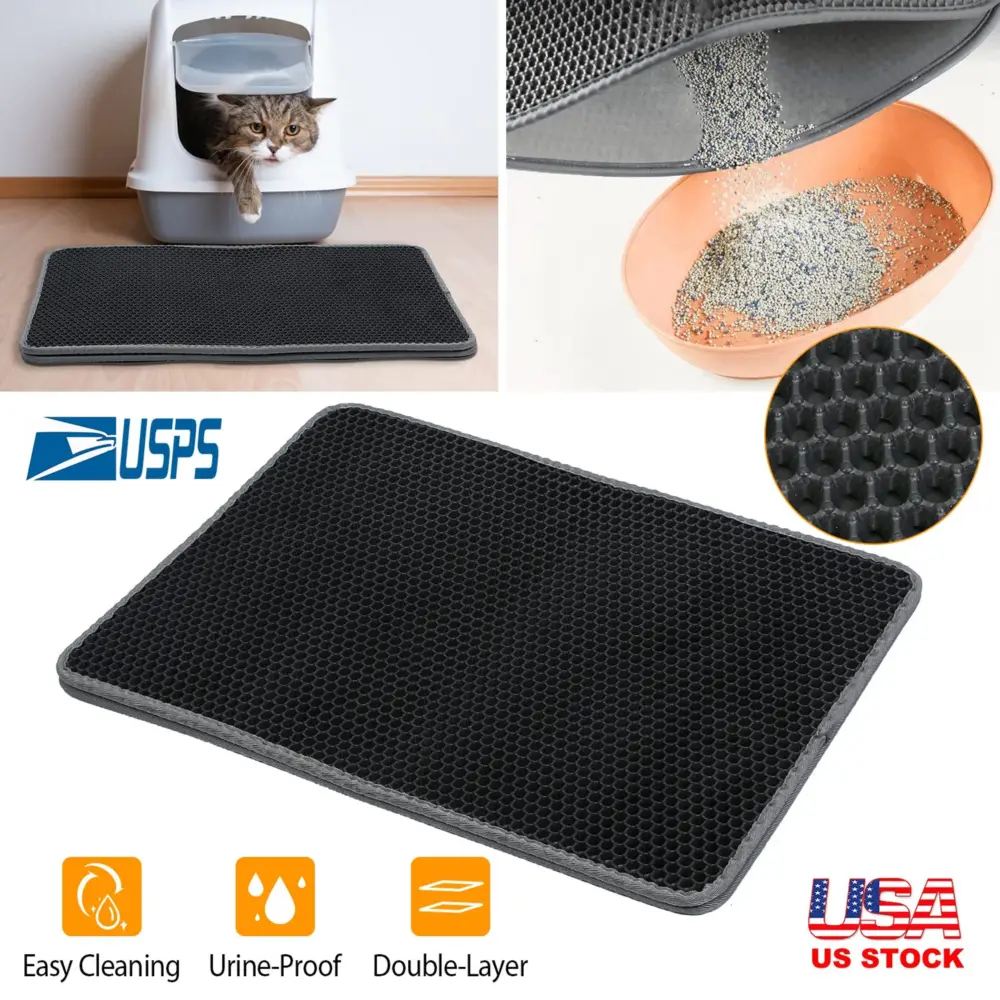
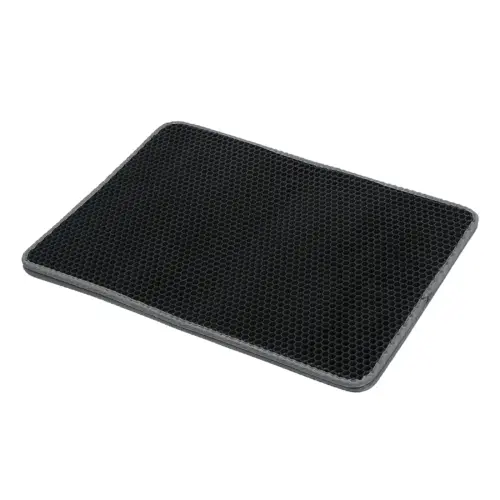
Double-Layer Honeycomb Cat Litter Trapping Mat, View product
$53.95
Why it fits: Keeps the box zone contained in a small space: litter drops through the honeycomb top into a lower layer, over a waterproof base.
-
Cat Scratcher Guy
Wooden Cat Scratcher with Reversible Insert, View product
$32.95
Why it fits: A flat scratcher sized for a tight floor plan, about 19.5 x 5.5 x 2 in, with felt pads underneath to help protect a rental floor.

Keeping litter and odor in the box zone
Stray granules and smell show up sooner when the box is a few steps from where you live. Most of the fix is routine:
- Scoop at least once a day, as the ASPCA recommends, with the scoop and bags right beside the box.
- Keep it unscented. The ASPCA says most cats prefer unscented litter and warns that a cat can take a dislike to scented cleaners, so wash the box weekly with unscented soap and keep air fresheners away from it.
- Clean accidents with an enzymatic cleaner made to neutralize pet odors, as the ASPCA suggests, so the spot is less likely to draw your cat back.
- Catch litter at the exit with a trapping mat right where your cat steps out, and no rug.
The honeycomb litter mat in our picks above handles that last job, and its waterproof base protects a rental floor. The listing doesn’t give dimensions, so measure the floor at your box’s exit before you order. It sits with our other cat essentials.
For box sides, litter choice and emptying the mat, see how to stop cat litter tracking. If you rent, protecting an apartment from pet damage covers the floor around the box and the move-out clean.
How to move the litter box without accidents
Cats get attached to the place they go, so a sudden jump to a new spot, especially one out of sight of the old one, is a common reason for accidents right where the box used to be.
Small moves: a few inches a day
To shift the box across a room, VCA suggests moving it only 6 to 8 inches at a time and leaving it in each new position for at least a day. That’s slow, so save it for a move of a few feet, such as out of a walkway and into the nearest corner.
Bigger moves: a second box first
- Set up a second box in the new spot, the same type with the same litter, while the old box stays put.
- Let your cat find it. Show the way once if you like, but don’t carry your cat in or hold it there.
- Scoop both boxes daily, so neither one becomes the box your cat avoids.
- Once your cat has used the new box reliably for several days in a row, remove the old one.
- Clean the old spot with an enzymatic cleaner, and put a chair or a basket there so it stops looking like a toilet.
Moving to a new apartment? Set the box up in your cat’s first base room before it leaves the carrier, then move it to its permanent place with the steps above. Our guide to helping a cat adjust to a new home covers that first room.
If your cat stops using the box
A few patterns point straight back to the spot:
- Accidents where the old box was: put a box back there for now, then move it in small steps.
- Puddles just outside a cabinet or behind a screen: the space may be too tight or too dark. Take the box out of the enclosure for a while.
- Avoiding the box after a loud noise, such as a dryer buzzer or a slammed door: move the box away from the source.
- Waiting by a closed door: the door is swinging shut. Fix it open with a stop or a hook, not a shoe.
- One cat using the box while the other goes elsewhere: one may be guarding it. Add a second box in a different spot.
Once the spot is settled, the box itself is the next decision. We compare disposable and reusable litter boxes, including what each costs over a year in a small apartment.
Safety note
Any sudden change in litter box habits is worth a call to your veterinarian, even when it lines up with a move, because pain or a urinary problem can look like a dislike of the new spot. A cat that strains, or keeps returning to the box and passes little or no urine, needs a veterinarian right away, especially a male: a blocked bladder is an emergency.
Related guides
-
How-to
How to Introduce a New Cat to Your Cat: A Step-by-Step Plan
A staged plan for adding a cat to a home that already has one, from a transition room and scent swaps to sightings and short supervised meetings, with how long each stage takes, the body language to watch and what to do if it goes wrong.
-
How-to
How to Help a Cat Adjust to a New Home After Moving
A settling plan that starts at the new front door: what goes in the base room, how arrival day and hiding should go, why the old bed and litter stay, when to open more rooms, how to secure doors and screens, how long settling takes and when to call your veterinarian.
-
Guide
Should You Get a Second Cat? How to Tell if Yours Would Welcome One
A second cat can be good company or a daily source of stress. Learn what lonely behavior often means, what makes a cat likelier to accept a newcomer, which pairings tend to work, what one more cat takes in space, money and time, and what to try first.