Cat Care How-to
How to Introduce a New Cat to Your Cat: A Step-by-Step Plan
Short answer
Give the new cat its own room, then work through scent swaps, meals and play at the closed door, a room swap, sightings through a barrier and short supervised meetings. Move on once both cats are eating and relaxed; go back a step at any hiss or hard stare. Most stages take a few days to a week.

How long each stage takes
The Feline Veterinary Medical Association (FelineVMA, formerly the American Association of Feline Practitioners) says in its step-by-step guide to introducing a new cat that the process can take from a few days to a few months, sometimes longer, and that moving on before every cat is comfortable can lead to long-term tension. Treat these times as rough guides; your cats set the pace.
| Stage | Move on when | Often takes |
|---|---|---|
| Settling in | The new cat eats, uses the box and explores | Several days to a week or two |
| Scent swapping | Both sniff the other’s bedding calmly | A few days |
| Meals and play at the door | Both eat and play there without hissing | Several days |
| Room swaps | Each explores the other’s space calmly | A few days |
| Sightings through a barrier | Glances, not stares | Several days |
| Supervised meetings | Visits stay calm as they get longer | Several days or longer |
If a stage goes badly, drop back to the last one that went calmly and stay there a few more days before trying again.
Before the new cat arrives: set up a transition room
Choose a quiet room with a door that latches, away from busy walkways and not the room with your resident cat’s litter box, bowls or favorite bed. Everything in it should be new or belong only to the new cat, as International Cat Care’s guide to introducing cats advises.
- Litter box, litter and scoop in a corner away from the food, with a mat at the exit.
- Food and water bowls, apart from each other and from the box.
- Places to hide: a cave-style or high-sided bed, a cardboard box and, later, the open carrier.
- Something to climb, such as a sturdy shelf or cat tree; FelineVMA notes that vertical space gives a cat more control over its surroundings.
- A scratcher, so the new cat has its own spot to scratch and mark rather than the door frame.
- A wand toy, plus two or three soft cloths for scent swapping and a towel for the carrier.
We don’t sell litter boxes or litter; our new kitten checklist has the full supplies list and room-proofing for cords, string and plants, and works for adult cats too.
Vet check first. FelineVMA advises that every cat in the home have a recent check-up, and that your veterinarian test the new cat for common contagious diseases before it meets your other cats. Keep them apart until that visit.
Keep your resident cat’s world the same. The ASPCA’s advice on introducing your cat to a new cat is to keep mealtimes the same, leave litter boxes and scratching posts where they are, and give plenty of attention. FelineVMA and International Cat Care also suggest synthetic feline pheromone diffusers; FelineVMA says to set one up in the transition room and one in the main living area a day or two before the new cat arrives. They’re optional; your veterinarian can say whether one is worth trying.
-
GOOPAWS
4-in-1 Self-Warming Cat Cave Bed, Choose color
$40.95
Why it fits: A hiding place for the transition room: set it up as a cave so a nervous new cat can watch from cover, then use it as a mat as the cat relaxes. One size, 21 x 17 x 3 in.
-
Cat Scratcher Guy
Wooden Cat Scratcher with Reversible Insert, View product
$32.95
Why it fits: A scratching spot that belongs only to the new cat, so it can mark its own room. Floor-level, about 19.5 x 5.5 x 2 in, with catnip included to draw it over.
-
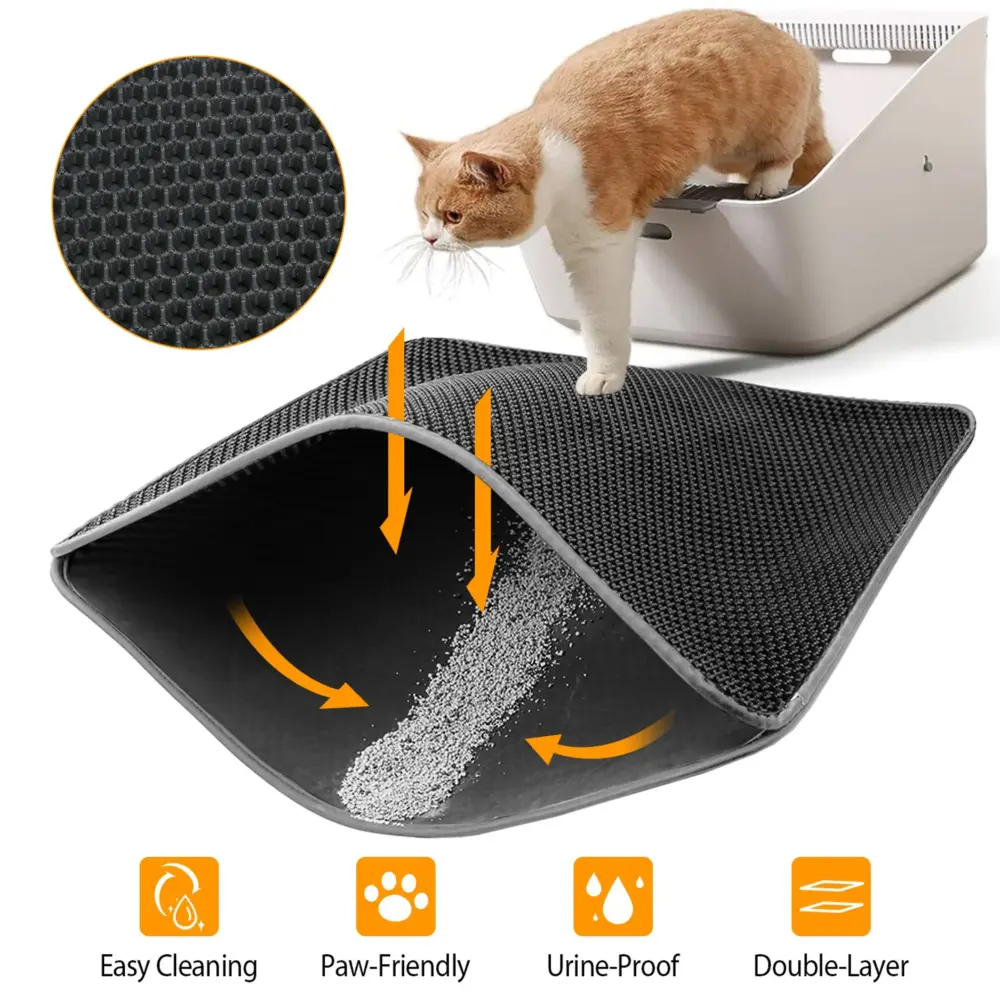
Double-Layer Honeycomb Cat Litter Trapping Mat, View product
$53.95
Why it fits: A transition room is often a carpeted spare room: the honeycomb top catches litter at the box exit, the waterproof base protects the floor, and it opens like an envelope to empty.
-
Armarkat
Soft-Sided Pet Carrier, View product
$65.95
Why it fits: A carrier that doubles as a hideout: lower the new cat in through the top on day one, then leave it open in the room. 19 x 12 x 12 in, up to 22 lb, per Armarkat.




Day one: straight to the transition room, no meeting yet
Before you bring the new cat inside, shut your resident cat in another room, as the ASPCA suggests, and carry the new cat in a carrier covered with a towel or blanket so the cats can’t see each other, as FelineVMA advises. Go straight to the transition room, close the door, open the carrier and let the new cat come out when it’s ready, even if that takes hours. Leave the carrier there, open, as one more hiding place, then let your resident cat out. Sniffing or hissing at the door is normal at this point. No meeting yet, not even a peek.
The Armarkat soft-sided carrier we stock opens from the top as well as both sides, which makes it easier to lower a wary cat in; Armarkat’s listing gives its size as 19 x 12 x 12 inches for pets up to 22 lb. A carrier that lives in the room as a hideout is one your cat is less likely to dread on vet day, as our guide to getting a cat used to a carrier explains.
How to introduce a new cat to your cat, step by step
Do a session or two a day. Move on after two or three relaxed sessions in a row; drop back a step at the first sign of tension.
- Let the new cat settle in. Spend quiet time in the room and play with a wand toy. Stay here until it eats, uses the box and explores rather than hiding all the time. If the resident cat’s sounds at the door frighten it, keep your resident cat away from that door with a chair or a few boxes.
- Swap scents. Once a day, swap a blanket or soft toy between the two cats’ spaces. When both cats sniff the swapped items calmly or ignore them, rub a soft cloth gently on one cat’s cheeks and leave it near the other cat with a treat on it, as the ASPCA suggests. Hissing at the item or peeing outside the box means it’s too soon.
- Feed and play on either side of the door. Put the bowls on each side of the closed door, far enough away that both cats eat normally, and move them closer over several days. Play near the door too; FelineVMA suggests two toys tied together with strong string, one on each side, in 5- to 20-minute sessions. Put the string toy away afterward, and if a cat growls at the door, don’t scold it: move the bowls back.
- Swap rooms. Settle your resident cat in a favorite room with a lick mat spread with wet food, and let the new cat explore the main living area for a few minutes. Return it to its room and let your resident cat investigate in its own time. Lengthen the visits over a few days.
- Let them see each other through a barrier. Use a screen or glass door, a door open a crack too narrow to squeeze through, or a door-height pet gate; the ASPCA cautions that a cat can easily jump even a tall gate, so stay with them. Keep first sightings to a minute or two, after play, and end while both are calm. International Cat Care describes relaxed cats glancing at each other occasionally without staring each other down.
- Hold short, supervised meetings. After play and a meal, open the barrier and let them share a large room for a few minutes. Each cat needs a way out and somewhere high to go; keep a towel or cushion within reach to block their view if tension builds. Cats already used to a harness can meet on leashes, one person per cat on opposite sides of the room, as FelineVMA describes; if yours isn’t, harness train your cat first rather than during the introduction. Add a few minutes each day.
- Build up to time alone together. International Cat Care suggests starting with just a few minutes of unsupervised time; stay home and within earshot for those first sessions. Keep the transition room as the new cat’s retreat at night and while you’re out until you’re confident. Long term, aim for one of each resource per cat, plus one, spread around the house; our multi-cat household setup covers where they go.
Tip
Advice on food during sightings differs. The ASPCA suggests treats when the cats notice each other; International Cat Care warns that cats naturally eat and play alone and can find doing it in view of another cat stressful. A sensible middle path: serve meals out of each other’s sight, toss a treat after a calm glance, and never set bowls side by side to make friends.
Adopting two? FelineVMA says bonded cats can share a transition room; cats that aren’t bonded each need their own. With several resident cats, the ASPCA suggests introducing each one to the newcomer separately.
Body language: when to move on or go back a step
Watch both cats. The quiet one that slinks out of the room is telling you as much as the one that hisses.
- Keep going: both cats eat, groom and use the box as usual; they glance at each other and carry on; ears forward, tails up or soft; curious sniffing at the door or the bedding; dozing or playing with the other cat in view.
- Go back a step: hissing, growling or yowling; staring; a stiff, crouched body with ears sideways or flat; a puffed or lashing tail; one cat blocking a doorway, the food or the litter box; hiding, eating less, or peeing outside the box; swatting or chasing that sends the other cat running.
A hiss at the door in the first days is common. It means slow down, staying at this stage or going back one, not that the cats will never get along. The goal, as International Cat Care puts it, is comfort in each other’s presence; many pairs never groom or sleep together, and that’s fine.
Introducing a kitten to an adult or older cat
The steps are the same, vet visit included. The usual problem is energy more than hostility: a kitten wants to chase and wrestle, while an older cat may just want to rest. FelineVMA suggests two or more play sessions a day, of at least 5 minutes each, for high-energy cats, so they don’t turn that energy on the other cat. Play with the kitten before every meeting, and give your older cat one-on-one time too.
Give the older cat places the kitten can’t follow, such as a high perch or a room the kitten isn’t allowed into. A hiss or a paw swat at a pouncing kitten can simply be an adult cat setting a limit; it’s a problem when the kitten won’t back off, or the older cat starts hiding, eating less or skipping the litter box. Then separate them for part of each day and go back a step.
If your resident cat is elderly or unwell, talk to your veterinarian first: FelineVMA advises against adding a cat when the resident cat is in poor health or is a senior with medical concerns. Whether your cat would welcome company at all is the question in should you get a second cat. Adding a puppy instead? See how to introduce a puppy to a cat.
Mistakes that set an introduction back
- Letting them work it out. The ASPCA warns that aggression at a first meeting may set the mood for the relationship that follows.
- Punishing a hissing cat. International Cat Care advises against it; it only makes a frightened cat more frightened.
- Picking up a cat in a tense moment. FelineVMA advises against it; a tense cat that can’t reach the other cat may turn on whoever is closest. Slide a cushion between the cats instead.
- Sharing from the start. One litter box or one set of bowls for two wary cats invites guarding.
If the introduction goes wrong
Hissing at the door, staring or guarding
Go back to scent swapping and move the bowls farther from the door. Once the cats share space, break up staring contests with furniture between their favorite spots, add shelves so they can pass at different heights, and put extra resources where the other cat can’t watch them.
A fight
Safety note
Never reach between fighting cats. Block their view with a towel, cushion or piece of cardboard, then guide them into separate rooms, each with litter, water and a bed. If either cat is limping or bleeding, or later has a sore or swollen spot, call your veterinarian; bites can be hard to see under fur. If you’re bitten, ask your doctor’s advice.
Give them a day or two fully apart; then, as the ASPCA suggests, go back to the barrier stage for about a week before the next meeting.
Hiding, not eating or litter-box accidents
Separate the cats again and slow down. A cat that stops eating should see your veterinarian promptly. Peeing outside the box can be stress, but it can also be a medical problem: the Cornell Feline Health Center’s page on feline lower urinary tract disease lists it among the signs, and a change in the number of animals at home among possible sources of stress. A cat that strains in the box and passes little or no urine, especially a male, needs a veterinarian right away; Cornell calls a blocked urethra an absolute emergency.
After a vet visit
A cat back from the clinic smells different. The ASPCA suggests keeping the cats in separate rooms for at least a day afterward, even if only one went.
When to get help
The ASPCA recommends getting help if one cat spends most of its time hiding or keeps bullying the other. The same goes for repeated fights or weeks with no progress. Start with your veterinarian: pain or illness can make a cat less tolerant of company, and your veterinarian can refer you to a veterinary behaviorist.
Related guides
-
Guide
Should You Get a Second Cat? How to Tell if Yours Would Welcome One
A second cat can be good company or a daily source of stress. Learn what lonely behavior often means, what makes a cat likelier to accept a newcomer, which pairings tend to work, what one more cat takes in space, money and time, and what to try first.
-
How-to
How to Help a Cat Adjust to a New Home After Moving
A settling plan that starts at the new front door: what goes in the base room, how arrival day and hiding should go, why the old bed and litter stay, when to open more rooms, how to secure doors and screens, how long settling takes and when to call your veterinarian.
-
Checklist
Multi-Cat Household Setup: How Many Litter Boxes, Bowls and Beds
Two cats need three litter boxes, and the same one-per-cat-plus-one rule covers feeding stations, water bowls, scratchers and resting spots. See where each one goes, how to tell bonded cats from rivals, the quiet signs a home is too crowded, and a walk-through checklist.