Cat Care Checklist
Multi-Cat Household Setup: How Many Litter Boxes, Bowls and Beds
Short answer
Start with one of each resource per cat, plus one: two cats need three litter boxes, three feeding spots, three water bowls, three scratchers and at least three places to rest or hide. Spread them across the rooms each cat uses, out of sight of each other, with litter well away from food and water.
The multi-cat rule: one per cat, plus one
International Cat Care (iCatCare), in its advice on multi-cat households, lists bowls, litter trays, beds, high resting places, hideaways, scratching posts, entry points and toys as things cats don’t share outside their own social group, and suggests one per cat plus one extra, in separate locations. The extra gives a cat somewhere else to go when the first is taken, or watched.
| Resource | How many | Where | Avoid |
|---|---|---|---|
| Litter boxes | One per cat, plus one | Different rooms, one on every floor | Boxes side by side; dead-end closets |
| Feeding stations | One per cat, plus a spare spot | Out of sight of each other | A row of bowls on one mat |
| Water bowls | One per cat, plus one | Apart from food and litter | Water only beside the food |
| Scratchers | One per cat, plus one | By beds, doorways and daily routes | All of them in one room |
| Beds, hideaways, perches | More than you have cats | High and low, in separate rooms | One cat tree as the only high spot |
What counts as a separate place
A resource is separate only if a cat can use it without being seen from the next one: two boxes in one bathroom are one toilet area, and a double bowl is one feeding station. The AAFP and ISFM feline environmental needs guidelines explain that when resources sit in different locations, cats can avoid seeing each other, which cuts competition, bullying and stress. Treat the counts as a minimum; stairs, a large home or an older cat who tires easily can call for more.
Friends, rivals and cats who take turns
Cats that rub faces, groom each other, sleep touching or play together form a social group, and a bonded pair may happily share a bed or a window seat. Cats that keep their distance need their own sets of resources in their own parts of the house. Bonded or not, every cat still gets its own feeding station, and the litter box count stays at one per cat, plus one. The AAFP and ISFM guidelines also note that many cats time-share, using the same bed or perch at different times of day; that is a working arrangement, not a shortage.
Litter boxes: how many and where
The ASPCA’s advice on litter box problems gives the same count and adds a box on each level of a multistory home. It also warns that one cat can control access to the boxes and keep the others away, so placement matters as much as number. We don’t sell litter boxes or litter, so this part is brand-neutral.
- Different rooms, every floor: never lined up in one bathroom or laundry room.
- A view and two ways out: cats like to see who is coming. Skip closets and the far end of a narrow hallway, where a cat can be cornered as it steps out.
- Quiet: clear of the washer and dryer, busy doorways and low windows with a view of cats outside.
- Open boxes if anyone ambushes: a hooded box with a flap hides who is waiting outside. iCatCare suggests open trays, or taking the door off a covered one.
- Scooped often: at least daily, and iCatCare suggests twice a day in a multi-cat home.
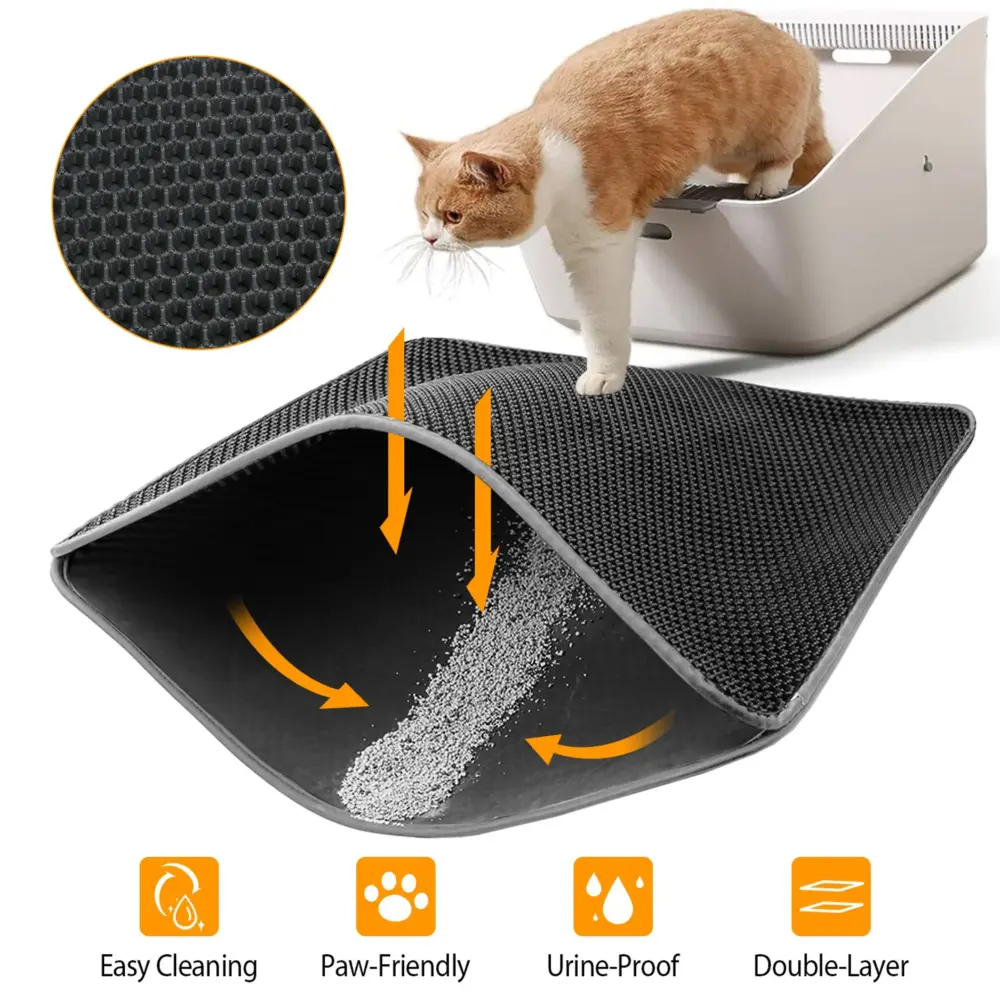
- A trapping mat where tracking shows: each extra box is one more place for litter to ride out on paws, so start with boxes on carpet or beside a walkway.
Short on space? Spread boxes across a bathroom, a bedroom corner and the quiet end of a living area first. If two must share a room, put them on opposite sides with furniture breaking the line of sight.
Safety note
A cat that starts going outside the box, strains, or makes frequent trips that produce little needs a veterinarian before you rearrange anything; these can be signs of a urinary problem, not just stress. A cat that strains and passes little or no urine, especially a male, needs a veterinarian or an emergency clinic right away.
Our double-layer honeycomb litter mat goes at a box exit: the honeycomb top cleans paws on the way out, litter drops into the lower layer, the waterproof base guards the floor, and it opens like an envelope to pour litter back. To set each mat tight against its box and empty it, see how to stop cat litter tracking.
Food and water: separate stations out of each other’s sight
Cats generally prefer to eat alone, and one that eats beside another may race, give up or wait its turn. The AAFP and ISFM guidelines say every cat in a household should have its own feeding station, and iCatCare advises against grouping bowls. Water needs a plan too: cats prefer to drink away from where they eat, and a cat challenged at the bowl may simply drink less.
- One station per cat, plus a spare spot, each with its own bowl or plate.
- Out of sight of each other: different rooms, opposite sides of a kitchen island, or different heights, such as a shelf for a confident climber and the floor for a cat that doesn’t jump.
- Bowls pulled out from the wall, so a cat can eat while keeping an eye on the room.
- Water in several places, away from food and litter, including the room the quieter cat prefers. iCatCare suggests large ceramic, glass or stainless steel bowls filled to the brim, so a cat can stay watchful while it drinks.
- A plan for different diets: feed in separate rooms with the doors closed, or ask your veterinarian about a microchip feeder, which opens only for the cat it is set up for.
A cat that bolts its meal and then raids the other bowl usually needs more distance or a closed door; see how to slow down a cat that eats too fast. For the exact spot in each room, including how far to keep food from the litter box, see where to put cat food and water bowls.
For wet food at each cat’s own station, the SodaPup jigsaw lick mat slows licking with its grooves and is dishwasher safe. It comes in Green or Pink, so two cats can each keep a mat of their own.
Scratching spots: one per cat, plus one, on each cat’s route
Scratching keeps claws in shape, and it is also marking: cats leave scent from glands in their paw pads along with the visible scratches. In a shared home that makes scratchers part of how cats divide up space, so put them on the routes each cat already uses, not all in one corner.
- One per cat, plus one, spread over at least two rooms.
- Beside each cat’s favorite sleeping spot, since many cats stretch and scratch as soon as they wake.
- At doorways and room entrances, where cats like to mark, and where a crowded cat may otherwise go for the door frame.
- Both angles: a tall, heavy post for cats that reach up and a flat scratcher for cats that rake the rug, since two cats in one house can prefer different ones.
- Steady, so it doesn’t wobble or slide when a cat pulls.
Our Cat Scratcher Guy wooden scratcher is the flat kind, about 19.5 x 5.5 x 2 in, small enough for a doorway or beside a bed; the insert is reversible and replaceable, and catnip is included. We don’t sell tall posts, so pair it with one elsewhere. For coaxing each cat onto its own, see how to get a cat to use a scratcher instead of the sofa.
Beds, hideaways and high places
Resting places are often where crowding shows first: the confident cat takes the warmest bed and the highest perch, and the other ends up under the bed. Practical tips from the Feline Veterinary Medical Association and iCatCare call for at least as many safe places as there are cats, each sized for one cat, set apart from each other, with a way in and out on at least two sides.
- More resting spots than cats, in different rooms.
- High and low: a cleared shelf, cabinet top or cat tree for watching the room, and a covered bed or a box on its side for hiding.
- Two ways up and down for each perch where you can manage it, so no cat gets trapped at the top.
- More than one high place, because one cat can easily hold a single cat tree.
- A warm spot for every cat, not one sunny window that everyone competes for.
- Hiding places left alone: don’t pull a cat out to socialize, and keep an open carrier around as one more retreat.
A cave-style bed makes a good hideaway, but its single opening can become a dead end if another cat waits outside, so put it where the cat inside can see out.
-
GOOPAWS
4-in-1 Self-Warming Cat Cave Bed, Choose color
$40.95
Why it fits: A hideaway and a warm spot of its own for the cat that needs time out: the self-warming design traps body heat. Use it as a cave, or open it into a mat if guarding starts. 21 x 17 x 3 in.
-
Armarkat
Ultra-Plush Cuddler Bed for Cats & Small Dogs, Choose size
Price range: $55.95 through $72.95
Why it fits: An open bed with no doorway for another cat to guard: a raised rim to lean on, a skid-free base, and a cat can step out on any side. Small is 22 x 22 x 8 in; a Medium is also offered.


Play: separate sessions and shared ones
iCatCare points out that insecure cats won’t play in front of a more confident cat, so one wand toy for everyone often means the bold cat makes every catch while the other watches from the doorway. The AAFP and ISFM guidelines recommend playing with each cat at separate times and in separate places, with toys kept in more than one location.
- A short session with each cat alone, with the door closed if the other cat barges in.
- At the quieter cat’s best time, such as while the other cat is asleep or eating.
- Shared games only between friends, with boxes, tunnels or perches nearby so either cat can step out.
- A catch, then a snack at that cat’s own feeding station.
- One-on-one attention every day, petting or brushing included, without another cat cutting in.
Some wrestling is fine. The ASPCA’s guide to aggression between cats in the same household describes play fighting as mutual: the cats switch roles often, ears stay forward, and claws may come out without doing damage. When one cat always chases and the other always runs, hides or hisses, it has stopped being play.
For one cat at a time, our motion-activated rolling cat toy ball wakes when touched and darts like prey, with about an hour of play per charge. Run it with you in the room, then put it away before the next cat gets a turn.
Signs your setup is too crowded
Tension between cats is often quiet. iCatCare notes that when resources are limited, cats either avoid each other or suppress their natural behavior to avoid conflict, so the cat losing out may simply do less. Watch for:
- Hissing, growling, swatting, chasing or fighting.
- Staring, or one cat sitting in a doorway or beside a box or bowl as another approaches.
- A cat that leaves the room whenever another walks in.
- A cat that waits for another to finish eating, or that eats or drinks less.
- One cat always up high or under the bed while the other has the run of the house.
- Going outside the box, spraying, or licking a patch of fur thin.
The fix is usually more resources in better places. Sketch your home and mark where each cat sleeps, eats and spends time, as iCatCare suggests; where their routes cross, or in a room one cat avoids, add a resource or a second way through. A full set of litter box, water, bed and scratcher in the quieter cat’s favorite room is a good first step.
If the cats fight, interrupt with a sharp noise or a cushion slid between them, never your hands, and give them separate rooms. The staged plan in introducing a new cat to your cat also works for bringing long-time housemates back together.
Safety note
Call your veterinarian about any bite wound, limping, a cat that stops eating or hides most of the day, or a change in litter box habits. Pain and illness can make a cat less tolerant of company, and your veterinarian can refer you to a veterinary behaviorist if the tension continues.
What to skip, and what cats can share
- Double bowls, long feeding mats and side-by-side meals meant to make cats friends, which put them nose to nose at every meal.
- Scented litter, air fresheners and strong cleaners near boxes and beds. The same Feline Veterinary Medical Association and iCatCare tips note that some scents can feel threatening to cats and lead to toileting outside the box.
- Punishment for hissing, spraying or accidents, which adds stress without showing a cat what to do instead.
Bonded cats often share a bed, a window or a cat tree, and a water bowl in a shared hallway can serve as everyone’s extra. If a dog lives with your cats, keep the litter boxes and cat food out of its reach; for the rest, see which bowls, beds and brushes dogs and cats can share.
A printable multi-cat setup checklist
Walk through your home with this list, then again a week or two after any big change, such as a new cat, a move or a cat that has been unwell.
Count
- Litter boxes: one per cat, plus one
- Feeding stations: one per cat, plus a spare spot
- Water bowls: one per cat, plus one
- Scratchers: one per cat, plus one, both upright and flat
- Resting and hiding places: more than you have cats, high and low
Spread and access
- Litter boxes in separate rooms where you can, never side by side, and one on every floor
- Food bowls out of each other’s sight; water away from food and litter
- The quieter cat’s favorite room has a box, water, a bed and a scratcher
- No single doorway or staircase is the only way to the boxes or the food
- Every litter box spot and every perch has two ways out
- Every cat gets solo play and attention each day
Upkeep
- Boxes scooped at least daily, and litter mats emptied before the lower layer fills
- Fresh water every day; food bowls and lick mats washed after meals
- Scratcher inserts flipped, then replaced when worn
- New hissing, hiding or litter box changes noted, and box changes raised with your veterinarian
The litter mat, scratcher, cave bed and toy ball are in our cat essentials; for more on everyday life with cats, browse our cat care guides.
Related guides
-
Guide
Should You Get a Second Cat? How to Tell if Yours Would Welcome One
A second cat can be good company or a daily source of stress. Learn what lonely behavior often means, what makes a cat likelier to accept a newcomer, which pairings tend to work, what one more cat takes in space, money and time, and what to try first.
-
Checklist
Cat Sitter Checklist: Preparing Your Cat, Home and Sitter for a Trip
What to settle before a cat sitter takes over: how many visits to book, a meet-and-greet and trial visit, a one-page care sheet, vet consent and emergency contacts, supplies with spare days, a litter routine a sitter can keep, and the days you leave and come home.
-
Guide
What to Get Your Cat for Christmas: Gifts for Hunters, Scratchers, Nappers and Snackers
Choose a Christmas gift by instinct: a chase toy for the hunter, a floor scratcher for the rug clawer, a warm cave bed for the napper and a lick mat for the fast eater. Plus safe unwrapping, gifts for cat owners and what to skip in a home with cats.