Cat Care Checklist
Cat Sitter Checklist: Preparing Your Cat, Home and Sitter for a Trip
Short answer
Book at least one sitter visit a day, and do a meet-and-greet and a trial visit before you travel. Leave a one-page care sheet on food, medicine and hiding spots, written consent for the sitter to get vet care, and supplies with spare days in one place. Keep the litter, play and scratching routine your cat already knows.

Cat sitter checklist at a glance
A sitter keeps your cat in the territory it knows, which spares many cats a car ride and a strange room. The catch is that the sitter only knows what you tell them: where the scoop lives, which cat steals the other’s breakfast, which closet your cat disappears into when the doorbell rings. Work through this list a week or two before you leave.
- Visits: at least one a day booked, a meet-and-greet done and a trial visit behind you
- Care sheet: food, medicine, habits and hiding spots on one page, with each cat’s photo
- Vet: the clinic told your dates, treatment authorized in writing, payment arranged
- Contacts and ID: a backup person with a key, and microchip details that reach you
- Supplies: food, litter and medicine for the trip plus spare days, all in one spot
- Litter: boxes clean and left where they are, the scooping routine shown to the sitter
- Routine: play, scratching and resting spots left where your cat already uses them
- House: windows latched, closets and the dryer checked, lilies and string put away
- Travel days: every cat counted before you lock up, and a quiet homecoming
What you can leave off the list
- New things in the last week. A new bed, toy or brand of litter is one more change on top of your absence. Set it up a couple of weeks ahead, or wait until you’re home.
- A heaped bowl instead of visits. Several days of food in a bowl or an automatic feeder can’t tell anyone whether your cat is eating, drinking and using the box, and noticing that is the sitter’s real job.
- A thick medical file. Current medicines, ongoing conditions, vaccine dates and your vet’s number are enough for most cats. For a cat with a complex condition, ask your clinic for a one-page summary.
Drop-in visits or overnight care, and a trial visit
Book at least one visit every day, even for a weekend away. Water gets tipped over, a cat gets shut in a closet, and some problems can’t wait: International Cat Care warns that a blocked urethra, which occurs almost exclusively in male cats, is an emergency that can be fatal within two to three days.
| Schedule | Often suits | Ask about |
|---|---|---|
| Daily visit | Healthy adult cats, shorter trips | A set time, and how long they stay |
| Twice daily | Set meals, medicines, kittens, seniors | Spacing between visits for doses |
| Overnight | Cats who dislike being alone, long trips | Hours actually spent in your home |
Ask for visits at roughly the times you feed now, and agree on what a visit includes: fresh food and water, scooping, a look at every cat, a few minutes of play and a photo or text afterward. If your cat needs close medical monitoring, ask your veterinarian whether boarding at the clinic would be safer than home visits. Have a dog as well? Our comparison of dog boarding vs a pet sitter helps you decide whether one sitter covers both, and if your dog goes to a kennel while your cat stays home, see what to pack for dog boarding.
Questions to ask before you book
- Have they cared for cats, including shy ones who hide from visitors?
- Can they give medicine the way your cat takes it: a pill, a liquid or an injection?
- Are they insured and bonded, and can you call two or three references?
- Who covers the visits if they fall ill or get snowed in?
- What will they do if they can’t find your cat, or your cat seems unwell?
The AKC’s advice on choosing a pet sitter adds a written agreement that includes a veterinarian release form and an emergency contact, and a trial run first, which matters even more with a cat who hides.
The meet-and-greet and a trial visit
- Invite the sitter over while you’re home. Let your cat watch or approach in its own time; don’t pull it out from under the bed to say hello.
- Walk through a full visit together: food, water, scooping, every hiding spot, where the trash goes and how the door locks.
- If your cat takes medicine, have the sitter give a dose while you watch, so you both know it works.
- Book a trial visit while you’re out for the day or away for a night, then compare notes on what the care sheet missed.
Writing the care sheet
Aim for a page per cat, with a recent photo at the top so the sitter can tell two tabbies apart. Leave the printed copy beside the food and send the sitter a copy they can open on their phone.
Food and water
- The food, the amount and the times, measured with the scoop or spoon you leave out
- Wet food: how much per meal, and where opened cans go
- Who eats where, and whether one cat finishes another’s meal
- Which treats are allowed and how many, with nothing from the table
- Each water bowl or fountain, refreshed at every visit
- What normal eating looks like: clears the bowl in minutes, or grazes all day
That last line is what makes a skipped meal visible. International Cat Care notes that cats can develop liver problems if they go without food even for a short time, so ask the sitter to tell you the same day if a bowl comes back untouched.
Medicine and health notes
- Each medicine’s name, dose, time and what it’s for
- How your cat takes it: in food, in a treat or by mouth, and the trick that works
- Where it’s kept, and whether it lives in the fridge
- What to do about a missed or spat-out dose: call you or the vet, and never double the next one unasked
- Ongoing conditions, and what your veterinarian told you to watch for
Habits and hiding spots
- Where your cat hides from visitors, from under the bed to the top of a closet
- Places a cat can get shut in: closets, cabinets, the garage, the basement, the dryer
- Which doors stay shut, and whether your cat waits by the front door to slip out
- How your cat likes to be greeted: petted, talked to or simply left alone
- Quirks that are normal for your cat, such as a yowl at dusk or naps in the bathtub
Tip
Ask the sitter to lay eyes on every cat at every visit. A shy cat may stay hidden all week, which is fine, but a flashlight under the bed confirms it’s there and looks comfortable. If a cat can’t be found, the sitter checks the shut-in spots on your list and calls you that day.
Vet details, ID and emergency contacts
If your cat gets sick on day three, the sitter needs to get it to a clinic that will treat it without waiting for you to land.
- Your clinic’s name, phone, address and hours, plus the nearest 24-hour emergency hospital
- A call to the clinic before you go: your dates, the sitter’s name and what it needs from you
- Written permission for the sitter to seek treatment, with a spending limit and how payment works
- A backup contact nearby with a key, who can decide if you can’t be reached
- Your cat’s microchip number and registry, with your current phone number on file
- The carrier, out and open, with a towel inside
- ASPCA Animal Poison Control: (888) 426-4435, open around the clock; a consultation fee may apply
Some clinics have their own consent form, so ask rather than assume a note will do. A chip only helps if the registry can reach you; Humane World for Animals advises updating your registry details whenever they change. A stranger will struggle to get a frightened cat into a carrier it dreads, so if yours bolts at the sight of it, start on getting your cat used to the carrier well before the trip. If a cat slips out while you’re away, the sitter does the searching, so send them our guide on what to do if your dog or cat is lost with the care sheet.
Safety note
Ask the sitter to call your veterinarian straight away (or the emergency hospital after hours), then you, if a cat strains in the litter box with little or no urine or cries while trying, vomits repeatedly, has diarrhea and isn’t eating, hides and refuses food and water, has trouble breathing, or may have eaten something toxic, such as a lily or a medicine.
Supplies in one place, with spares
Put everything on one shelf or in one basket, so the sitter isn’t opening every cabinet in your kitchen. Pack for the trip plus a few days more, because flights get canceled and drives run long.
- Food for every day you’re away, plus extra days, in the food your cat already eats
- Medicine for the trip plus spare doses, with the treats you use to give it
- Litter to top up every box, and enough for a full change on a longer trip
- The litter scoop, bags for scooped litter and directions to the outside trash
- Paper towels, gloves and an enzyme cleaner for accidents and hairballs
- A flashlight for checking under beds and behind furniture
- Spare keys and the alarm code, with a second key held by your backup contact
Ordering anything for the trip? Leave time for delivery before you pack; our shipping page has the timings.
A litter setup a sitter can keep up with
The ASPCA advises scooping at least once a day and keeping one box for each cat, plus one extra. With one visit a day, that means the sitter scoops every box at every visit, and the box doubles as the best health check a sitter has.
- A full litter change two or three days before you leave, in the litter your cat already uses
- Every box left where it is now, since a moved box can send a cat elsewhere
- The sitter shown how you scoop, where the bags go and how much to top up
- A quick note at each visit on what’s in the box, including any diarrhea or blood
- A same-day call to the vet if urine clumps get smaller or fewer, and an immediate one if there are none
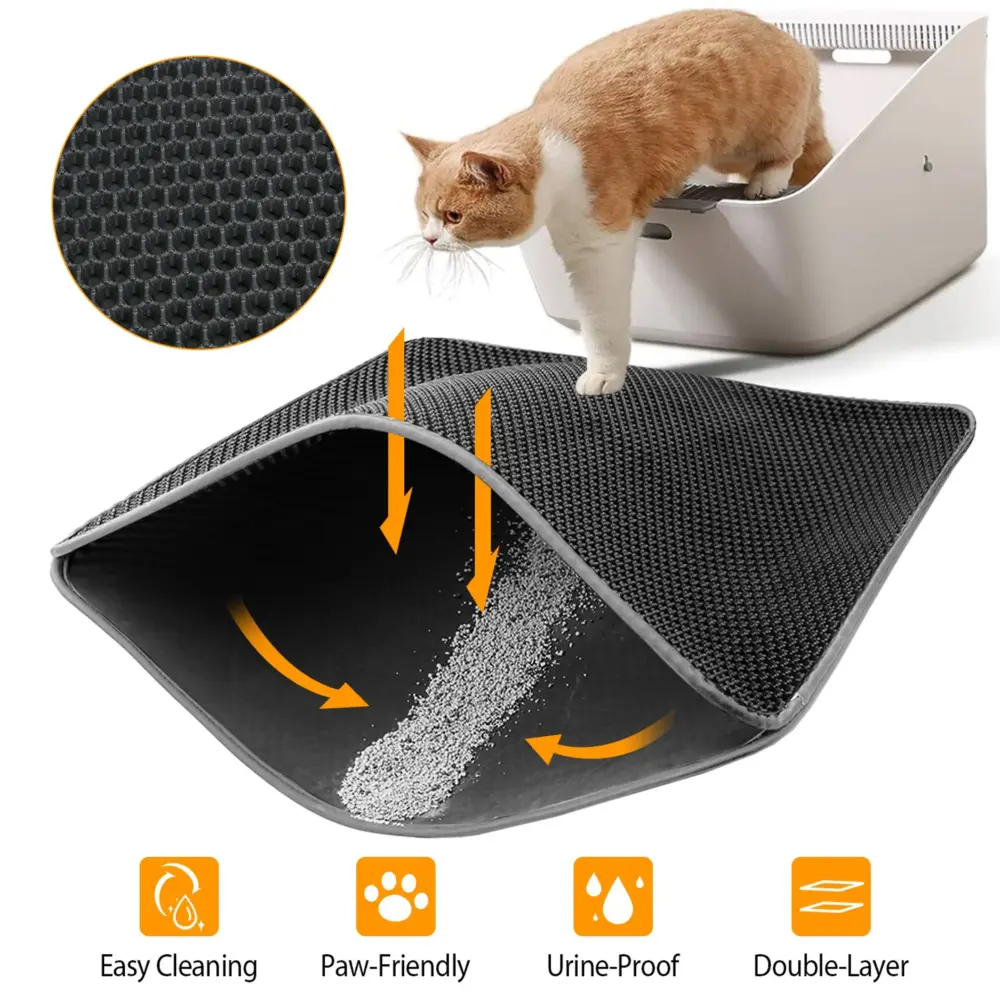
- A trapping mat at the box exit, so a week of stray litter doesn’t spread through an empty house
For the box and litter side of the mess, and how to empty a honeycomb mat, see our guide on how to stop cat litter tracking.
Keeping your cat’s routine going
International Cat Care’s advice on stress calls predictable behavior and daily routines a great way to minimize stress in cats. You can’t be there, but your schedule can: meals, play and quiet time at about the usual hours, in the usual places.
- A few minutes of wand-toy play before a meal at each visit, ending in a catch, if your cat will join in
- Wand and string toys put away before the sitter leaves
- The scratcher left where your cat already uses it, often beside its bed or the sofa
- Beds, hideaways and window perches left where they are now
Our guide to how long to play with a cat explains the hunt, catch and eat sequence a sitter can copy. A shy cat may not play with a stranger at all; a toy that moves on its own, run only while the sitter is there, gives it something to chase without coming close.
These four from our cat essentials support the play, resting, scratching and litter routine above. The picks are limited to Nilosi’s catalog, and anything new should go in a couple of weeks before you leave, so it’s already part of your cat’s day rather than one more change.
-
Motion-Activated Rolling Cat Toy Ball, View product
$42.95
Why it fits: Lets a shy cat play without a stranger holding the toy; the sitter sets it out during a visit, and it wakes at a touch and darts like prey.
-
GOOPAWS
4-in-1 Self-Warming Cat Cave Bed, Choose color
$40.95
Why it fits: Gives a hiding cat a spot the sitter can check first, used as a cave, sack, bed or mat, with a self-warming design that traps body heat.
-
Cat Scratcher Guy
Wooden Cat Scratcher with Reversible Insert, View product
$32.95
Why it fits: Gives your cat a scratching spot of its own while you are away; set it down weeks ahead near a favorite spot, with the included catnip.
-
Double-Layer Honeycomb Cat Litter Trapping Mat, View product
$53.95
Why it fits: Keeps each litter visit to a scoop and a pour: the mat traps litter from paws at the box exit and opens like an envelope to tip it back.




The day you leave and the day you get home
Leaving day
- Breakfast and play at the usual times, and packing behind a closed door so no cat climbs into a suitcase
- Every cat counted and seen before you lock up
- Closets, cabinets, the garage and the dryer checked, then inside doors set as the care sheet says
- Windows latched, screens checked and blind cords tied up out of reach
- Lilies out of the house, bouquets included; the FDA warns that the whole plant, pollen and vase water too, is toxic to cats
- Ribbon, string and hair ties put away
- The thermostat left at the setting your cat is used to
- The care sheet, keys and supplies left out, and a text to the sitter once you’re on your way
Coming home
- Your arrival time shared, with visits kept booked until you’re actually home
- A chat with the sitter, and their notes on food, litter and behavior read
- Room for a cat who is aloof or clingy for a day or two; let it come to you
- Your usual feeding and play times back from the first evening
- A call to your veterinarian if your cat isn’t eating normally, hides far more than usual or has litter box changes
- Anything the care sheet missed added now, so the next trip starts from a better list
Related guides
-
Checklist
Multi-Cat Household Setup: How Many Litter Boxes, Bowls and Beds
Two cats need three litter boxes, and the same one-per-cat-plus-one rule covers feeding stations, water bowls, scratchers and resting spots. See where each one goes, how to tell bonded cats from rivals, the quiet signs a home is too crowded, and a walk-through checklist.
-
Guide
Should You Get a Second Cat? How to Tell if Yours Would Welcome One
A second cat can be good company or a daily source of stress. Learn what lonely behavior often means, what makes a cat likelier to accept a newcomer, which pairings tend to work, what one more cat takes in space, money and time, and what to try first.
-
Guide
What to Get Your Cat for Christmas: Gifts for Hunters, Scratchers, Nappers and Snackers
Choose a Christmas gift by instinct: a chase toy for the hunter, a floor scratcher for the rug clawer, a warm cave bed for the napper and a lick mat for the fast eater. Plus safe unwrapping, gifts for cat owners and what to skip in a home with cats.