Car Travel How-to
Traveling With Two Dogs in the Car: Seats, Tethers, Loading and Stops
Short answer
Give each dog an outer back seat, middle seat empty, and its own tether clipped to the back of its harness, short enough that neither can reach the other. Pair them once each rides calmly alone; keep chews and food off the seat. At stops, take both dogs out, one door at a time, leash on before tether off.
Planning who sits where
The default layout for traveling with two dogs in the car is one dog on each outer seat of the back bench, with the empty middle seat as a buffer. Each dog gets a window and a patch of seat of its own, and neither has to lie on or step over the other. Neither rides up front, where the passenger airbag deploys.
With a window on both sides, the real decision is which dog sits where:
- The curb-side seat, behind the front passenger, goes to the dog you most need to control at the door: the one who bolts the moment it opens, or an older, stiff dog who needs a lift. The other dog uses the street-side door, which is fine in a driveway or a quiet parking space but needs care at a roadside stop.
- Size decides whether the layout works at all. Each dog should be able to lie down on its own seat without meeting the other. Tethers won’t keep apart two large dogs who can’t both stretch out without touching. A crate secured in an SUV’s cargo area for one of them, or two cars, may suit them better; if both ride in crates, give each dog its own rather than squeezing two into one. We don’t sell crates.
- Temperament sets the tether length. If one dog is the pushy one at home, crowding the other off beds or hovering over its toys, expect the same in the car and give that dog the shorter tether.
- Lock the rear windows and keep them closed or open no more than a crack. Two dogs means two sets of paws near the switches.
Two tethers in one back seat
What you need, for each dog:
- A harness that fits, with a ring on the back between the shoulder blades. Size each dog separately.
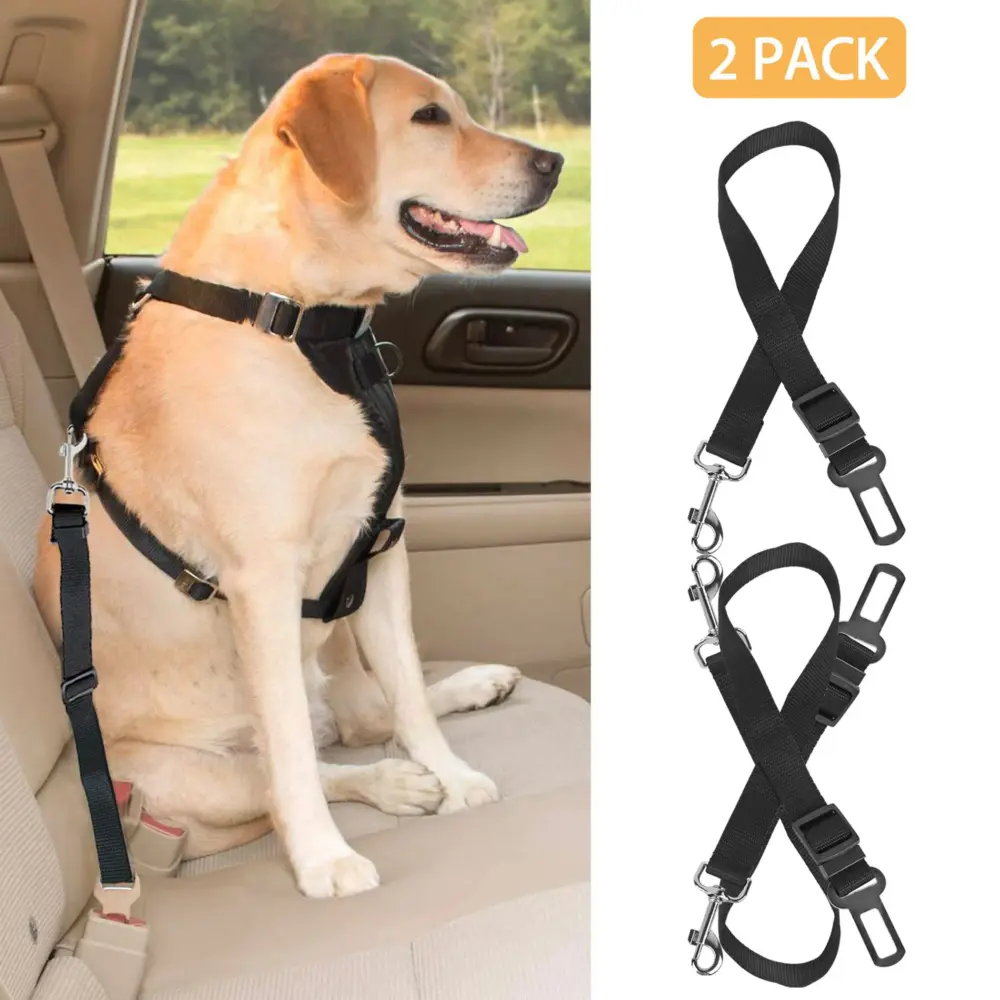
- A seat belt tether of its own. Never clip two dogs to one tether.
- A leash in the door pocket on that dog’s side, so it’s in your hand before the door opens.
Then set up the two tethers together:
- Use each seat’s own buckle. Plug each tether into the buckle for the seat that dog sits on, and leave the middle buckle empty. Check that each tab clicks in, holds when you tug and releases normally.
- Clip to the back ring of the harness, never a collar, and not a harness that connects to the collar, as some no-pull designs do.
- Set each length on its own. With one dog on its seat, shorten the tether until it can sit, stand, turn and lie down, and no more. Our guide to choosing and setting up a dog seat belt or booster seat walks through the single-dog fit check.
- Run the two-dog reach test. With both dogs tethered, hold a treat over the middle seat. Neither nose should get past the middle of it, and when both dogs stand and lean toward each other there should still be a clear gap. Test them lying down too: a dog stretched out reaches farther than one sitting up.
- Check the front and the windows. Neither nose should get past the front seat backs, into the gap between them or out a window.
- Recheck at every stop for a tether wrapped around a leg, a twisted harness or one tether lying under the other dog.
Why lengths that suit one dog are often too long with two: in many cars, each outer seat’s buckle sits on that seat’s inner edge, close to the middle. The two anchor points are much closer together than the dogs are, so two generous tethers can let both dogs meet in the middle of the bench, and that is also where tethers cross and tangle. If you find them wrapped, pull over somewhere safe and, with the doors shut, unclip one dog at the harness end, untangle and clip back on.
Tip
If your two sleep curled up together at home, it’s tempting to give them enough slack to do the same in the car. Resist it: tethers long enough for the dogs to reach each other are long enough to cross, wrap a leg or turn a shared nap into an argument over space.
A small dog and a big dog: booster plus tether
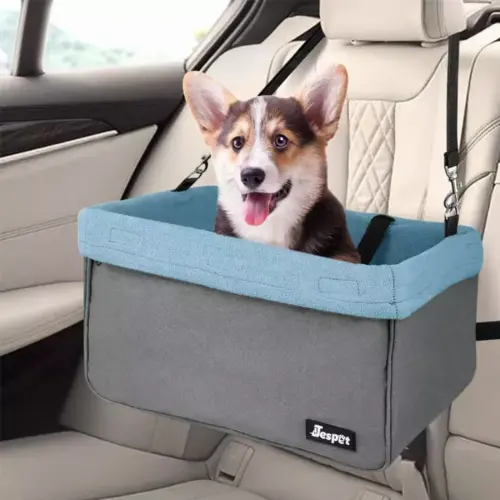
Spacing matters most when the dogs are very different sizes: a big dog who leans over or steps on a small one can frighten or hurt it without meaning to. A booster gives the small dog a raised spot of its own, and its built-in tether keeps it there.
- Check the fit, not just the scale. Ours holds pets up to 24 lb, and its 16 by 13 inch seat is all the room the small dog gets. A dog over the limit, or one who likes to sprawl, rides on a tether like the big dog.
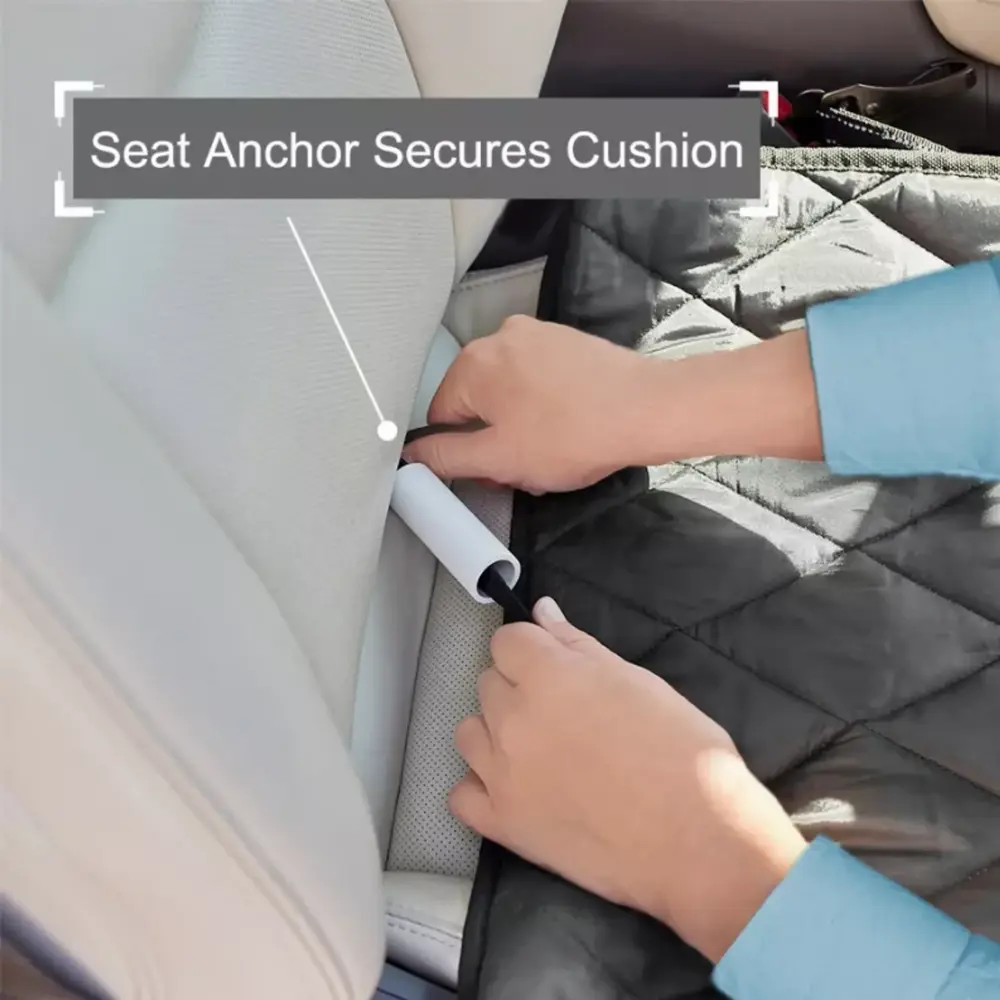
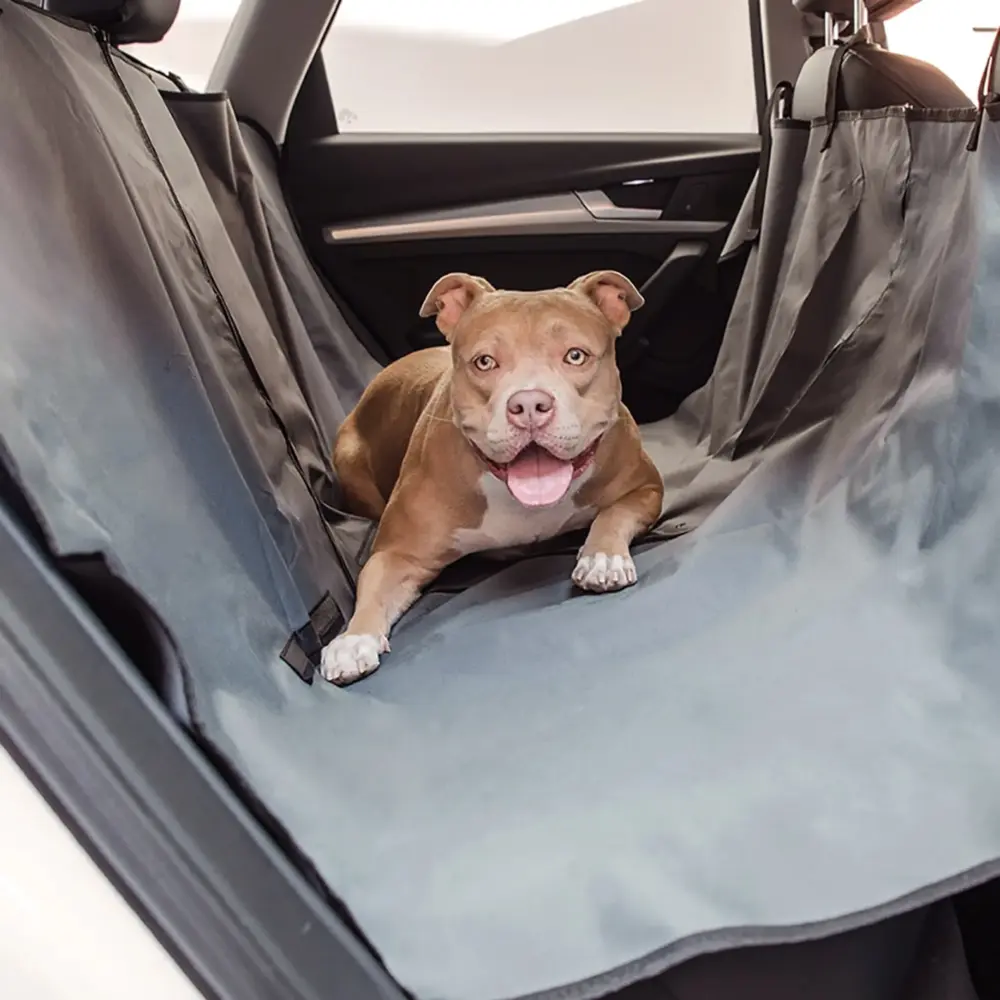
- Strap the booster straight onto an outer seat with a headrest, as in the booster steps of the seat belt and booster guide above, not on top of a slippery cover. The hammock’s detachable zipper lets you adapt it to one seat, so the big dog’s side can stay covered.
- Clip the built-in tether to the back of the small dog’s harness and check that it keeps the dog seated: its front paws shouldn’t get over the rim, and it shouldn’t be able to scramble out toward the other dog.
- Set the big dog’s tether by the booster. Standing and leaning that way, its nose should stop short of the rim.
- Give the big dog the curb-side door unless an older dog needs it. The small dog is in your arms at the street-side door anyway, while the big dog gets in and out on its own legs.
A toy-size dog in a carrier instead? The floor-level carrier layout in our guide to traveling with a dog and a cat in the car works the same way, and covers the rest if a cat is coming too.
Our picks for this layout, limited to Nilosi’s own travel and car accessories:
-
Adjustable Dog Car Seat Belt Tether, View product
$23.95
Why it fits: Two tethers in one pack, one for each seat's own buckle; shorten each until the dogs can't reach each other. Clip to a harness, never a collar. Fits most, not all, seat belts.
-
GOOPAWS
Dog Booster Car Seat with Safety Tether, Choose color
$53.95
Why it fits: For the smaller dog of the pair: a raised seat whose built-in tether clips to a harness. Holds pets up to 24 lb and the seat is 16 x 13 in, so check your small dog fits it.
-
GF PET
Waterproof Dog Car Hammock Seat Cover, View product
$60.95
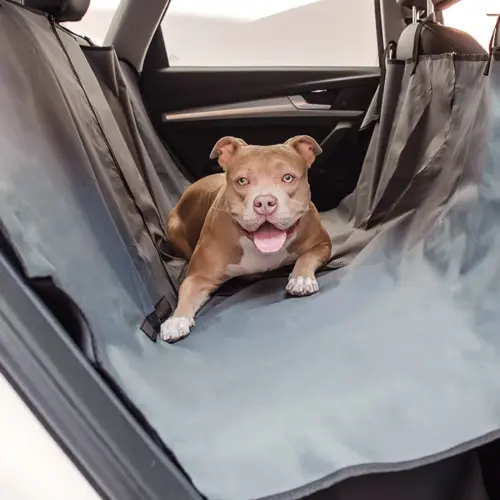
Why it fits: One waterproof cover for both dogs: rear bench, backrests and the backs of the front seats, with seat-belt openings that keep the buckles free. 58 x 57 in; a cover, not a restraint.

If one dog is anxious or won’t settle
In a shared back seat, one dog’s pacing, whining or panting is hard for the other to ignore, so work on each dog alone before you pair them.
- Each dog rides calmly alone first. If one dislikes the car, start with short sessions in the parked car; our guide to getting a dog used to car rides takes it one step at a time.
- Then pair them on short drives around the neighborhood, ending at home. Some nervous dogs ride better beside a calm companion and others worse; a few drives will tell you which pair you have.
- Settle both before you leave with a walk and a potty break, and put a familiar blanket on each dog’s seat.
- Rewards come from a passenger, one dog at a time, handed to each dog on its own side, never tossed onto the seat between them. If you’re driving, the training waits.
- Drooling, vomiting or panting that doesn’t ease is a question for your veterinarian well before the trip. On the road, clean up at the next safe stop, before the other dog investigates.
Loading and unloading in order
VCA’s road trip advice is to get a leash or harness on your dog before any door opens. With two dogs, that becomes one rule: no dog ever goes from tethered to free. The leash goes on before the tether comes off, the tether goes on before the leash comes off, and each door closes before the next one opens.
Choose the order by temperament. The dog who goes in second waits beside you on its leash while you deal with the first, so the dog who waits better goes in last and comes out first.
Leaving home
- Harness and leash both dogs indoors, then walk them out together.
- Load the eager dog first, through its own door: in, tether clipped, leash off and into the door pocket, door closed. Your patient dog waits beside you on a short leash.
- Load the patient dog through the other door the same way. If that door is on the street side, do it in the driveway, not at the curb.
- Look back before you drive: each dog on its own seat, no tether under a leg or across the other dog, rear windows locked.
Getting out
- Park in a quiet spot away from moving traffic, ideally with open space beside the street-side door.
- Patient dog first. Open its door partway and block the gap with your body. Leash on, tether off, dog out, door closed.
- With that leash short in one hand, go to the other door and repeat.
- With a helper, each person takes one dog, but the second door still stays shut until the first dog is out and its door is closed.
Safety note
Never unclip a tether before that dog’s leash is in your hand, and never open both rear doors at once. Two loose dogs in an unfamiliar parking lot can run in two directions, and you can only chase one.
Rest stops with two leashes
Plan a break every couple of hours, paced by whichever dog needs to go more often; puppies and older dogs often need stops sooner, and our guide to traveling with a senior dog in the car covers what an older dog needs. Both dogs come out every time: VCA warns never to leave a dog alone in the car, since the inside can get dangerously hot very quickly, and a second dog in the back doesn’t change that. Driving solo and need the restroom? Our road trip with a dog checklist covers taking turns, drive-throughs and paying at the pump.
At the stop:
- Head for the quiet edge of the pet area. A strange dog is harder to handle with a leash in each hand, and one dog’s reaction can set off the other.
- One leash in each hand, short across the parking lot and looser on the grass. Untangle crossed leashes by moving yourself, never by letting go of one.
- A patch each. Let each dog sniff and go a few feet from the other, and bag both before you move on.
- Water one dog at a time, a few feet apart, and skip a shared bowl if either dog guards food or water.
- Wipe paws, then reload in the leaving-home order: eager dog first, patient dog last.
Two small things from our catalog make a two-leash stop easier:
-
Yucky Puppy
Waterproof Poop Bag Holder, Choose size
Price range: $23.95 through $24.95
Why it fits: Two zippered, waterproof pouches in the set, one clipped to each leash, so both full bags ride sealed to the next bin and your hands stay free for the leashes.
-
Flipo
Fold-A-Bowl Dog Water Bottle with Fold-Out Bowl, Choose color
$28.95
Why it fits: Holds 26 oz and its cover folds out into a bowl, so you can water one dog, then the other; the wrist strap keeps the bottle on your wrist while you hold the leashes.


When the dogs squabble
Most back-seat squabbles come from one of four things:
- Crowding. One dog’s head, paws or body ends up in the other’s space.
- Something to guard. The ASPCA’s guide to dog aggression lists food, chews, toys, water bowls and favorite resting spots among the things dogs guard, and in a car the better seat can be one of them.
- Excitement with nowhere to go. The same guide gives the example of two dogs barking at someone through a fence, where one may turn on the other. Two tethered dogs barking at a passing dog are in much the same spot.
- Feeling unwell. A carsick or sore dog may snap at a companion it usually tolerates.
The fixes follow the causes:
- Shorten the tethers until the reach test passes again, so a stare-down can’t turn into contact.
- Clear the back seat of chews, toys and food, and give each dog one blanket on its own seat.
- Manage the view if the trouble starts with barking. Our guide to stopping a dog barking in the car covers seat position, a quiet cue taught in the parked car and two dogs who set each other off.
- Don’t reach back while you’re driving. The ASPCA notes that people who grab or push fighting dogs are often bitten. Pull over as soon as it’s safe and keep your hands away from both heads; once the dogs have broken apart, leash one, unclip it and walk it away.
- If it keeps happening, add distance: a secured crate for one dog, two cars, or a sitter at home. If a dog who used to ride peacefully starts snapping, the ASPCA advises a veterinary check before anything else, to rule out a medical cause, then help from a veterinary behaviorist or certified professional dog trainer whose plan rewards good behavior rather than relying on force.
Safety note
Tethers, a booster and a hammock keep two dogs in their own spaces and away from the driver. None of them, including the ones we sell, is crash protection. If crash performance matters most to you, look for a crate or car harness with independent crash-test certification.
Related guides
-
Guide
How to Travel With a Dog in a Pickup Truck: In the Cab, Not the Bed
Your dog rides in the cab, never the open bed. See where a dog sits in a crew, extended or regular cab, how to tether and cover truck seats, how to get in and out of a tall cab, and why a parked truck is no place to wait.
-
Checklist
Traveling With a Senior Dog in the Car: A Checklist for Easier Rides
A car-trip checklist for an older dog: what to ask your veterinarian before a long drive, how to help a stiff dog in and out without a jump, a padded, secured spot in the back seat, hot and cold cars, more frequent stops, and the medications and records to keep in the cabin.
-
Checklist
Taking Your Dog to the Beach: Checklist for Sand, Salt Water and Heat
A beach-day checklist for dog owners: the rules to check before you go, water so your dog doesn't drink the ocean, hot sand and heat, waves and rip currents, and a fresh-water rinse before a covered ride home.