Walking & Training Buying guide
Reflective Gear for Walking a Dog at Night: What Drivers Actually See
Short answer
Reflective material returns light from headlights and does nothing without them, so it is useless to a cyclist with no lamp or a driver who has not reached you yet. Light-emitting gear is visible from any angle at any time. Use both, put the reflective elements on the leash and on yourself rather than only on the dog, and remember that a driver at thirty miles an hour needs to see you from well over a hundred feet to stop comfortably.
Our picks at a glance
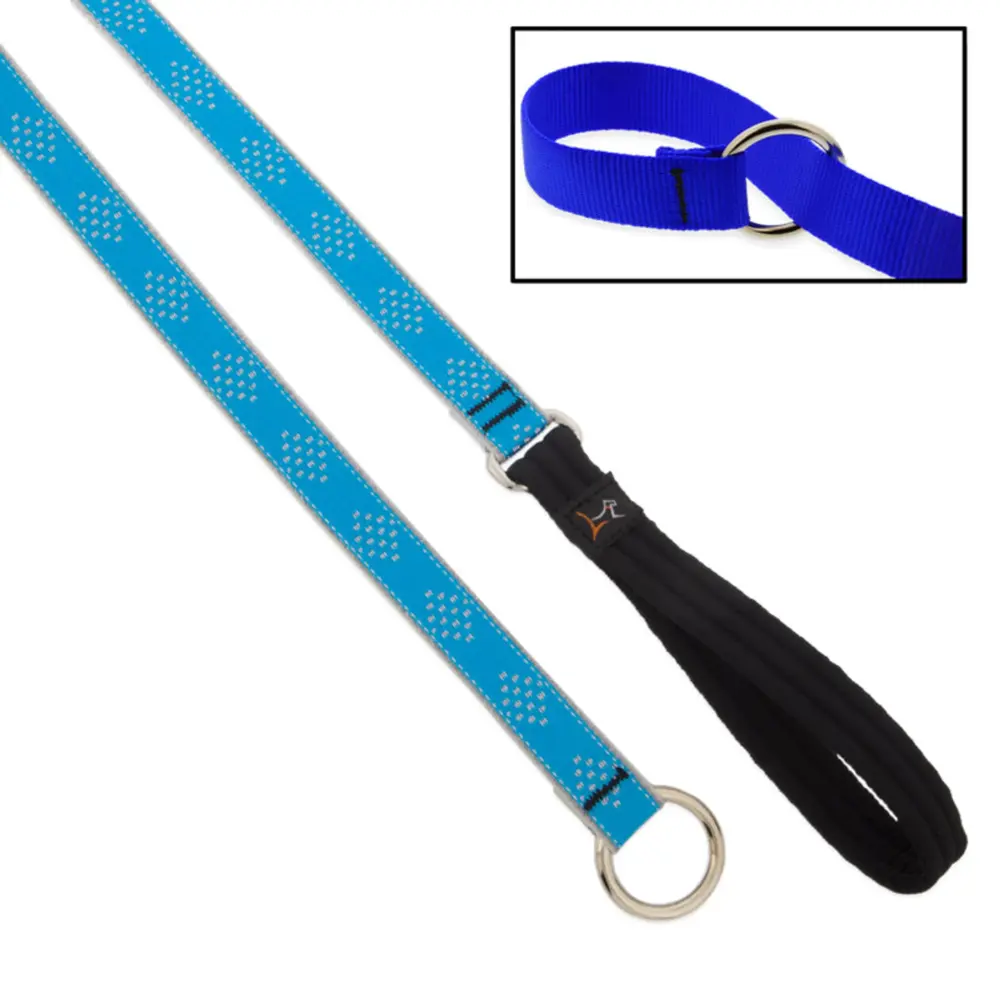
- Lupine Reflective Slip LeadA slip lead with the reflective pattern woven into the webbing rather than glued on
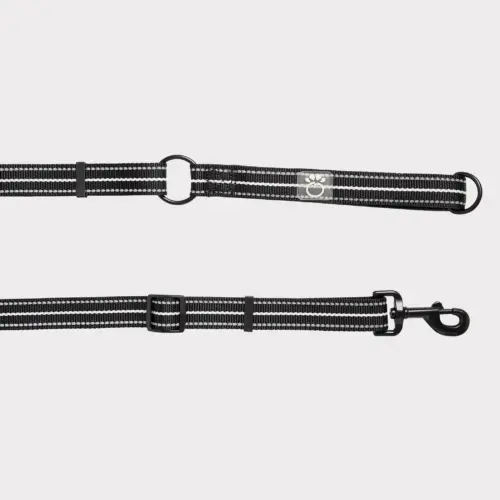
- Eezy-6 Reflective Dog LeashAn adjustable reflective leash with a padded neoprene handle
- Reflective No-Pull Dog HarnessA front-clip harness with reflective threads woven through the design
- Reflective Dog CollarAn everyday flat collar with reflective threads woven through the pattern
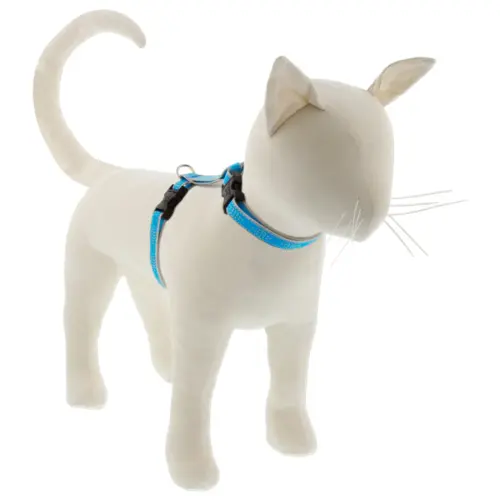
- Reflective H-Style Cat HarnessA lightweight H-style cat harness with a reflective weave and quick-release buckles
Reflective is not the same as lit
This distinction decides everything else. Retroreflective material bounces light straight back toward its source, which is why it lights up brilliantly in headlights and is invisible from any other angle.
That makes it excellent for the specific case of a car approaching head-on with its lights on, and worthless for a cyclist running without a lamp, a car turning out of a side road whose lights are pointed elsewhere, or anyone looking at you across a dark park.
A light-emitting item, such as a clip-on LED or an illuminated collar, produces its own light. It is visible from every angle, in fog, and before any headlight reaches you. The sensible setup is both: reflective for the headlight case, a light for everything else.
| Reflective | Light-emitting | |
|---|---|---|
| Works without a light source | No | Yes |
| Visible from the side | Poorly | Yes |
| Needs charging or batteries | No | Yes |
| Works in rain | Much less well | Yes |
| Survives washing | Woven designs do | Usually must be removed |
| Cost | Built into gear | A separate item |
How far away a driver needs to see you
Stopping distance is the number that matters and it is longer than most people assume. At thirty miles an hour a car needs roughly seventy-five feet of braking distance plus the driver’s reaction distance, which puts the total somewhere around a hundred and twenty feet in good conditions. Wet roads extend that considerably.
Dipped headlights illuminate much less of the road ahead than most drivers realise. The practical conclusion is that one small reflective patch is not enough: you want several, spread out, and ideally moving.
Movement is the most powerful signal there is. Reflective material on legs and ankles, moving up and down, registers as a person far faster than a static patch on a jacket, which is why reflective ankle bands outperform much larger reflective panels.
Where reflectivity belongs on a dog
A reflective collar is the most commonly bought item and the least useful, because a collar is a narrow band sitting below the car’s light beam, often under fur, and frequently facing the wrong way.
- The harness is better than the collar: more area, higher on the body, and it faces outward on both sides.
- The leash is the single most useful reflective item, because it spans the gap between you and the dog and shows a driver that there is a person attached.
- A coat with reflective piping covers the largest area, particularly along the top of the back.
- A collar is worth having reflective but should never be the only thing.
- Avoid relying on a tag or a small charm. The area is too small to register at distance.
Woven reflective threads, where the pattern itself is reflective rather than a strip stitched on top, keep working after the washing that eventually peels a glued-on strip off. It is worth looking for specifically.
The leash is the most useful reflective item
A reflective leash does something nothing else does: it shows the connection. A driver who sees two separate glints does not necessarily understand what they are looking at. A driver who sees a line between them understands immediately that there is a dog and a person and that neither is going to move independently of the other.
It also sits at roughly waist height, which is squarely in the headlight beam, and it moves as you walk. If you buy one reflective item, buy this one.
An adjustable leash is worth considering for dark walks for a separate reason: being able to shorten it in traffic and let it out on a quiet path means your dog is not permanently on a tight lead. How to hold a dog leash covers the handling.
You are the harder one to see
This is the part that gets reversed. People put a reflective harness, a collar and a light on the dog, then walk in a black coat. The dog is low, often dark, and frequently on the verge; the person is tall, in the road at crossings, and wearing nothing visible.
A reflective band on each ankle and one on the wrist of the hand holding the lead costs very little and does more for your safety than anything on the dog. A high-visibility vest is better again, and a head torch serves two purposes: it lets you see what your dog is eating off the ground, and it makes you unmistakably a person.
- Reflective bands on both ankles, which move and read as a person
- Something reflective on the arm holding the leash
- A reflective or lit leash spanning you and the dog
- A light on the dog’s harness, visible from behind as well as in front
- A torch or head torch, for seeing as well as being seen
- Walk facing oncoming traffic where there is no pavement
- Keep the dog on the side away from the road
Cats on a harness after dark
The same logic applies with less margin. A cat on a harness is very low to the ground, usually dark, and much harder for a driver to see than a dog. A reflective harness helps, and the honest answer is that harness walks after dark in any area with traffic are not a good idea.
If you do walk a cat in low light, keep to enclosed gardens and quiet paths, and use a reflective harness and a reflective lead so that cyclists and pedestrians can see the setup. Harness training a cat covers the groundwork.
What stops working when it rains
Wet reflective material loses a large part of its effectiveness, because a film of water on the surface scatters the light instead of returning it. The same walk that is comfortably visible on a dry night is markedly less so in rain, exactly when stopping distances are longest.
Rain also means drivers have less visibility through the windscreen, headlights reflect off the wet road surface, and everyone is in more of a hurry. The correct response is to add a light rather than to rely on reflectivity alone, and to be more conservative about where you walk.
Fog is worse still, because reflective material needs a direct line from the headlight and fog scatters it. In fog, a light is the only thing that genuinely works. Walking a dog in the rain covers the rest of the wet-weather kit.
Our picks
-
Lupine Pet
Lupine Reflective Slip Lead, Choose size & design
Price range: $33.95 through $35.95
Why it fits: A slip lead with the reflective pattern woven into the webbing rather than glued on, and a padded handle. Collar and lead in one for a quick dark walk.
-
GF PET
Eezy-6 Reflective Dog Leash, Choose size & color
Price range: $27.95 through $32.95
Why it fits: An adjustable reflective leash with a padded neoprene handle, which shortens in traffic and lets out on a quiet path.
-
Lupine Pet
Reflective No-Pull Dog Harness, Choose size & design
Price range: $41.95 through $45.95
Why it fits: A front-clip harness with reflective threads woven through the design, giving a large reflective area high on the body where headlights catch it.
-
Lupine Pet
Reflective Dog Collar, Choose size & design
Price range: $22.95 through $28.95
Why it fits: An everyday flat collar with reflective threads woven through the pattern, so the shine does not wear off in the wash.
-
Lupine Pet
Reflective H-Style Cat Harness, Choose size & design
$28.95
Why it fits: A lightweight H-style cat harness with a reflective weave and quick-release buckles, in two size ranges.


A setup you can put on in ten seconds
Kit that takes effort does not get used on a wet Tuesday in November. Build a setup that lives together by the door and goes on without thought.
- Keep the reflective harness and lead as the default pair, not a special-occasion set.
- Clip a small light to the harness permanently and charge it on a fixed day each week.
- Keep two ankle bands on the same hook as the lead, so picking one up means picking up all of it.
- Keep a head torch there too, with the batteries checked when the clocks change.
- Put a spare light in a coat pocket, since the main one will be flat exactly once.
- Check the reflective surfaces monthly; a dirty reflective strip returns far less light.
For the rest of the kit that lives on that hook, see dog walking essentials and what to look for in a poop bag holder.
Common questions
Is a reflective collar enough on its own?
No. It is small, low, often hidden by fur and frequently facing away from the road. Treat it as one element of a setup rather than the setup.
What colour is most visible at night?
At night, colour matters far less than reflectivity and light. In daylight and dusk, fluorescent yellow and orange stand out best; neither does anything in full dark, which is a common misunderstanding about high-visibility clothing.
Do LED collars bother dogs?
Most dogs ignore them. Choose one that does not flash directly into the dog’s eyes, check it is not heavy enough to pull the collar round, and introduce it indoors first like any new piece of kit.
Related guides
-
Comparison
Slip Lead vs Standard Leash: When Each One Belongs
A slip lead is a collar and lead in one piece that tightens when a dog pulls. That makes it excellent for handling and a poor everyday choice for a dog who pulls constantly. This comparison covers both sides honestly.
-
Comparison
BioThane vs Nylon Leashes: Which Holds Up Better
Coated webbing and traditional nylon behave completely differently once they get wet. This comparison covers how BioThane is made, where it genuinely wins, and the situations where nylon remains the sensible choice.
-
Guide
How to Measure a Dog for a Harness, Collar or Coat
Three soft-tape measurements (chest girth, neck and back length) are all you need to choose a harness, collar or coat size. This guide also covers the two-finger fit check and what to do when your dog is between sizes.