Walking & Training Buying guide
How to Choose a Dog Collar: Type, Width, Hardware and the ID Tag
Short answer
Most dogs need a flat collar with two fingers’ room underneath; save martingales for dogs who slip collars, and skip choke and prong types. Go about 1/2 inch wide for toy dogs and young puppies, 3/4 inch for small to medium dogs, 1 inch for larger ones. The ID tag needs your cell number, then a backup.
Our picks at a glance
- Reflective Dog CollarOur one collar is flat and everyday
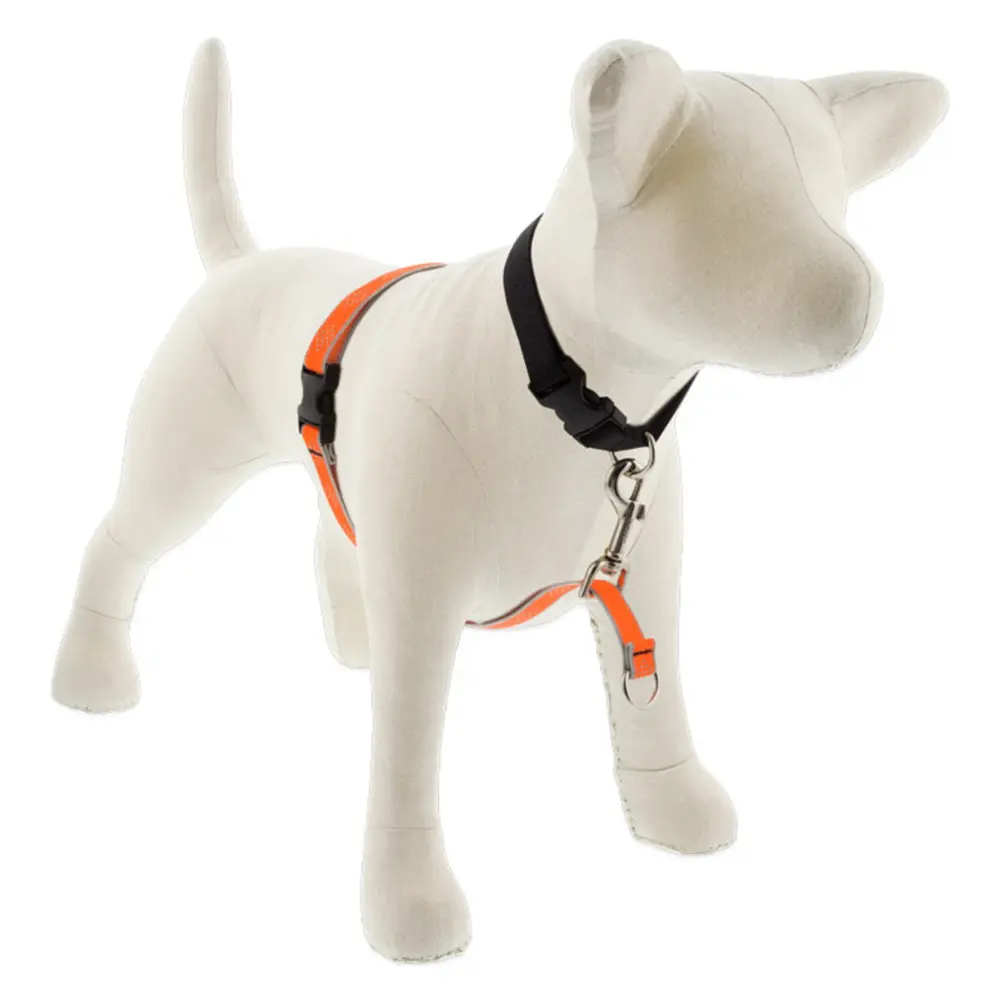
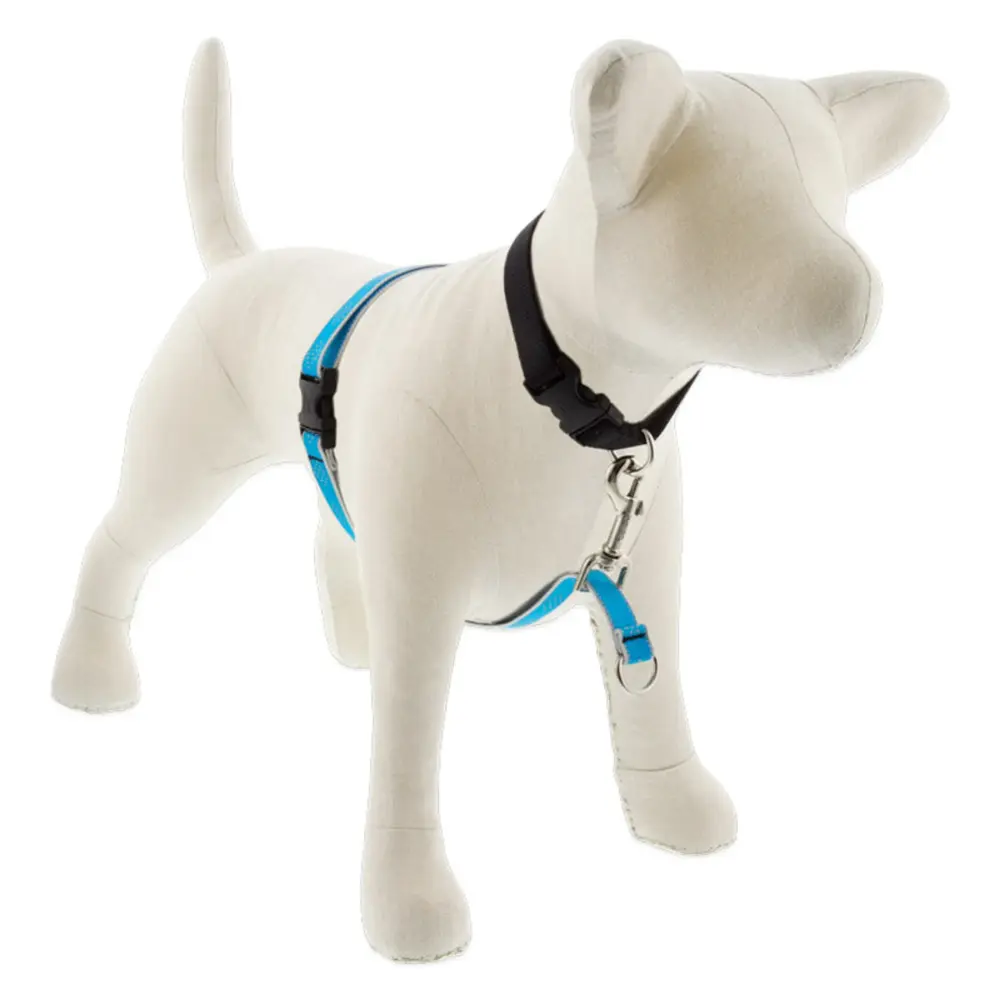
- Reflective No-Pull Dog HarnessA front-clip harness for a dog who pulls
Collar types and what each one is for
Most dogs need one collar: a flat one that carries ID and takes a leash on calm walks. The other types solve specific problems, and two are best left on the shelf.
| Type | How it works | Suits | Watch for |
|---|---|---|---|
| Flat | Stays one size once fastened | Most dogs, every day | Can slip over a narrow head |
| Martingale | Tightens a set amount on a pull | Dogs who back out of collars | Take off when unsupervised |
| Breakaway | Comes apart if it snags | Dogs at risk of snagging | May release on a leash |
| GPS or smart | Adds a tracker or sensor | Dogs who bolt or roam | Charging, weight, fees |
| Choke or prong | Pressure when the dog pulls | Not recommended | Injury, fear, anxiety |
Flat collars: the everyday default
A flat collar stays the same size once it’s fastened, so it never tightens on the neck. It closes with either a belt-style buckle, which sets the size by its holes, or a side-release clip, which adjusts with a slider and opens with a squeeze. The AKC’s guide to finding and choosing the right dog collar calls it the most widely available type and the one that holds a name tag. Its limit is the dog’s shape: a collar loose enough to be comfortable can slide over a head no wider than the neck.
Martingale collars: for dogs who back out
A martingale has two loops. The larger one sits around the neck; when the leash pulls on the smaller one, the larger loop tightens by a limited amount, enough to stop the collar slipping over the head. The AKC says that slight tightening discourages pulling without obstructing the airway. It suits dogs whose heads are no wider than their necks, sighthounds such as Greyhounds and Whippets being the classic case, and any dog who has already slipped a flat collar. Fit it so the two rings of the smaller loop don’t meet when it’s pulled tight; if they touch, the collar can’t tighten enough to hold.
Because it tightens, a martingale is a walking collar. Tags on it come off with it after the walk, so between walks the ID needs another home, usually a flat collar.
Breakaway collars: when snagging is the worry
A breakaway collar has a connector that comes apart under enough force, so a dog caught on a crate wire, a fence or another dog’s jaw during play can pull free. The catch is that it can also release on a leash, so some designs have two rings to clip the leash through together, and many owners clip the leash to a harness instead.
Safety note
Any collar can catch on something. The AKC’s article on collar dangers names three situations to weigh: time in a crate with a collar on, wrestling with other dogs and anything in the yard a collar could hook on. Its advice when you’re unsure is to take the collar off. A collar that tightens is the hardest to free from a snag, so a martingale comes off whenever your dog is off leash or unsupervised.
Whether a collar should stay on at home and overnight is its own question; our guide to whether a dog can wear a harness all the time covers what comes off indoors and what stays on.
GPS and smart collars
A location tracker or activity sensor on the collar can help you find a dog who bolts, but it needs charging, adds weight that matters on a small dog, and some only work with a paid plan. It backs up the ID tag rather than replacing it: a neighbor who finds your dog reads the tag, not your app.
Collars we’d skip: choke chains and prong collars
Both work by making pulling uncomfortable. VCA Animal Hospitals’ article on training collars and harnesses warns that choke collars can cause tracheal damage and that choke, pinch and prong collars can make a dog more fearful or anxious. If pulling is the reason you’re shopping, the fix is usually a harness rather than a different collar; our dog harness vs collar comparison covers where the pressure goes and when to use both.
Choosing a collar material
- Nylon webbing: light, inexpensive, washable and made in every width. The AKC suggests nylon for puppies because it’s inexpensive, which helps when a puppy outgrows a few collars in a row. Look for tightly woven webbing with smooth, sealed edges.
- Leather: durable, the AKC says, but it needs regular care. Most leather collars close with a belt-style buckle.
- Neoprene and padded linings: a softer layer against the neck. The AKC notes that neoprene resists dirt and suits dogs whose hair mats.
- Coated webbing: sealed in a smooth plastic coating that wipes clean and doesn’t soak up water, a practical choice for a dog who swims.
Whatever the material, skip studs, bows and dangling charms on an everyday collar; the AKC warns that decorations can irritate the skin or snag during play. It also suggests washing the collar whenever your dog has a bath, so dirt and oil aren’t held against the skin.
Collar width by dog size
Width is mostly a matter of scale. A narrow collar keeps weight off a small neck; a wider one spreads a pull over more of a big dog’s neck. As a starting point:
| Width | Usually suits | Why |
|---|---|---|
| 1/2 inch | Toy dogs, young puppies | Light on a small neck |
| 3/4 inch | Small to medium dogs | Balances weight and strength |
| 1 inch | Medium to large dogs | Spreads a pull more widely |
| 1.5 to 2 inches | Giant and very strong dogs | A width we don’t carry |
These bands overlap, and build matters as much as size. A fine-boned dog with a 14-inch neck may be more comfortable in 1/2 or 3/4 inch, while a stocky, strong dog with the same measurement suits 1 inch. Going wider won’t stop a dog from pulling, though; that’s a job for training and, often, a harness.
Sizing: reading overlapping size ranges
Measure the neck where the collar will actually ride, then pick a size range that includes that number. Our guide to measuring a dog for a harness, collar or coat shows where the tape goes and how to do the two-finger check once the collar arrives.
Adjustable collars come in overlapping ranges, so one measurement often fits two or three sizes. Choose the one that puts your dog’s number near the middle, leaving room to loosen or tighten. Take a 15-inch neck and the ranges we stock: 10–16 would sit near its loosest setting and 15–25 at its tightest, while 12–20 or 13–22 leave room both ways. Check that the range you want is offered in the width you’ve chosen.
For a growing puppy, flip the logic: choose a range where today’s measurement sits in the lower half, as long as the collar tightens enough to pass the two-finger check now, and check the fit weekly.
Tip
Order by the neck measurement, not by breed or weight. Two dogs of the same weight can have very different necks, and a thick coat or a fresh haircut changes the number too.
What to check on the hardware
- Buckle or clip: a belt-style buckle holds a size set by its holes; a side-release clip adjusts in finer steps with a slider and comes off in a second, handy at bath time. It isn’t a breakaway, though: it’s built to stay shut under a pull.
- The slider and the tail: after the first few walks, check that the slider hasn’t crept and that the loose end is tucked into its keeper, where it can’t flap or catch.
- The D-ring: metal, fully closed, and roomy enough that the leash snap doesn’t bind. The AKC’s collar guide favors a D-ring over a round O-ring for handler control. If tags and leash share the ring, check that no tag is caught in the leash snap.
- Reflective weave: threads woven into the webbing are part of the strap; printed or sewn-on trim sits on top and is worth checking after a few washes. Either kind reflects headlights rather than glowing, and a collar is a small target, so clip on a light as well after dark. The rest of an evening walk kit is in our list of dog walking essentials.
What goes on the ID tag
A tag is the ID anyone can read on the spot, without a scanner. The AKC’s article Are ID Tags Enough? notes that most tags fit only two to four lines of text, so put the information that gets your dog home first:
- Your cell number, with the area code. The phone you carry on walks, not a landline that rings in an empty house.
- A second number: a partner, a nearby friend or your veterinarian’s office, for the times you can’t pick up.
- A medical or behavior note, if a finder needs to know it: “Needs daily meds,” “Deaf” or “Shy, don’t chase.”
- “Microchipped,” which tells a finder or a shelter to scan.
- Your dog’s name and your city or town, if there’s room and you want them there.
Name or no name?
The AKC includes your dog’s name among the things to consider. Some owners leave it off so a stranger can’t call the dog by name; others want a finder to be able to. Either choice is reasonable, as long as the name never pushes a phone number off the tag.
What to leave off
- An old number. Update the tag the day you change phones or move.
- Long sentences that shrink the engraving until it can’t be read.
- Anything you’d rather a stranger didn’t know, such as your full home address; a phone number does the job.
Tag styles, license tags and a quieter collar
Hanging tags jingle and can catch; a rubber silencer or a tag pouch quiets them. Slide-on tags and riveted plates sit flat on the collar, so buy them to match its width, and the AKC also mentions collars with your contact details embroidered on. Many cities and counties require a dog license, usually with a tag to wear, and vets commonly hand out a rabies tag at vaccination; check your local rules. We don’t sell tags, so this part needs an engraver or tag maker.
The tag and the microchip work together
A microchip can’t fall off, but nobody can read it without a scanner, and it’s only as useful as the contact details you’ve registered with it. A tag works the moment a neighbor picks up your dog. The AKC’s point is that collars come off and tags break, so the chip is a permanent backup to the tag, not a substitute for it. If the worst happens, what to do if your dog or cat is lost covers the first hour and who to call.
The collar we carry
We stock a single collar line in walking and training, so these picks come from Nilosi’s own catalog, not a survey of every collar on the market.
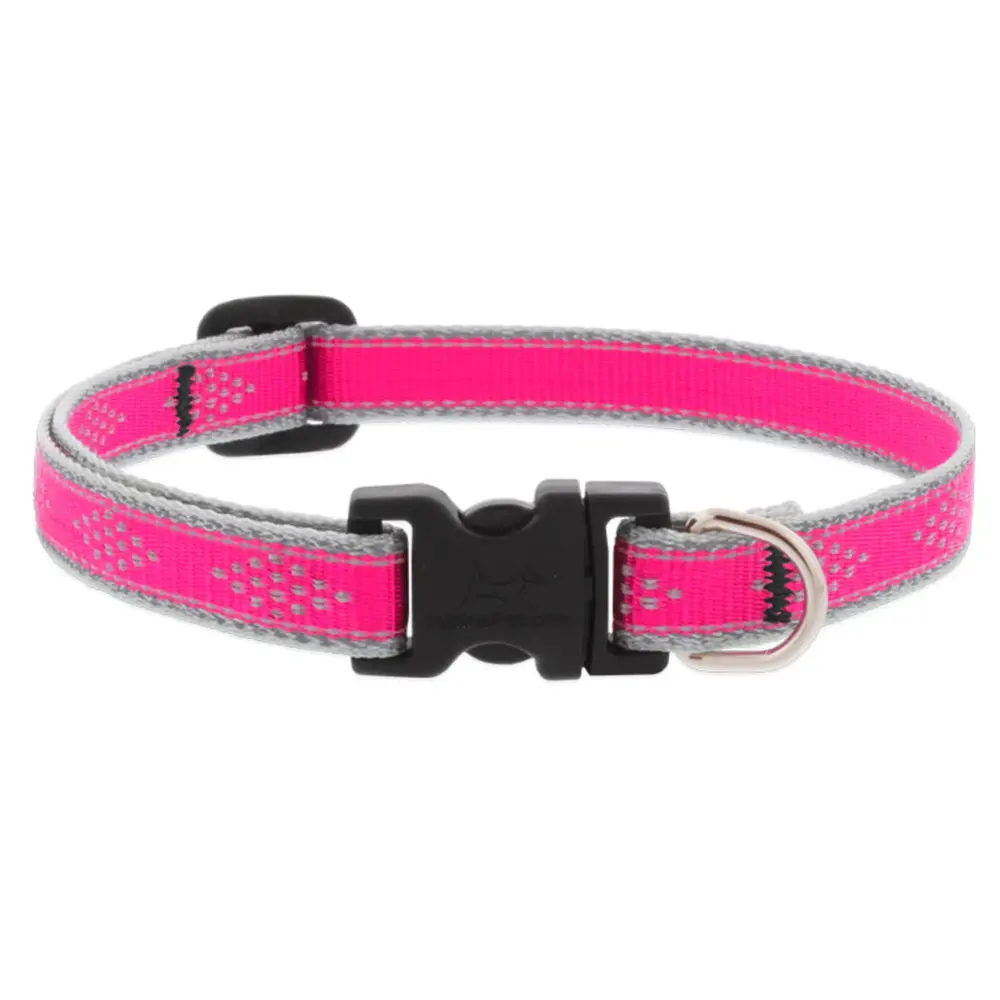
The Lupine Pet Reflective Dog Collar is an everyday flat collar with reflective threads woven into the pattern rather than printed on top, and a strong D-ring for the leash and ID tags. Its listing names 3/4- and 1-inch widths, and the width options also include 1/2 inch. The adjustable sizes run from small necks up to 25–31 inches, in six designs, so choose the width first and then a size range offered in it. It’s made in the USA; our guide to made in USA dog products lists the other items we stock that carry that claim.
Who it suits: a dog who walks calmly on a collar, or one who walks in a harness and wears this collar for ID, especially if you walk after dark. Where it falls short: it won’t hold a dog who slips flat collars, the widest option is 1 inch, and the listing doesn’t mention personalization, so the ID goes on a tag. If your dog pulls: the second pick is Lupine’s front-clip no-pull harness for medium and large dogs, which attaches to an everyday collar like this one.
-
Lupine Pet
Reflective Dog Collar, Choose size & design
Price range: $22.95 through $28.95
Why it fits: Our one collar is flat and everyday, with woven reflective threads and a D-ring for leash and tags. Pick the neck range that puts your dog near the middle.
-
Lupine Pet
Reflective No-Pull Dog Harness, Choose size & design
Price range: $41.95 through $45.95
Why it fits: A front-clip harness for a dog who pulls, which attaches to the everyday collar your dog wears. Medium and large dogs only, 16 to 38 in girth.


Take the neck measurement twice before ordering. If the size you picked turns out wrong, it counts as a change of mind, and our returns policy sets out what that means.
Related guides
-
Buying guide
Reflective Gear for Walking a Dog at Night: What Drivers Actually See
Most night-walk kit is bought for the dog, when the person is the harder one to see and the one standing in the road. This covers the difference between reflective and light-emitting gear, how far ahead a driver needs to pick you out, and where reflectivity actually belongs.
-
Buying guide
Made in USA Dog Products: Collars, Harnesses, Coats, Bowls and Wipes
Six dog items we stock carry a Made in USA claim from their maker or listing: two Lupine Pet walking pieces, a DCNY coat for small dogs, a SodaPup slow feeder and lick mat, and Mr. Peanut’s wipes. Learn what the label should mean, what it leaves out and how to check a claim yourself.
-
Buying guide
How to Choose the Right Dog Harness: Style, Strap Shape and Build
Choose a harness by how it goes on and how it's built: overhead, step-in or vest, a chest piece that leaves the shoulders free, padding where the straps press, and hardware scaled to your dog. Plus how our two dog harnesses differ.