Beds & Comfort How-to
How to Measure a Dog for a Bed: Curlers, Sprawlers and Crates
Short answer
Measure your dog in their usual sleeping position: across the widest point of the curl for a curler, nose to base of tail for a sprawler. Add a couple of inches for a curler and 6 to 8 for a big sprawler, then compare that with the sleeping area inside any rim and the space it goes in.
What you need, and when to measure
A bed is sized for a dog lying down, so the standing measurements used for gear don’t carry over. Harness sizing starts from chest girth on a dog standing square (see how to measure a dog for a harness); a bed needs the shape your dog makes asleep. Gather these first:
- A soft tape measure, or a length of string and a ruler.
- Painter’s tape or a few sticky notes to mark the floor beside a sleeping dog, so you can measure after they wake.
- A note on your phone with three labels: curl, stretch and space.
- The inside measurements of the crate, car area or floor spot where the bed will go.
- The listing’s dimensions for any bed you’re considering, including the inner size if it has a rim.
Watch two or three ordinary naps, not the collapse after a long hike. Many dogs curl up tight in a cool room and stretch out when it’s warm, and the bed has to work for both.
Step by step: measuring your dog for a bed
- Find the usual position. Note whether your dog sleeps curled in a ball, half curled, flat on their side or on their belly with legs tucked. If it varies, measure each one.
- Mark, don’t wake. While your dog sleeps, press painter’s tape on the floor at the outermost points: the tip of the nose, the back or rump, and the farthest paw.
- Take the curl width. For a curled dog, measure across the widest part of the circle, from the outside of the back to the farthest nose, paw or tail.
- Take the stretch. For a dog lying stretched out, measure nose to base of tail for length, then from the spine to the tips of the outstretched paws for width.
- Repeat and keep the largest. Measure each position twice, on different naps if you can, and keep the bigger number each time.
- Add room to move. Add a margin so your dog can circle, shift and stretch (the next two sections give a guide), and write down the sleeping area you need.
- Measure the space. Measure the inside of the crate, the car area or the floor spot, and note any height limit.
- Compare inside with inside. Match your number to the bed’s sleeping area, then check its outer size against the space.
Tip
If your dog wakes the moment you reach for the tape, measure them standing: nose to base of tail gives a rough stretched-out length. Treat it as a fallback, because a dog on their side with legs out takes up more width than a standing one.
Curlers: sizing a round or bolster bed
A curler sleeps in a ball, often with their back or chin pressed against something. Round, donut and bolster beds suit the habit because the raised rim gives them something to lean on, and the curl width is the number that matters.
Aim for a sleeping area a couple of inches wider than the curl, so your dog can circle and settle without the rim pushing them out of shape. Go much bigger and the rim ends up out of reach, and the bed loses the snug, propped-up feel that made you choose it. A chin resting on the rim is normal; hips or shoulders spilling over it mean the bed is too small.
If your curler stretches out on warm evenings, a bed sized only for the curl will leave legs over the edge: size to the stretched-out width, or keep a second, flat spot for those nights. For what a raised rim can and can’t do for a nervous dog, see do calming dog beds work.
A worked example: a 14-inch curl
A small dog whose curl measures 14 inches across has room to shift inside a 16-inch sleeping area. At 18 inches, that same 16-inch inside is too tight, even if the bed’s outer size of 22 inches looks generous on the listing; look for 20 inches or more inside, which on our cuddler means the Medium.
Sprawlers: sizing a flat bed or mat
A sprawler sleeps on their side or belly with legs out, or flat on their back. They need length and width more than a rim, so flat beds, mattresses, crate pads and mats suit them, as do beds with a bolster on only one or two sides.
Use nose to base of tail as the length and spine to paw tips as the width. Then add room to move: a few inches on every side for a small dog, and roughly 6 to 8 inches of extra length, plus a few inches of width, for a medium or large dog that sleeps fully stretched out. A tail draped over the edge is fine; a head, elbows or hips on the floor are not.
Older dogs and dogs with stiff joints may find a low, flat bed easier to step onto than a tall rim, so note the rim height as well as the footprint. Ask your veterinarian if your dog seems sore getting up or lying down.
Reading a listing: outer size vs sleeping area
Most bed listings give outside dimensions, and on a rimmed bed those include the bolster. The space your dog actually lies in can be several inches smaller.
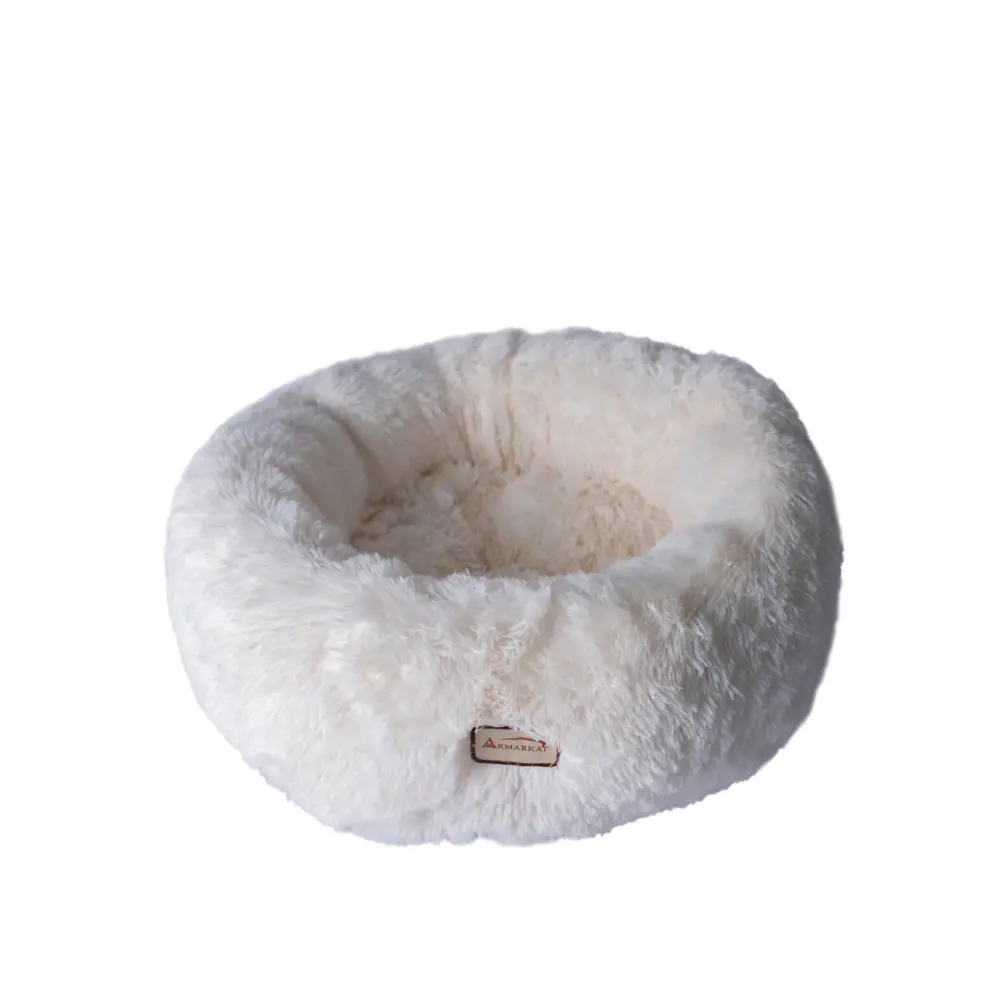
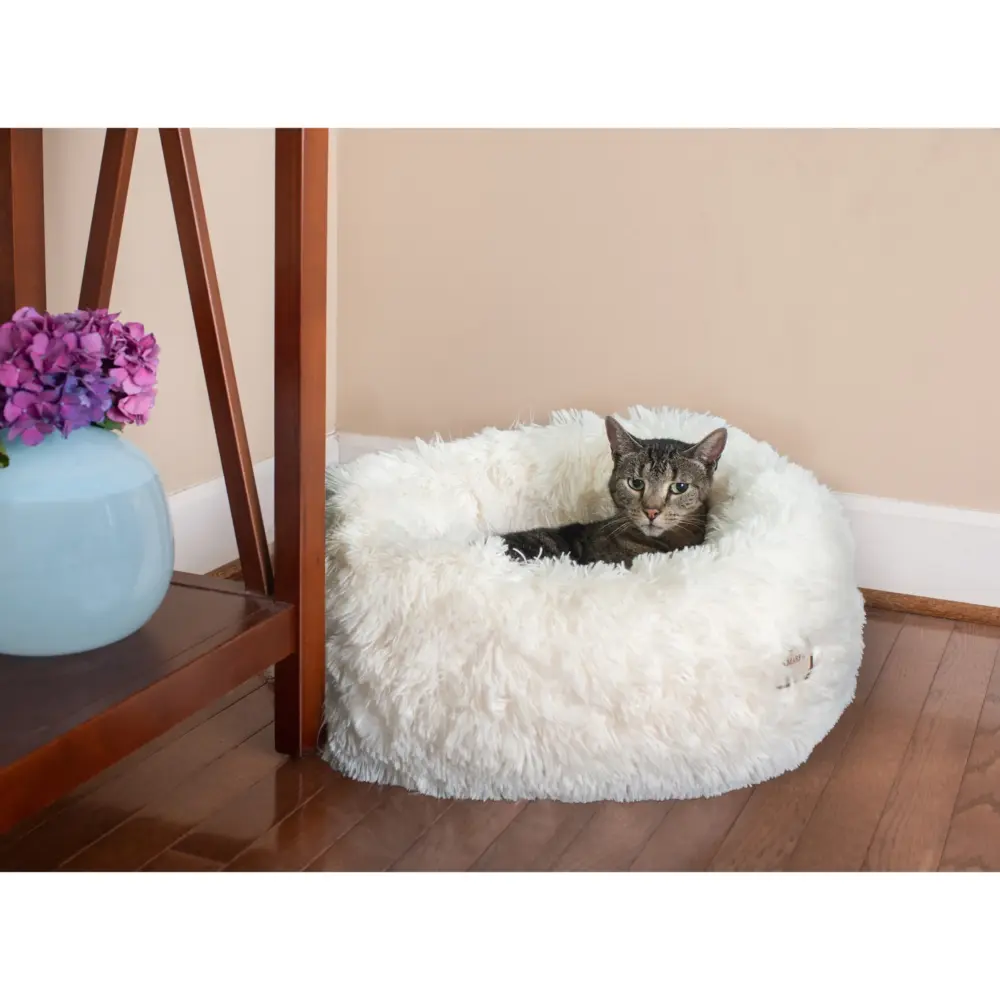
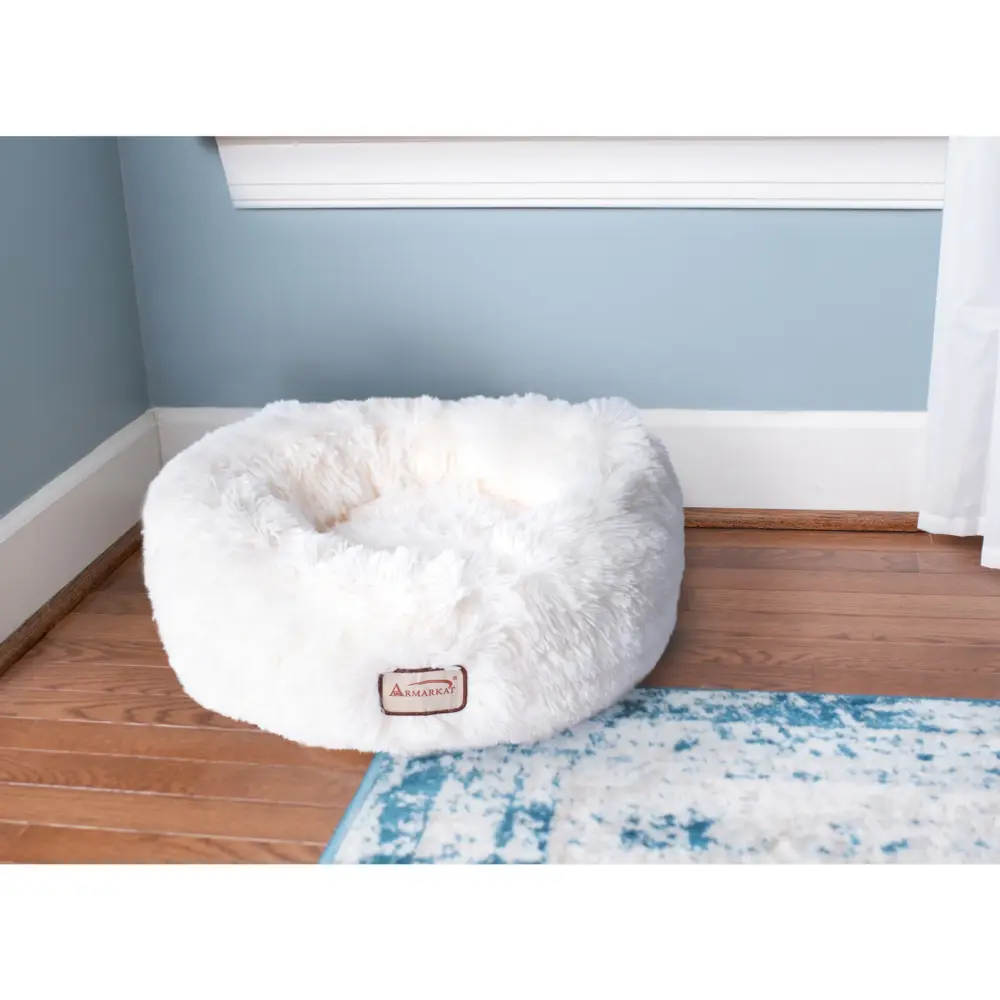
The Armarkat cuddler we stock shows how big the gap can be. Armarkat lists the Small at 22 × 22 × 8 inches overall with a 16-inch inner diameter, and the Medium at 28 × 28 × 9 inches overall with a 22-inch inner diameter, both on a 3.9-inch pad. In each size, the rim accounts for 6 inches of the listed width.
When a listing gives only outer dimensions for a rimmed bed, ask the seller for the inner size, or estimate the rim’s thickness from the photos and subtract it twice. On a rimmed bed, the listed height is usually the rim, not the cushion: the Small stands 8 inches tall at the rim, but its pad is 3.9 inches thick.
Whatever the bed, compare the right pair of numbers:
| Bed type | Measure | Compare with |
|---|---|---|
| Round or donut | Curl width at the widest point | Inner diameter |
| Bolster bed | Curl width or stretch length | Area inside the bolsters |
| Flat bed | Stretch length and width | Full listed size |
| Raised cot | Stretch length and width | Fabric area inside the frame |
| Crate pad | Inside of the crate floor | Listed pad size |
Measuring the crate, car or corner
Crates
Measure the floor inside the crate, wall to wall, rather than going by the crate’s model size. A bed that matches the floor lies flat. One that is too big rides up the walls and leaves a ridge in the middle; one that is too small slides around and leaves bare tray at the edges.
Then check the height. A thick pad or rim lifts your dog, and Humane World for Animals’ crate-training guide says the crate should be large enough for your dog to stand up and turn around in. Put the bed in, and if your dog’s head now brushes the roof when they stand, choose a thinner pad. For what else belongs in the crate, and when a puppy is ready for bedding at all, see what to put in a dog crate.
Safety note
Some dogs, puppies and bored adolescents especially, chew bedding, and swallowed stuffing or fabric can cause a blockage. If yours tears into beds, don’t leave a plush bed in the crate while they’re alone, and ask your veterinarian or a trainer about the chewing.
Cars
In the back seat or cargo area, measure the flat part only; a bed laid across a sloping seat or a wheel arch won’t lie flat. A bed is for comfort on the ride. It won’t keep your dog in place if you brake hard, so it goes with the way your dog normally rides, such as a secured crate or a harness and tether, never instead of it.
Corners and floors
Measure the floor spot and leave clearance for a door’s swing, a heat vent and the main walkway. A square or rectangular bed fills a corner neatly; a round one leaves dead space there but suits an open patch of floor. Keep it away from drafty doors and windows, too.
One more space to measure is your washing machine. A bed that fits your dog but not your washer drum has to be hand washed or taken to a laundromat, so check the care label and the drum before you buy; our guide to washing a dog bed covers beds that don’t unzip.
Between sizes: when to go up or down
If your dog falls between two sizes, the space and the sleeping style decide.
- Size up for a dog who sometimes sprawls, a puppy who is still growing, two pets who share a bed, or a dog who digs and circles for a while before settling.
- Stay smaller for a tight curler who likes to press against the rim, or a bed going into a spot where a bigger one would block a doorway.
- Let the space win. If the right bed for your dog won’t fit the crate, use a flat pad that matches the crate floor there and put the bigger bed somewhere else in the house.
Re-measure a puppy every few weeks while they grow, and expect the first bed to be outgrown. A puppy who still chews is better on an easily washed bed or blanket than on the bed you hope to keep for years.
Mistakes and quick fixes
Measuring mistakes to avoid
- Sizing by name, weight or breed. One brand’s Medium can be another’s Small, and a “fits dogs up to” weight can’t tell how your dog lies. Go by inches.
- Forgetting the crate door. A soft pad folds through the opening; a firm rimmed bed that fits the floor may not.
- Rounding down. When two readings differ, the larger one is the one your dog will use.
If the new bed doesn’t seem right
- Shoulders or hips hang over the edge: a chin on the rim is normal for a curler, but more than that means the sleeping area is too small or your dog wants to stretch out.
- Your dog lies beside it on the floor: the room may be warm, the bed may be too small, or the spot may be wrong. Try moving it before deciding the size is the problem.
- It bunches up in the crate: it’s bigger than the floor. Swap in a pad that matches the inside measurements.
- It slides when your dog jumps in: look for a skid-free base, or set the bed against a wall.
- Your dog suddenly won’t settle: a dog who now struggles to lie down, keeps shifting or avoids a bed they used to like may be uncomfortable or in pain, so talk to your veterinarian. If the bed itself has flattened or been outgrown, see when to replace a dog bed.
Try a new bed on a clean floor before it goes into the crate or car, and keep the packaging until you’re sure. A bed returned because the size you chose didn’t suit your dog counts as a change-of-mind return, so you pay return postage and a restocking fee applies; the returns page has the details.
Our beds: for cats and small dogs only
Nilosi stocks one bed and one mat sold for dogs as well as cats, and the picks below are limited to those. We don’t carry a bed for medium or large dogs. If your dog’s curl measures more than about 20 inches across, even the Medium cuddler’s 22-inch inner diameter leaves too little room to turn, and the measurements above will serve you when you shop elsewhere.
-
Armarkat
Ultra-Plush Cuddler Bed for Cats & Small Dogs, Choose size
Price range: $55.95 through $72.95
Why it fits: A rimmed cuddler for small dogs who curl up; Armarkat lists 16 in inside the Small and 22 in inside the Medium. Not for bigger dogs.
-
The Green Pet Shop
Chillz Cooling Gel Mat for Dogs & Cats, View product
$45.95
Why it fits: A foldable cooling mat for a dog who sprawls flat on warm days; we list it in Medium only, so ask us for its size before you order.

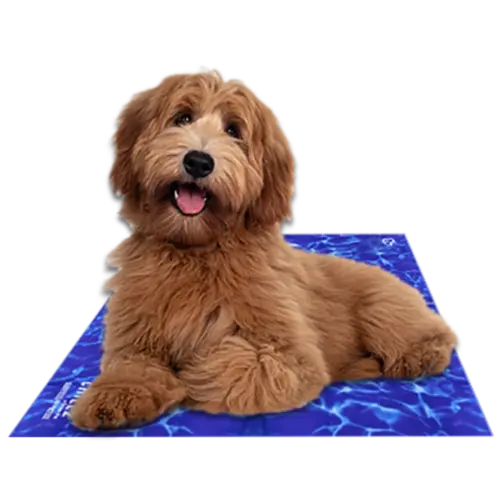
The Chillz is a mat to lie on, not a chew: take it away if your dog starts biting or digging at it. If you want either product checked against your measurements before you order, ask us. Measuring a cat instead? Our guide to choosing a cat bed covers caves, cuddlers and where cats like to sleep. Every bed and mat we carry is in beds and comfort.
Related guides
-
Guide
Why Do Dogs Dig in Their Beds? Normal Nesting and When It’s a Problem
Digging, scratching and circling before lying down is normal nesting. Learn why dogs do it, how to tell a normal routine from a frantic one, what extra digging says about the bed, how to handle a bed shredder and when to call your veterinarian.
-
Checklist
When to Replace a Dog Bed: 7 Signs, Plus Cat Beds and Gel Mats
A checklist for deciding when a dog or cat bed is past saving: the fold-and-press test for flat filling, smells that return after a proper wash, tears that put a chewer at risk, worn bases, rims and gel mats, a pet who has outgrown the bed, and what only needs a wash.
-
Checklist
What to Put in a Dog Crate: Bedding, Water, Toys and What to Leave Out
A checklist for the inside of a dog crate: water that won’t tip, bedding once your dog stops soiling or shredding it, a cool layer for hot sleepers, which chews and toys need you watching, a cover for den lovers, what to leave out, and how to adjust for puppies, chewers and seniors.