Toys & Play Guide
Is Tug of War Bad for Dogs? What the Game Actually Does
Short answer
No. Tug does not make a dog aggressive or dominant, and for most dogs it is one of the most useful games you can play. The risks that are real are mechanical rather than behavioural: hard sideways yanking, a game that never has an off switch, and puppies with loose teeth. Keep the motion low and horizontal, build a reliable release, and end while the dog still wants more.
Where the aggression myth came from
The idea traces back to a model of dog behaviour built on the notion that dogs are constantly trying to rise in rank, and that letting one win a contest teaches them they outrank you. That framework has been abandoned by behaviour professionals, and the studies it was based on described captive wolves in artificial groups rather than dogs living with people.
What actually happens during tug is cooperative. Two individuals hold opposite ends of an object and pull. Neither is deciding anything about status. The dog who wins a round of tug does not generalise that into anything else, and dogs who are allowed to win more often tend to stay more interested in playing with their person, not less.
There is one genuine observation buried in the myth. A dog who gets wildly over-aroused during any game, tug included, can start making poor decisions: grabbing clothing, mouthing hands, refusing to disengage. That is an arousal problem, and the fix is structure rather than banning the game.
What tug actually does for a dog
Tug is one of the few games that gives a dog a full predatory sequence in a form you control. Grabbing, holding and shaking are all behaviours a dog is built to perform, and a dog who never gets to perform them tends to find an outlet you like less.
- It burns more than a walk. Two minutes of hard tug asks more of a dog physically and mentally than ten minutes of walking on a pavement.
- It builds engagement. A dog who plays tug with you learns that you are the source of the best thing in the room, which pays off everywhere else in training.
- It teaches impulse control. A game with a start cue and a release cue is a repeated exercise in waiting and letting go.
- It works in a small space. A flat, a hallway or a wet afternoon are all fine for tug in a way they are not for fetch.
- It gives mouthy dogs a legal target. Puppies and adolescents who grab sleeves usually need somewhere to put that behaviour rather than less of it.
The jaw, neck and spine question
This is the part worth taking seriously, and it has nothing to do with temperament. Damage from tug comes from the direction and speed of the force, not from the game itself.
The dog is built to pull backwards and shake side to side. Problems come from the human end: lifting a dog off the front feet, swinging them, or jerking upward and sideways against a dog who is braced. Those movements load the neck and spine in directions they are not designed to absorb, and on a small dog they can do it with very little force.
- Keep the toy low, at or below the dog’s chest height
- Pull backwards and let the dog pull backwards, rather than lifting
- Let the dog do the shaking; you hold steady
- Never lift a dog off the ground by a toy, at any size
- Stop if the dog is being dragged rather than pulling
- Use a long toy so your hands stay away from the mouth
Safety note
Teeth are the other limit. Do not play hard tug with a puppy who is losing baby teeth, usually between about four and seven months, and go gently with any dog who has had dental work or has visible tooth damage. If your dog yelps, drops the toy suddenly, or starts chewing on one side only, stop and speak to your veterinarian.
Dogs who should play a gentler version
Almost every dog can play some form of tug. These are the ones where the game needs adapting rather than avoiding.
| Dog | How to adapt |
|---|---|
| Puppy under seven months | Very light resistance; let them win often; stop during teething |
| Toy and small breeds | Small toy, low to the floor, almost no counter-pull |
| Senior dog or one with joint issues | Short rounds, no twisting, sitting on the floor to keep it level |
| Dog who guards objects | Trade for food rather than reaching; see a professional first |
| Dog who redirects onto hands | Long toy, strict rules, end the game the moment skin is touched |
| Brachycephalic breeds | Short rounds with real breaks; watch breathing more than enthusiasm |
The rules that make tug a training exercise
Unstructured tug is where the problems people worry about actually appear. Four rules turn it into something closer to a training session that your dog finds thrilling.
- The game starts on your cue. Hold the toy still and say something consistent. A dog who grabs before the cue gets a pause, not a tug.
- The game ends on your cue. One word, every time, followed by stillness from you.
- Teeth on skin ends the round. No telling off; the toy simply goes away for thirty seconds. Most dogs work this out in one session.
- You finish first. Stop while the dog still wants another round, which keeps the toy valuable and stops the arousal climbing past the point of sense.
Let the dog win plenty of rounds. Winning is the reward that keeps the game worth playing, and it does not teach a dog anything about who is in charge. A dog who never wins stops playing.
Teaching a reliable release
The release is the single most useful thing tug can teach, because it transfers to every object you will ever need a dog to give up. Trade rather than take.
- Play for a few seconds, then stop pulling and hold the toy completely still.
- Say your release word once, in a neutral voice. Do not repeat it.
- Wait. A dead toy is boring and most dogs let go within a few seconds.
- The instant the toy is released, mark it and restart the game immediately. The reward for letting go is more tug.
- If the dog will not release after about fifteen seconds, show a treat near the nose, swap, then restart.
- Repeat until letting go is fast, then begin asking for it earlier in the game rather than only when the dog is tired.
Tip
Keep the reward for releasing as the game itself wherever you can. A dog who learns that letting go ends the fun gets slower at it; a dog who learns that letting go restarts the fun gets faster.
Choosing a tug toy
The toy decides how safe your hands are and how long the game lasts. Length matters most: a long toy keeps the dog’s mouth well away from your fingers and gives both of you a clear end. Construction decides whether it survives.
Layered fabric toys handle tug better than single-layer plush, because a tooth that punctures one layer meets another rather than opening a tear. Soft fleece on the outside is kinder to teeth and gums than hard rubber or rope under tension. Rope is the material to think twice about, since swallowed strands cause serious problems in the gut. For the choice between a filled plush toy and a flat one, see stuffed vs stuffing-free dog toys.
-
Tuffy
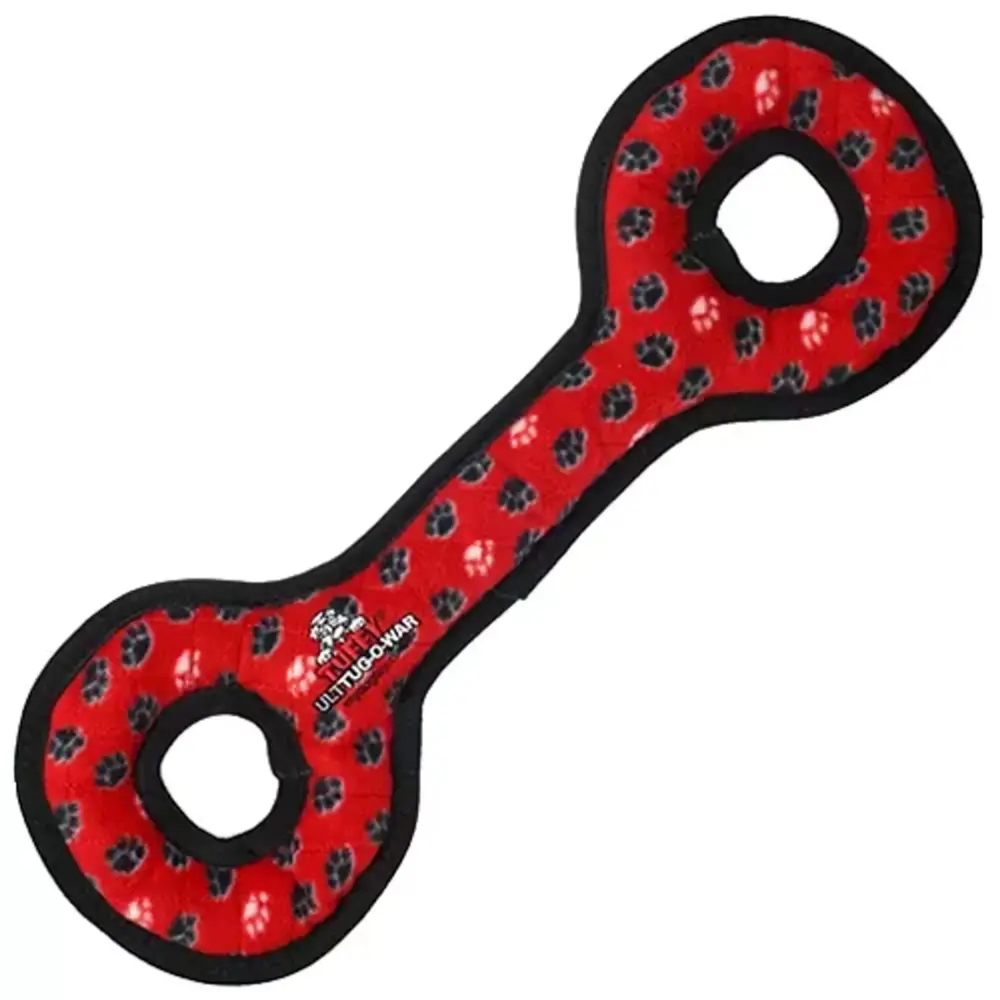
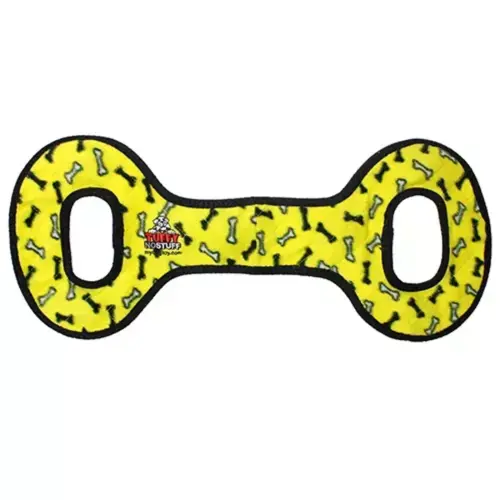
Ultimate Tug-O-War Dog Toy, Choose color
$38.95
Why it fits: A straight two-handled tug built from up to four layers, soft fleece outside and luggage-grade fabric inside. The long body keeps your hand away from the mouth.
-
Tuffy
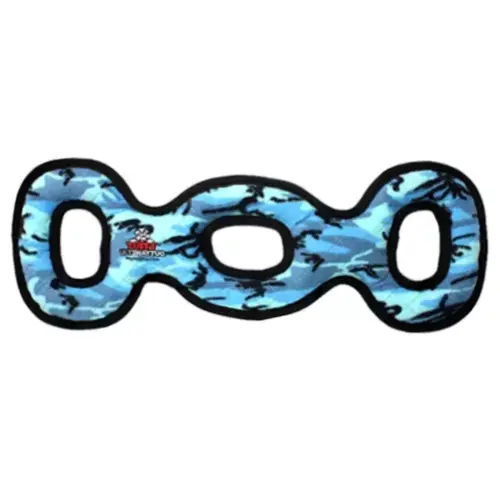
Ultimate 3-Way Tug Dog Toy, Choose color
$39.95
Why it fits: A three-way shape with more than one grip point, so two people or two dogs can each take an end without crowding the middle.
-
Tuffy
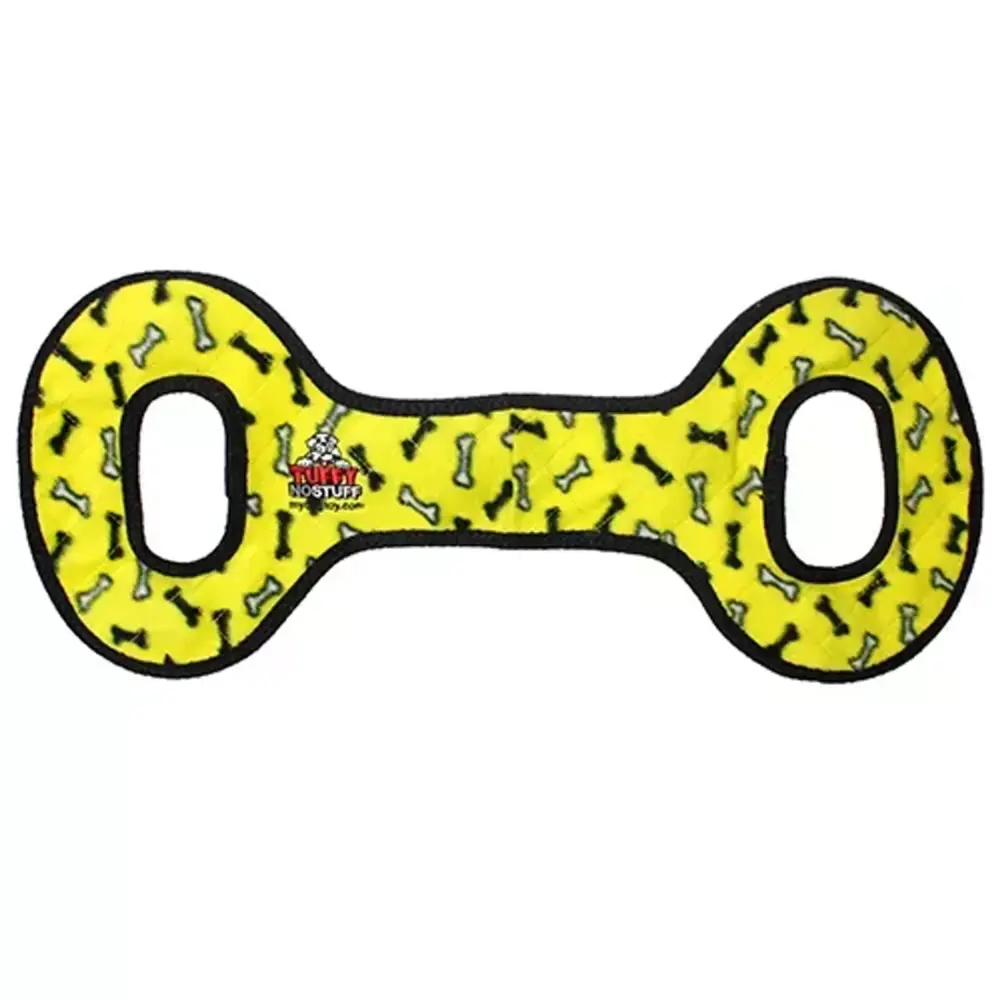
No Stuff Ultimate Tug-O-War, Choose color
$33.95
Why it fits: The same layered build with no stuffing inside, for a dog whose real goal is gutting the toy rather than playing with you.
-
Fire Hose Crocodile Dog Toy, View product
$30.95
Why it fits: Fire-hose material with no stuffing and squeakers that keep working after a puncture. Good for tug that turns into fetch.

When to stop a session
The best time to end tug is slightly before you want to. Arousal climbs during the game and takes a while to come down afterwards, so a dog who plays until they are frantic spends the next hour unable to settle.
- The dog is missing the toy and grabbing air or clothing
- The dog has stopped responding to the release cue they usually know
- Breathing has gone from working hard to struggling
- The dog is pulling with the whole body weight rather than the head and neck
- Anyone in the room is getting knocked into
End with the toy going away rather than being left on the floor. A tug toy that lives in a cupboard stays exciting; one that lives under the sofa becomes furniture within a week. For how that fits with the rest of the toy box, see how many toys a dog should have, and for a dog who is simply not interested yet, getting a dog interested in toys starts with tug for exactly these reasons.
Common questions
Should I let my dog win?
Yes, often. Winning keeps the game worth playing and teaches a dog nothing about rank. If you never let the dog win, the game stops being rewarding and they stop offering to play.
My dog growls during tug. Is that a problem?
Usually not. Play growling is normal and sounds different from a warning: the body stays loose and bouncy, the dog re-engages after a pause, and the growl rises and falls. A stiff body, a hard stare and a growl that does not stop when you stop are different, and worth a conversation with a qualified behaviour professional. Reading dog body language covers the difference in detail.
Can two dogs play tug together?
Many can, with supervision and a toy long enough for two mouths. Watch for one dog repeatedly taking the toy away rather than pulling, and separate if either dog stops being able to disengage.
Does tug work for puppies?
It is one of the best games for them, at very low resistance. Let the puppy win most rounds, keep the toy on the floor, and pause the hard version while the adult teeth are coming through.
Related guides
-
Comparison
Stuffed vs Stuffing-Free Dog Toys: Which Lasts, Which Is Safer
Both are plush toys, and they fail in completely different ways. This comparison covers why dogs gut a stuffed toy, what stuffing-free versions gain and lose, how layer counts change durability, and which one suits the way your own dog plays.
-
Guide
Why Does My Dog Bring Me Toys? What It Means and How to Respond
A toy at the door is usually a greeting, an invitation to play or both. Learn to tell which, when to play, say hello or trade, and what to do when it turns into demand play or keep-away.
-
Guide
Why Do Dogs Like Squeaky Toys? And How to Keep Squeaker Play Safe
A squeak sounds like small prey and goes off the instant your dog bites, so every chomp pays off. Why some dogs squeak for hours or whine with a toy, what to do about a dog who digs out the squeaker, how to choose a squeaky toy and how to live with the noise.