Toys & Play How-to
How to Use a Dog Enrichment Tube: Tug, Treats and Snuffling in One
Short answer
Start far easier than you think you need to. Load the toy so food falls out on the first nudge, let your dog succeed within seconds, and only then make it harder. Most dogs who ignore an enrichment toy were handed it at full difficulty, failed, and wrote it off. Count whatever goes in the toy as part of the day’s food rather than as extra.
What the toy does
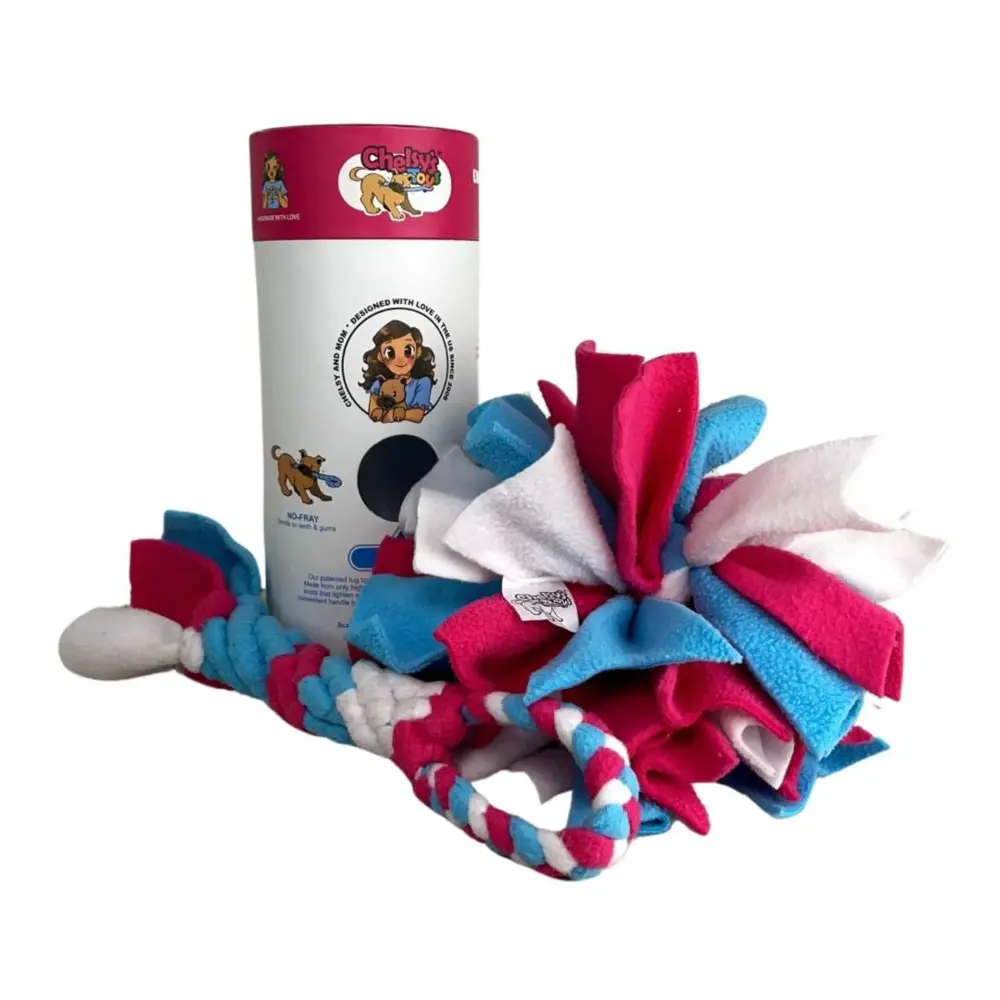
A three-in-one enrichment tube combines jobs that are usually separate products. There is a fleece tug element you hold the other end of, a tube that dispenses food as the dog moves it, and folds of fabric you push treats into so the dog has to nose them out.
Those three modes map onto three different needs. Tug is interactive and burns arousal. The dispensing tube is a solo problem-solving task. The snuffle element is a sniffing task, which is the one that actually calms a dog down. Having them in one object means the toy can match the dog’s state rather than you owning three things.
The reason this kind of toy matters is that physical exercise alone does not produce a settled dog. A dog who has walked for an hour and solved nothing is often still restless at four in the afternoon. Sniffing and problem-solving produce a different kind of tiredness.
Before the first session
- Pick a time when your dog is slightly hungry, not just fed
- Choose a quiet room with no other dogs competing
- Have the food measured out of the daily ration
- Use something high value for the first session: not dry kibble
- Put phones and other distractions away so you can watch
- Set the adjustable insert to its loosest setting
If you have more than one dog, work with them separately until each is confident. Competition over a food toy is the fastest way to create guarding behaviour around it.
Session one: make it obvious
- Load the tube loosely with food your dog genuinely wants, and leave the insert open so pieces fall out easily.
- Let your dog watch you put the food in. Do not hide the process.
- Put the toy on the floor and give it a nudge yourself so a piece falls out immediately.
- Say nothing and stand back. Resist helping unless the dog disengages entirely.
- When the dog pushes it and food appears, that is the lesson learned. Let them empty it.
- Pick the toy up and put it away while the dog still wants more.
The whole first session should last two or three minutes. The goal is not to occupy the dog; it is to teach them that this object produces food when touched.
Loading it so it is not too hard
Difficulty comes from three things, and you should only increase one at a time: how tightly the insert is set, what the food is, and how much work each piece requires.
| Setting | Easy | Hard |
|---|---|---|
| Insert | Fully open | Nearly closed |
| Food | Small, dry, free-running | Large, soft, sticky pieces |
| Quantity | Full, so pieces fall readily | A few pieces that have to be worked loose |
| Surface | Hard floor, toy rolls easily | Carpet or rug, toy resists moving |
| Mixing | One food type | Food wedged behind fabric in the snuffle folds |
Tip
Soft or sticky food in the dispensing tube turns an easy toy into a very hard one, because nothing falls out on its own. Keep soft food for the snuffle folds and use dry, free-running pieces in the tube until your dog is confident.
Raising the difficulty
Move up only when your dog empties the toy without hesitation two or three sessions in a row. The progression that works for most dogs runs roughly like this.
- Loose insert, high-value food, on a hard floor
- Loose insert, ordinary kibble, on a hard floor
- Half-closed insert, ordinary kibble
- Half-closed insert, on a rug so the toy does not roll freely
- Nearly closed insert, with a few higher-value pieces mixed in to keep interest
- Combined modes: food in the tube and treats hidden in the snuffle folds
If your dog stalls at any step, go back one and stay there for a week. There is no benefit to a dog working harder; the benefit comes from a dog working at all.
Using it as a tug toy safely
The fleece tug element is for games with you, not for solo chewing. Hand-tied fleece is soft on teeth and gums, which is what makes it suitable for tug, but it is not a chew toy and a determined dog will reduce it to strands.
Keep the usual tug rules: hold the toy low, let the dog do the shaking, never lift them off the ground, and end on a cue. Is tug of war bad for dogs covers the mechanics and the release training in detail.
Safety note
Loose fleece or fabric strands should never be swallowed. Check the tug section for fraying every time you use it and retire that part of the toy once strands come away in your hand.
The snuffle mode
This is the mode worth using most often and the one people skip. Push small pieces of food into the folds of fabric so they are hidden rather than visible, then let the dog work them out with the nose.
Sniffing lowers arousal. A dog who has spent ten minutes searching comes away calmer than a dog who has spent ten minutes chasing, which makes this the right mode for the evening, for a rainy day, or for a dog who has been wound up by something earlier.
Scatter a few pieces visibly on top for the first minute so the dog starts, then let them find the hidden ones. If your dog gives up, you have hidden the food too well. For more of the same approach, see food enrichment for dogs.
If your dog gives up
Giving up is almost always a difficulty problem rather than a motivation problem, and the fix is to make the next attempt easier rather than to encourage harder.
- Open the insert fully and use food the dog cannot ignore.
- Prime it by knocking a piece out yourself before handing it over.
- Shorten the session. Two minutes of success beats ten minutes of frustration.
- Check the floor. A toy that will not move on a thick rug is much harder than the same toy on tile.
- Feed the dog less beforehand. A dog who has just eaten has no reason to work.
- Stop helping. If you nudge it every few seconds the dog learns to wait for you rather than to solve it.
A dog who is frantic rather than giving up needs the opposite adjustment: slow the session down, use lower-value food, and finish before the frustration builds.
-
3-in-1 Dog Enrichment Tube, Choose color
$42.95
Why it fits: Three toys in one: a hand-tied fleece tug, a treat tube with an adjustable insert that sets the difficulty, and a snuffle ball for hiding food in the folds.
-
SodaPup
Jigsaw Enrichment Lick Mat for Dogs & Cats, Choose color
$25.95
Why it fits: A textured lick mat for the calmer end of the same job. Spread soft food into the grooves and freeze it for a longer session.
-
SodaPup
Honeycomb Slow Feeder Dog Bowl, View product
$30.95
Why it fits: A deep honeycomb slow feeder for meals, so a fast eater works for each mouthful instead of inhaling the bowl.


Cleaning and storing it
Food toys go rancid if they are put away dirty, and a toy that smells stale stops being interesting. The same applies to silicone mats, and how to clean a lick mat covers the grooves that a rinse always misses. Empty the tube after every use, rinse the parts that have held soft food, and let the fabric dry fully before storing.
Store it out of reach rather than leaving it on the floor. An enrichment toy that is permanently available becomes scenery within a week, and the whole value is in the dog being pleased to see it. For the same reason, rotate it with other toys rather than using it daily. Keeping a dog busy while you work covers building a rotation around the working day.
Common questions
How much food should go in it?
Measure it out of the daily ration rather than adding it on top. For most dogs a portion of a normal meal works well, and using the toy to deliver part of breakfast or dinner is better than treating it as a separate snack.
Can I leave my dog alone with it?
With the food modes, yes, once your dog is confident and you have checked the toy for damage. With the tug element, no; that part is for games with you.
Can cats use one?
The snuffle and food elements work for cats, though most cats prefer smaller puzzles and short sessions. Start with food visible on top and expect a cat to lose interest far sooner than a dog.
Related guides
-
How-to
How to Keep a Dog Busy While Working From Home: A Workday Plan
A workday plan for dogs whose people work from home: exercise before the first call, a bed beside the desk, a settle cue, quiet lick-mat jobs for meetings, short breaks, a calm fix for demand barking and practice at time apart.
-
Guide
Enrichment for Dogs on Crate Rest: Quiet Jobs Within the Vet’s Rules
Strict rest after surgery or an injury is hard on an active dog. Here are quiet jobs that fit the usual vet rules, from lick mats and slow meals to scent games within reach of the bed, lying-down tricks and gentle toy time if allowed, plus the signs that mean it's time to call the vet.
-
Guide
Toys for Dogs Who Destroy Toys: Choosing by Chewing Style
Shredder, tugger, carrier or steady chewer? Match toys to your dog's play style, see where fire hose and plush fit, play tug with rules and know when to retire a worn toy.