Feeding & Enrichment How-to
How to Clean a Lick Mat Properly, Including the Grooves
Short answer
Rinse it under warm running water the moment your dog finishes, before anything dries. For food that has already set, soak it in hot water with a drop of detergent for fifteen minutes, then work the grooves with a soft brush. Most food-grade silicone mats are dishwasher safe on the top rack. Dry it completely before storing, because a damp mat in a cupboard is what makes one smell.
Why grooves are the problem
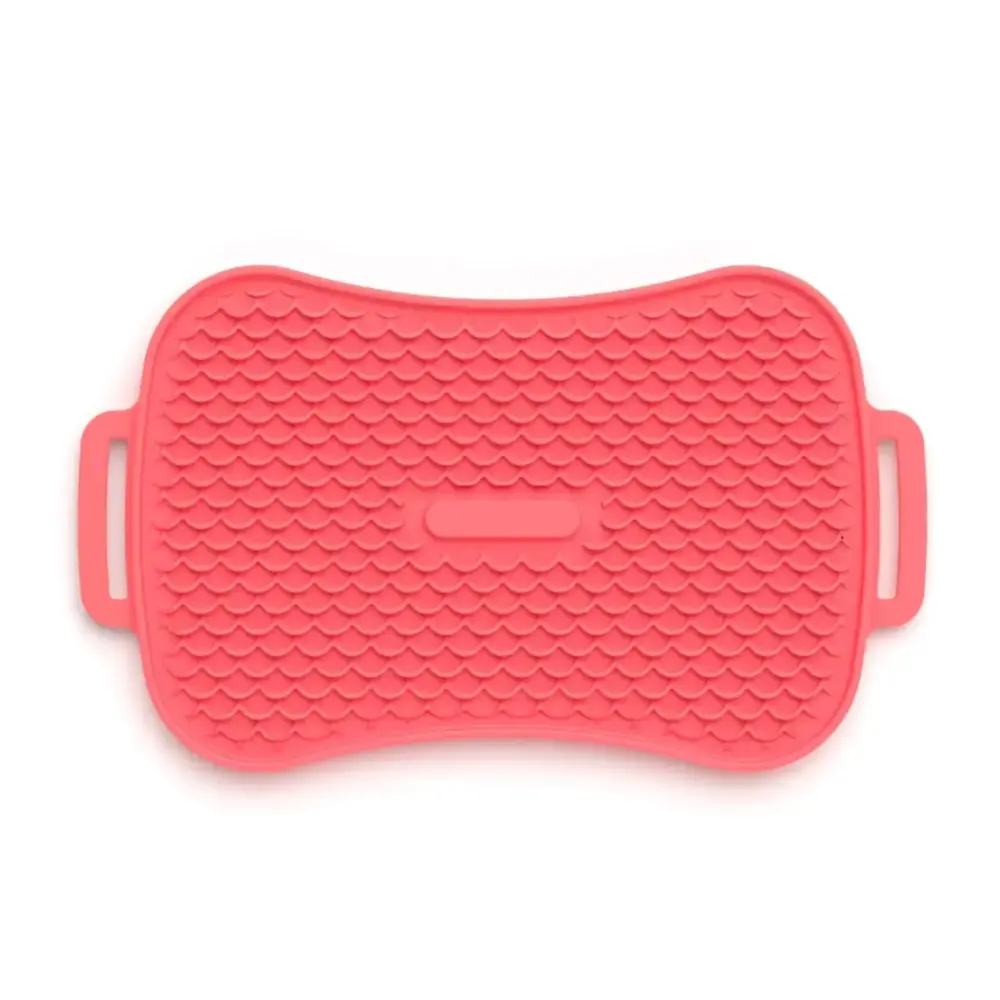
A lick mat works because the texture holds food in places a tongue has to work to reach. Every feature that makes it good at its job makes it bad to clean: the deeper and more intricate the pattern, the longer a dog works at it and the more food gets left in the corners.
The residue that matters is not the visible smear. It is the thin film in the base of each groove, which sets hard, goes rancid over days, and is where smell and bacteria establish. A mat that looks clean after a rinse often is not.
Silicone adds its own quirk. It is porous at a microscopic level and holds onto fats and oils more than glass or steel does, which is why a mat used for peanut butter can feel slightly greasy even after washing and can retain an odour.
Rinse immediately, every time
This is the whole trick, and it takes ten seconds. Food that is still soft rinses out under a tap with a thumb rubbed across the surface. The same food two hours later needs a soak and a brush.
Make it part of the routine: the mat comes away from the dog, goes straight to the sink, gets rinsed, and goes on the drainer. Leaving it on the floor until later is how every difficult cleaning job on this page begins.
Taking the mat away as soon as it is finished has a second benefit. A mat left down stops being interesting, and a dog who has licked a bare mat for twenty minutes has learned that it is sometimes empty.
The soak that does most of the work
For anything that has dried on, do not start scrubbing. Soaking does ninety per cent of the job with none of the effort and none of the damage to the pattern.
- Fill a bowl or the sink with water as hot as your hands can tolerate.
- Add a small amount of plain washing-up liquid. More does not help and is harder to rinse out.
- Submerge the mat fully, face down, and leave it for fifteen to twenty minutes.
- Lift it out and rub the surface with a thumb or a cloth; most residue will now lift in one pass.
- Work any remaining grooves with a soft brush, following the direction of the pattern.
- Rinse under running water until the surface no longer feels slippery.
- Stand it on edge to drain, then dry it completely before putting it away.
Tip
Boiling water is unnecessary and can distort a thinner mat over time. Hot tap water is enough to soften set food, and a longer soak beats a hotter one.
Brushing the pattern
The brush matters more than the detergent. A soft-bristled brush, a dedicated bottle brush, or an old toothbrush all work; a scouring pad does not, because it scratches silicone and creates more places for food to lodge.
Work along the grooves rather than across them, which pushes residue out of the channel instead of over the ridge into the next one. Hold the mat up to the light afterwards and look across the surface at an angle: dried residue shows as a dull patch against the sheen of clean silicone.
Keep the brush for this job alone. A brush that has been used on the washing up carries grease into the grooves you are trying to clear.
Dishwasher: yes, with conditions
Most food-grade silicone mats are dishwasher safe, and the dishwasher is genuinely better than hand washing for sterilising. Three conditions apply.
- Top rack only, away from the heating element, which can distort silicone.
- Face down or on edge, so water reaches the pattern. A mat lying face up fills with water and comes out dirty.
- Secure it. A light mat flips in the spray and lands on the element; wedge it between rack tines.
- Scrape or rinse first for anything thick, since a dishwasher filter does not enjoy peanut butter.
- Skip the heated dry if your machine lets you, or take the mat out and air dry it.
If your mat has a suction base or a rigid frame, check the maker’s guidance separately; the mat may be dishwasher safe while the base is not.
Frozen toppings and what they leave behind
Freezing a loaded mat makes a session last far longer and changes the cleaning problem. Frozen food thaws into the grooves as the dog works, so the residue ends up pushed deeper into the pattern than it would be from a fresh spread.
The fix is to let the mat come fully back to room temperature before rinsing, rather than running cold water over a cold mat, which hardens fats rather than dissolving them. Then soak as usual.
High-fat toppings are the ones that need the soak most: nut butter, full-fat yoghurt and wet food all leave an oily film. Pumpkin purée, mashed banana and softened kibble rinse out much more easily. What to put on a lick mat covers the options, including what to avoid.
Smells, stains and discoloured silicone
A persistent smell means fat residue rather than dirt. The remedy is a longer hot soak with a little bicarbonate of soda, or a run through the dishwasher on a hot cycle. Repeat rather than scrubbing harder.
Staining from carrot, pumpkin or anything with turmeric is cosmetic and permanent. It does not affect the mat and does not need treating; bleaching silicone to remove a stain damages the surface and is not worth it.
A mat that feels tacky or greasy after washing has absorbed oils into the silicone. A soak in hot water with bicarbonate of soda, left for an hour, usually resolves it. If it does not, and the mat has been in use for a long time, replace it.
Drying and storage
- Stand mats on edge to drain rather than stacking them wet
- Dry fully before storing; damp silicone in a cupboard grows mould at the edges
- Store flat or rolled, not folded, which creases thinner mats permanently
- Keep them out of the dog’s reach so they stay novel
- Keep a second mat so one can be drying while the other is in use
- Check the surface monthly for cuts, tears and chew marks
When to replace a mat
Silicone lasts a long time and is not immortal. Replace a mat when the surface is cut or torn, when pieces have been chewed off the edge, when the pattern has worn smooth enough that it no longer slows the dog down, or when a smell persists after a proper hot soak.
Chewed edges are the one to act on immediately. A lick mat is not a chew toy, and swallowed silicone can cause an intestinal obstruction. A dog who chews the mat rather than licking it should use one only under supervision, and should be given something appropriate to chew instead.
-
Super Feedy
Reversible Dog Lick Mat, Choose color
$37.95
Why it fits: A thick reversible silicone mat with a different pattern on each face, built to go in the dishwasher rather than be scrubbed by hand.
-
eMat Lick Mat Bundle, View product
$35.95
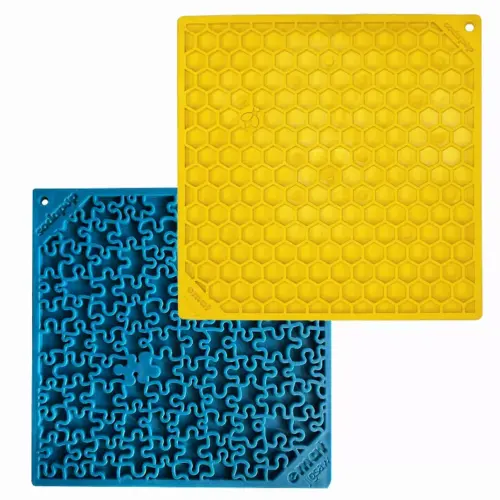
Why it fits: Two large mats in one bundle, a hard jigsaw pattern and an easier honeycomb, so one can be drying while the other is in use.
-
SodaPup
Jigsaw Enrichment Lick Mat for Dogs & Cats, Choose color
$25.95
Why it fits: A jigsaw-textured mat in food-safe materials, dishwasher safe, and small enough to freeze flat in a domestic freezer.
-
Super Feedy
4-in-1 Slow Feeding System, Choose color
$58.95
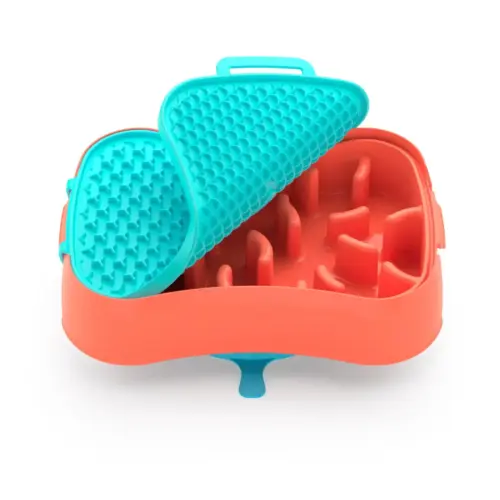
Why it fits: A slow feeder bowl with a reversible lick mat that doubles as a sealing lid, on a suction base, so prep and storage happen in the same object.

Food safety and how long a loaded mat can sit out
A lick mat spread with wet food, yoghurt or soft cheese is perishable food on a warm floor. The same rules apply as to anything else: at room temperature it should not sit out for more than a couple of hours, and in hot weather much less.
That matters for the common habit of loading several mats at once. Prepare and freeze them rather than leaving them in the fridge uncovered, where they dry out and absorb smells, and take one out at a time. Covered stacking in the freezer works well if the mats are flat.
Anything left uneaten should go in the bin rather than back in the fridge, because the mat has been licked and the food is now contaminated with saliva.
Suction bases and frames
Mats with suction cups on the back are helpful for a keen dog who pushes an ordinary mat around the kitchen, and they need slightly different care. The suction surface collects grime at the edge of each cup, which is the one place a dishwasher jet rarely reaches.
Wash the back as deliberately as the front, pressing each cup flat to open the rim, and dry it fully before the next use, since trapped water under a cup is what causes the stale smell people blame on the mat itself.
Suction only works on genuinely smooth, clean surfaces. On a textured tile or an unsealed worktop it will not hold, and the mat slides exactly as before. Wet the cups slightly before pressing down, and expect to re-press them during a long session.
Common questions
How often should a lick mat be cleaned?
After every single use. There is no version of this where a lick mat gets used twice between washes; the residue is food and it spoils.
Can I use hot water and bleach?
Do not use bleach on something your dog licks. Washing-up liquid and hot water, or a dishwasher cycle, are enough. If you want to sanitise further, a hot dishwasher cycle is the safest way to do it.
My dog licks the mat clean. Does it still need washing?
Yes. A mat that looks clean still has a film in the grooves and saliva across the whole surface, both of which grow bacteria within hours. How often to wash dog bowls covers the same issue for bowls.
Related guides
-
Comparison
Slow Feeder vs Lick Mat: Which One Does Your Dog Need?
A slow feeder stretches out a meal; a lick mat fills time and settles a dog. Buying the wrong one for the problem is the usual mistake. This comparison covers both, including the dogs who defeat them.
-
How-to
How to Check Your Dog Is a Healthy Weight at Home
Scales alone will not tell you whether your dog is a healthy weight. This guide covers the three-part hands-on check vets use, what each result feels like, and the changes that work when the answer is not what you hoped.
-
How-to
Where to Put Cat Food and Water Bowls, and How Far From the Litter Box
Choosing the spot for your cat’s food and water: how far to keep them from the litter box, why water belongs away from the food, which rooms and corners to avoid, feeding several cats or a cat with a dog, and how to move the bowls without putting your cat off its meals.