Cat Care Comparison
H-Style vs Vest Cat Harness: Which Is Harder to Slip and Easier to Fit
Short answer
A snug vest is generally the harder style to wriggle out of, because it holds more of the body, but fit matters more than style: a loose vest slips off as easily as a loose H-style. An H-style is lighter, cooler and adjusts at neck and girth. Choose the one your cat accepts calmly, then fit it snugly.
H-style vs vest harness at a glance
Both styles usually clip the leash to a ring on the back. What separates them is how much of your cat they cover and how they go on.
| Style | Coverage | Putting it on | Escape risk | Warm days |
|---|---|---|---|---|
| H-style | Two narrow loops joined along the back | Buckles on; some slip over the head | Secure if snug; neck loop can slip | Little fabric, so it stays cooler |
| Vest | A fabric panel over chest and back | Step-in, or over the head, then fastens | Often harder to slip when snug | More fabric, so it runs warmer |
Both escape cells carry the same condition. A vest a size too big slips as easily as a loose H-style, so fit decides more than style; the sections below show which details tip the choice.
How an H-style harness sits
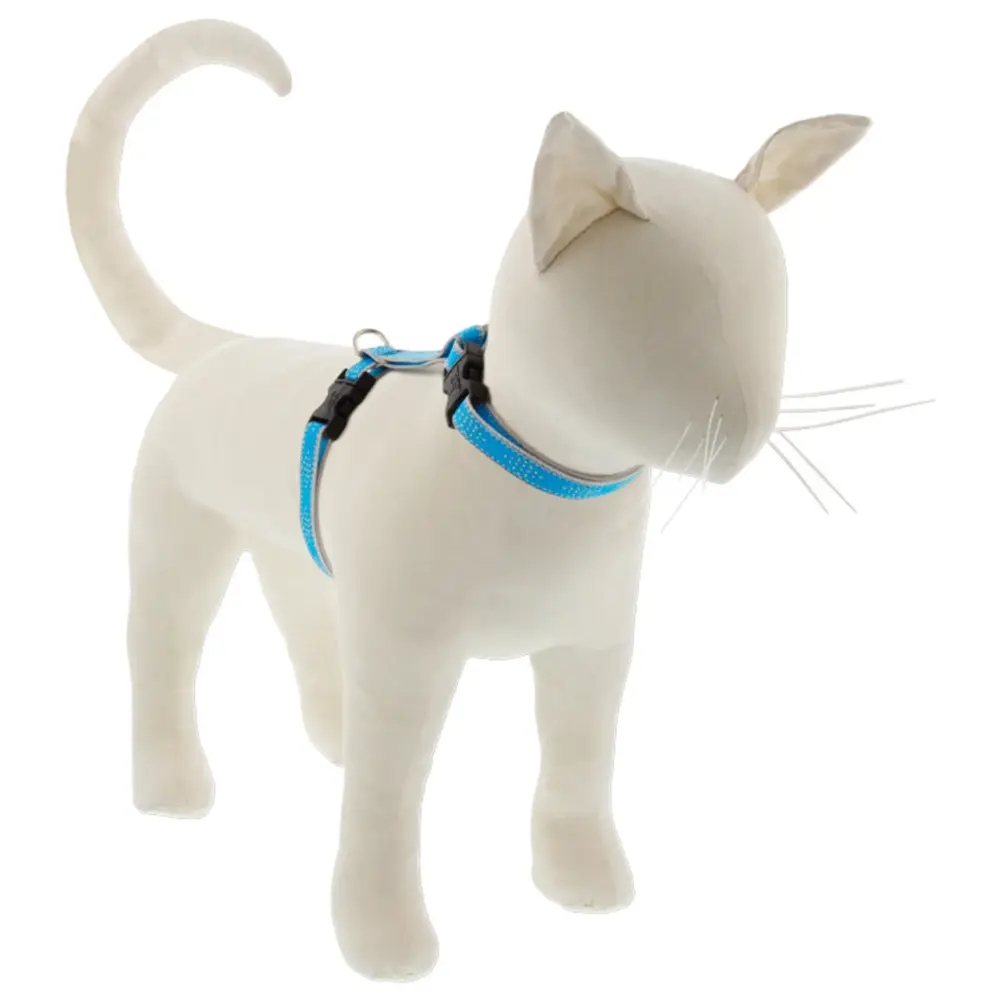
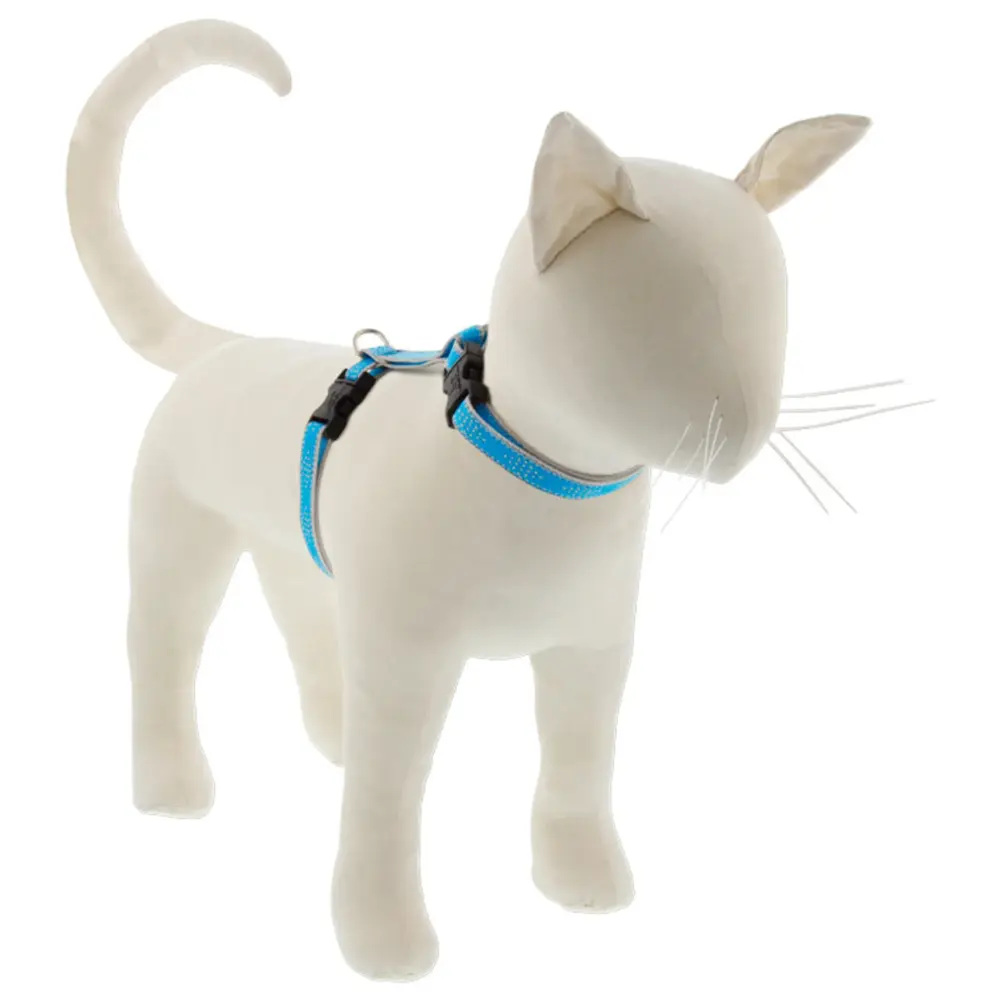
Laid flat, an H-style harness makes the shape of its name: one loop around the base of the neck, one around the chest just behind the front legs, and a short strap along the back joining the two.
- Light and minimal. Very little fabric touches the body, which suits warm days and cats that object to anything draped over their back.
- Two adjustment points. Neck and girth adjust separately, so one harness can be tuned to a slim cat, a deep-chested one or a kitten still filling out, within its size range.
- Narrow straps carry the whole pull. If your cat lunges or bolts, the force lands on two thin bands instead of spreading across the chest.
How a vest harness sits
A vest harness, sometimes sold as a walking jacket, wraps a panel of fabric around the chest and over the back. The panel is usually mesh, nylon or a padded fabric, and it fastens with hook-and-loop, buckles or both. Step-in vests have two openings for the front legs and fasten over the back; others slip over the head and close around the chest.
- Broader contact. A sudden pull is spread over more of the chest and back rather than concentrated on two straps.
- A feel some cats prefer. Some cats that fuss at thin straps seem to settle under a vest’s wider coverage. Others freeze or flop under it, and the only way to know is to try it indoors.
- Warmer. More fabric holds more heat, especially in padded designs.
- Sizing matters more. The fabric panel limits how far a vest can be let out or taken in, so a cat between sizes can end up with a gap at the neck or fabric bunching behind the front legs.
- Hook-and-loop has quirks. The rip as it opens can startle a cat, it catches long fur, and it grips less well as it clogs with hair, so a strip that looks closed may not hold under strain.
Which is harder to wriggle out of?
A well-fitted vest is generally considered the harder style to back out of, and the reason is simple: it holds more of the body, so there is more for a cat to slide out of. But both styles fail the same way, and fit decides far more than style.
Most escapes are a reverse. A startled cat stops, braces and backs up. The leash goes tight, and that tension holds the harness still while her body slides backward out of it: the front legs draw back through the girth loop or leg openings, and the neck opening rides forward until it clears her head. Cats are flexible, so a little slack is all it takes. Here’s how each style holds up against that:
- H-style. A neck loop sitting low at the base of the neck and a girth loop snug behind the front legs give the harness two firm anchor points. The neck loop is the weak point: set loose for comfort, it is the first thing to ride over the head.
- Vest. A well-fitted vest grips more of the body, so it’s slower to slide. A vest a size too big, a gaping neck opening or a hook-and-loop strip that’s only partly overlapped lets it peel away just as fast.
Three things matter more than the style you pick:
- A snug fit, rechecked every time. The fit checks further down work for both styles.
- A slack leash when she backs up. Pulling back is what drags a harness forward over the head. Step toward your cat to ease the tension, then crouch and pick her up.
- A harness made for cats. VCA’s guide to leash walking your cat warns that many cats can wriggle out of collars or harnesses designed for dogs, and recommends a correctly sized harness made specifically for cats.
Plan for the day a harness comes off anyway. A snap-open collar with an ID tag and a registered microchip are what help a loose cat get home, and our cat collar vs harness comparison explains how the two pieces share the work.
Safety note
A harness makes outings safer; it doesn’t make a cat safe to leave. Lupine’s product page for its reflective H-style harness warns that H-style harnesses should never be left on an unattended cat, and the same goes for vests. Take either style off after every outing, never tie a harnessed cat to anything, and don’t count on a harness as a backup for a cat that dashes for the door.
Putting it on without a fight
For plenty of cats, the deciding factor is how the harness goes on. There are four common designs:
- Buckle-on H-style. Both loops unclip. Lay the back strap along her spine, then buckle the neck and girth loops around her.
- Slip-on H-style. The neck loop is fixed and goes over the head; only the girth strap buckles.
- Step-in vest. Your cat stands with her front paws in two openings, and you bring the panel up and fasten it over her back. Nothing goes over the head, but you do handle the front legs.
- Overhead vest. It goes over the head like a turtleneck, then fastens around the chest.
A cat who hates things over her head is usually easiest in a buckle-on H-style or a step-in vest. One who won’t let you touch her paws will find the step-in vest the hardest. If she dislikes both, the buckle-on H-style generally asks the least of her: two clicks and it’s on.
Whichever you choose, introduce it in small steps, starting with a sniff and a buckle at mealtime. Our week-by-week plan for harness training a cat walks through each stage, including what to do when a cat flops over.
Tip
With a hook-and-loop vest, peel the strip open slowly when you take it off. A slow peel is much quieter than a quick rip, and it keeps the end of the session calm.
Which style suits your cat
Kittens
A growing kitten changes size quickly, which favors a strap harness you can let out at the neck and girth as she fills out; a vest is more likely to need replacing at the next size. Recheck the fit weekly. Ask your veterinarian before taking a kitten outdoors, especially before her vaccinations are complete, and start indoors either way.
Nervous cats
A nervous cat’s likeliest escape is a panicked reverse, which argues for the extra hold of a snug vest, if she accepts one. If getting a vest on takes a struggle, a buckle-on H-style she tolerates calmly, fitted snugly, is the better bet. Either way, keep sessions short and indoors until she moves normally, and stay close to the house when you go out.
Some nervous cats never enjoy outings, and that’s fine. Our look at indoor vs outdoor cats covers the middle grounds between staying in and going out. For a cat who likes fresh air but not walking, a ventilated GOOPAWS carrier backpack lets her ride instead, with its inside safety strap clipped to her harness.
Confident explorers
A bold cat that wants to climb, chase and investigate puts the most strain on a harness, so prioritize fit over comfort features; either style works if it’s snug. Keep to a light leash about 4 to 6 feet long, as VCA suggests, rather than a retractable one. If your cat has already backed out of a correctly fitted harness of one style, trying the other is reasonable, since cats’ shapes differ.
Big or long-haired cats
For a large cat, check the girth range before the style, and choose a size where her measurement sits comfortably inside the range, not at its very end. On a long, thick coat, press the tape through the fur to the body and make sure straps sit snug against her rather than floating on the coat. After each outing, tease out any tangles where the harness sat before they mat.
Warm days
A vest covers more of the body, so it adds more warmth than a strap harness: welcome on a cool evening, less so on a summer afternoon. In warm weather, go out early or late, keep outings short and stay near shade. Cats rarely pant, so panting or open-mouth breathing on an outing means it’s time to head inside to a cool spot; call your veterinarian if it doesn’t settle within a few minutes or she seems weak. Our guide to keeping a cat cool in summer covers the other heat signs to watch for.
How to check the fit of either style
- Measure first. With a soft tape, measure the chest just behind the front legs and the base of the neck, then compare with the maker’s sizes.
- Close everything fully. Buckles should click, and hook-and-loop strips should overlap edge to edge.
- Do the finger test. One or two fingers should slide flat under each strap or vest edge, and no more.
- Test the neck. With your cat standing, ease the harness forward by the leash ring. If the neck loop or the vest’s neck edge rides toward the ears, tighten it.
- Watch her move. She should walk with a normal stride, with straps or edges clear of the armpits and no fabric bunching behind the front legs.
- Recheck in a few minutes. A cat that tensed up as the harness went on may relax and leave it looser. Check again before every outing, since straps can creep.
- Look for rubbing afterward. Part the fur behind the front legs and under the straps. If skin stays red or sore, or she limps or flinches, stop and call your veterinarian.
When each style wins, and the verdict
- An H-style wins for cats who dislike anything over the head (in a buckle-on design), for warm weather, for growing kittens and for owners who want something light that goes on in seconds.
- A vest wins for a wriggly or nervous cat who accepts one, since a snug vest holds more of the body, and for cool evenings and strong cats whose lunges you’d rather spread across the chest. It’s also worth a try if your cat has backed out of a correctly fitted H-style.
- Neither wins on security alone. A loose vest is no safer than a loose H-style.
Start with the style your cat accepts most calmly, because a harness she tolerates is one you can fit snugly and check without a struggle. Then keep the leash slack when she startles and stay with her; that routine does more to prevent escapes than the choice of style.
The harness we carry, and how to size it
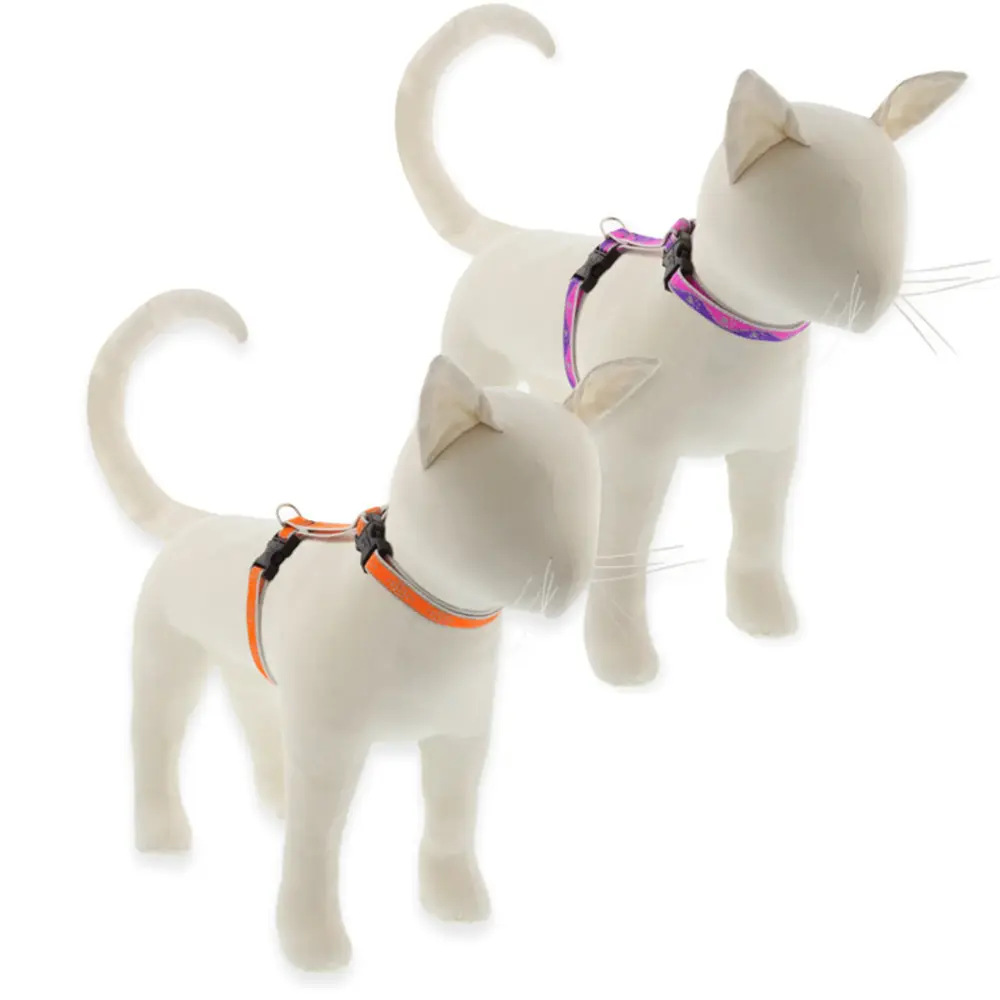
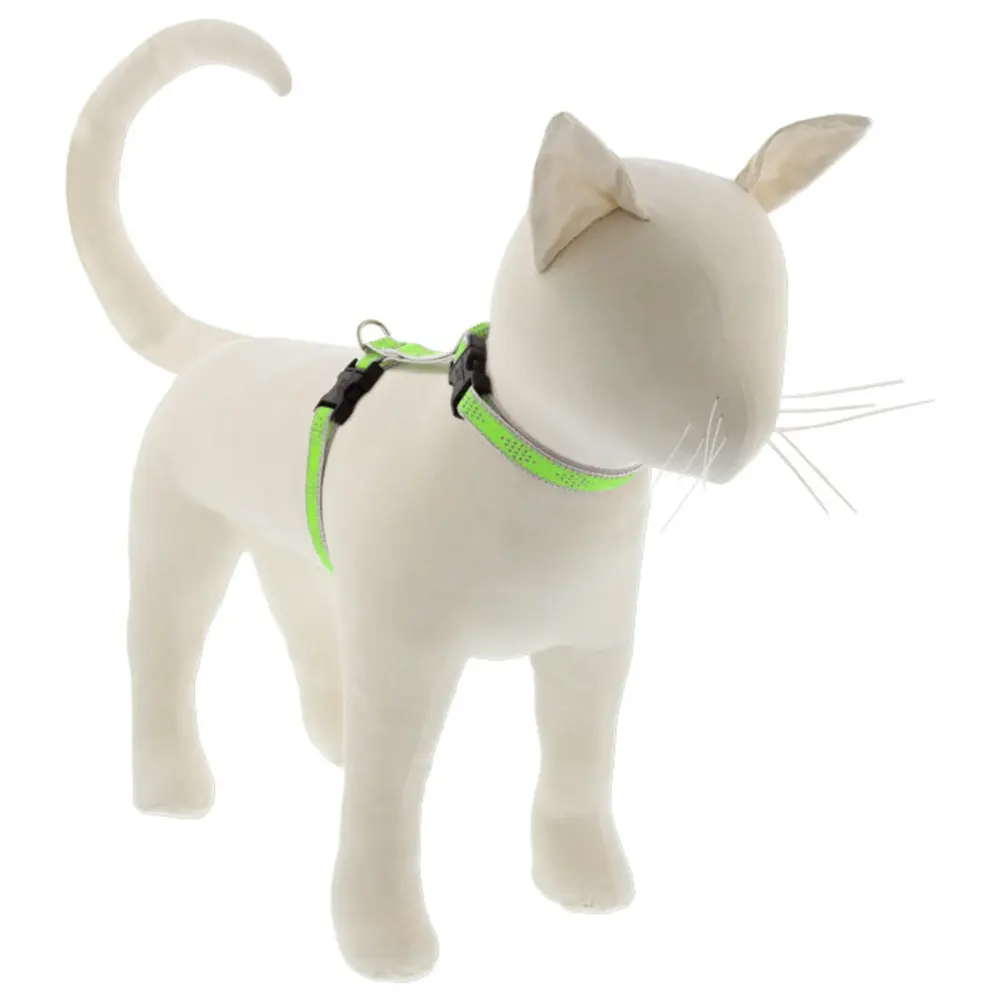
We carry one cat harness, and it’s an H-style; we don’t sell a vest harness. The Lupine Pet Reflective H-Style Cat Harness is a buckle-on design: its adjustable neck and girth straps each close with a quick-release buckle, so it can go on without passing over your cat’s head. Lupine describes it as a cat-specific H-style that doesn’t restrict the shoulders, and its reflective weave adds visibility at dusk. It comes in six designs and is made in the USA by Lupine Pet.
It’s offered in two girth ranges, 9–14 inches and 12–20 inches. A cat measuring 12 to 14 inches fits either, and our harness measuring guide has a section for cats that explains which range suits a cat in that overlap. Measure before you order, since a size you chose that doesn’t fit counts as a change-of-mind return under our returns policy. You’ll find the harness with the rest of our cat essentials.
If you’d rather try a vest, look for one made for cats, sized by chest girth, with a neck opening you can snug down and fastenings you can check at a glance, then put it through the same fit checks.
Related guides
-
Comparison
Indoor vs Outdoor Cats: Risks, Benefits and the Middle Ground
Indoor-only, supervised, daytime or free outdoor access? Compare all four on safety, disease, wellbeing, weight and wildlife, see which cats suit each, and learn how to move an outdoor cat indoors gradually.
-
Comparison
Should a Cat Wear a Collar or a Harness? ID, Outings and Safety
A collar and a harness do different jobs for a cat: a snap-open collar carries an ID tag, and a harness is the only safe place to clip a leash. Compare their safety rules and fit, see why a registered microchip is the ID every cat needs, and find out whether an indoor-only cat needs either.
-
Guide
Camping With a Cat: Is Yours Ready, and How to Keep Them Safe at Camp
Camping suits a confident, harness-trained cat, and only with someone always beside them. How to tell if yours is ready, rehearse at home, make the tent or car a safe base, handle litter and food at camp, explore on a leash and find a cat who slips away.