Cat Care Comparison
Should a Cat Wear a Collar or a Harness? ID, Outings and Safety
Short answer
Not strictly, but she does need ID. Every cat, indoor-only included, should have a registered microchip, and a snap-open collar with an ID tag is worth adding if she’ll wear it, because anyone can read a tag. For leash time outside, use a cat harness, clip the leash only to that and remove it afterward.
Cat collar vs harness at a glance
A collar and a harness aren’t two versions of the same thing. One carries information and the other carries a leash. A microchip belongs in the comparison too, because it does the collar’s most important job with nothing on the outside to snag.
| Option | Its job | When it’s worn | Leash? | Main risk |
|---|---|---|---|---|
| Collar | ID tag, bell or reflective strip | All day, if your cat accepts it | Never clip one to it | Snagging; use a snap-open buckle |
| Harness | A secure leash point outdoors | Supervised outings only | Yes, the only leash point | Backing out if loose; snags if left on |
| Microchip | Permanent ID read by a scanner | Always; it sits under the skin | No | Out-of-date registry details |
What a collar is for, and the safety rules
A collar’s job is to hold things. For most cats that means an ID tag with your phone number, which anyone who finds her can read on the spot, no scanner required. International Cat Care (iCatCare), in its guide to whether a cat should wear a collar, lists the other uses: a reflective strip so she’s easier to see in the dark, a bell, which can reduce the number of birds a cat catches without stopping hunting altogether, and the magnetic or electronic key that some cat flaps need. Flaps that read a cat’s microchip have made that last one optional.
The same guide is frank about the risks. A collar can rub and cause hair loss, a front leg can get pushed through it, it can catch in the mouth and injure the jaw, and a collar snagged on a branch or fence can strangle a cat. Those risks are why the rules for choosing one are strict:
- A snap-open buckle. iCatCare recommends a buckle that springs open and releases your cat if the collar gets caught. You’ll often see these sold as breakaway or safety collars.
- No elastic section. Stretchy collars are still sold as safety collars, but iCatCare says it would never recommend one with an elastic section, because they can also cause serious injuries.
- Few dangles, sealed bells. Anything hanging from a collar can catch on things, so keep it to the ID tag. If you add a bell, choose one that is completely sealed, with no slits a claw can hook into.
- Decent stitching. On a poorly made collar the stitching can loosen, and loose thread can be swallowed or wrap around the tongue. Replace a collar that’s fraying.
- A collar made for cats. Most dog collars are built to stay fastened under a leash’s pull, which is exactly what a cat’s collar shouldn’t do.
If you’d like your cat to wear one, start young: iCatCare notes that getting a kitten used to a collar is much easier than introducing one to an adult cat. Put it on just before a meal or a play session, so it arrives with something good.
Safety note
Treat flea collars as a separate product with separate risks. iCatCare warns that many flea collars sold in pet shops and supermarkets contain permethrin or organophosphates, which are toxic to cats. Ask your veterinarian for flea control suited to your cat instead of buying one off the shelf.
Microchips: the permanent ID
If you do only one thing for your cat’s identification, make it a microchip. iCatCare calls microchipping the safest and most permanent method, and VCA’s guide to microchipping your cat explains how it works: a passive tag about the size of a grain of rice, placed under the skin, with no battery or power source. It can’t fall off, but it can’t track your cat either. It only helps when a shelter or veterinary clinic scans it and looks up the number.
That lookup is the weak point. VCA stresses that a chip that isn’t registered makes the whole procedure pointless, and that you should update the registry whenever you move or change your phone number. If you adopted your cat and aren’t sure whose details are on file, ask your veterinarian to scan the chip, then confirm the details with the registry.
A chip and a collar work best together. The ASPCA’s position on pet identification supports exactly that pairing, because a tag can be read by anyone who finds your cat, while the chip still works if the collar comes off. A tag lets a neighbor call you straight away; the chip is the backup that can’t be lost. If your cat ever does get out, our guide on what to do if your dog or cat is lost covers who to contact first, the microchip registry included.
What a harness is for: leash time only
A harness has one job: giving a leash something secure to hold. Its loops sit around the base of the neck and the chest just behind the front legs, so if your cat startles and bolts, the pull lands on her chest and shoulders instead of her throat.
That’s why a leash should never go on a cat’s collar. A snap-open collar is designed to release under pressure, so it may let go the moment your cat panics, and a collar that doesn’t release puts the whole pull on her neck. VCA’s article on leash walking your cat adds that many cats can wriggle out of collars or harnesses designed for dogs, and recommends a harness that’s the right size and made specifically for cats.
Unlike a collar, a harness is never everyday wear. It goes on for supervised time outside and comes off when you come in, and a harnessed cat should never be left alone or tied up, where a strap can snag. Before the first outing, VCA advises making sure your cat wears ID and is microchipped, and asking your veterinarian about vaccinations and parasite prevention. Most cats also need a few weeks of short sessions indoors before they move normally in one; our guide to harness training a cat has the week-by-week plan, from the first sniff to a light leash about 4 to 6 feet long.
Cat harnesses come in two main shapes, a strappy H-style and a fuller vest, and either one is only as secure as its fit. Our comparison of H-style and vest cat harnesses covers which suits a nervous cat, a kitten or a determined escape artist, with a full set of fit checks.
Fit: snug, two fingers and a second check
Both pieces use the same finger test, but a poor fit goes wrong in different ways.
| Check | Collar | Harness |
|---|---|---|
| Finger test | 1–2 fingers under the band | 1–2 fingers under each loop |
| Recheck | After a few minutes of wear | Every time it goes on |
| Too loose | A leg or jaw can get caught | She can back out of it |
| Too tight | Rubbing and hair loss | Rubbing behind the front legs |
The collar’s second check comes from iCatCare: many cats tense their neck muscles when a collar first goes on, so a fit that felt firm can loosen once they relax. On a harness, after the finger test under each loop, ease the harness forward by the leash ring; if the neck loop moves toward the ears, tighten it before you open the door.
Tip
Kittens outgrow a good fit fast. Check a growing cat’s collar or harness every week or so, and loosen or resize it as soon as the finger test feels tight.
Does an indoor-only cat need either?
Indoor-only cats do get out: a delivery, a guest who doesn’t know the house rules, a screen that gives way. VCA recommends microchipping indoor cats for exactly that reason, since someone may open a door at the wrong moment. Beyond the chip, it depends on the cat:
- Content indoors, never near the door. A registered microchip covers the essentials, and a collar with a tag is a sensible extra if she tolerates it. Skip the harness unless you want to try outings.
- A door dasher. A microchip plus a snap-open collar with your phone number, if she’ll wear it, because the first neighbor to catch her can read a tag. Work on the habit too, with our guide to stopping a cat from running out the door.
- Hates anything around her neck. Don’t force it. Let the chip carry her ID, keep the registry current, and try a collar again later with treats if you like.
- Glued to the window. A harness, introduced slowly, for short supervised outings. Some cats never take to one, and indoor enrichment ideas such as window watching and daily chase games are the alternative.
A cat who goes outdoors on her own needs ID most of all: a microchip plus a snap-open collar with a tag, ideally with a reflective strip for crossing roads after dark. She should never go out alone in a harness, which can snag and hold her. Whether your cat should roam at all is a bigger decision than what she wears; our comparison of indoor and outdoor life for cats weighs the risks and the middle grounds.
When each one wins, and the verdict
- A collar wins when you want ID that anyone can read without a scanner, a reflective strip for a cat with outdoor access, or a sealed bell. It has to have a snap-open buckle, fit well and sit on a cat who’s comfortable wearing it.
- A harness wins whenever a leash is involved: a walk, time in the yard or a road-trip rest stop, where the leash goes on before the carrier opens.
- A microchip is the one piece every cat should have, indoor or out, with registry details you’ve checked recently.
- Both together suit a collar-wearing cat on outings: the tag stays on the collar, the leash clips to the harness, and you check that the two don’t rub or tangle.
Put simply, the tag goes on the collar, the leash goes on the harness, and the two never swap jobs.
The cat harness we carry, and what we don’t sell
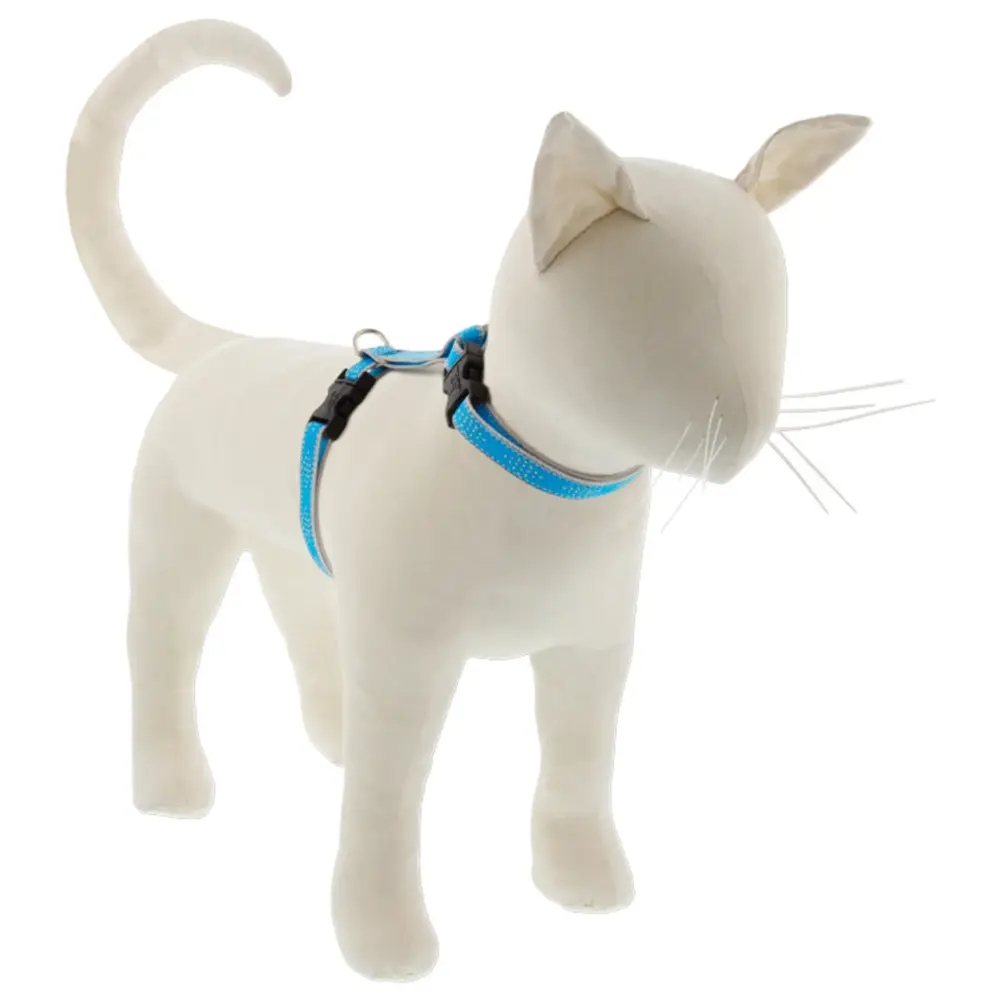
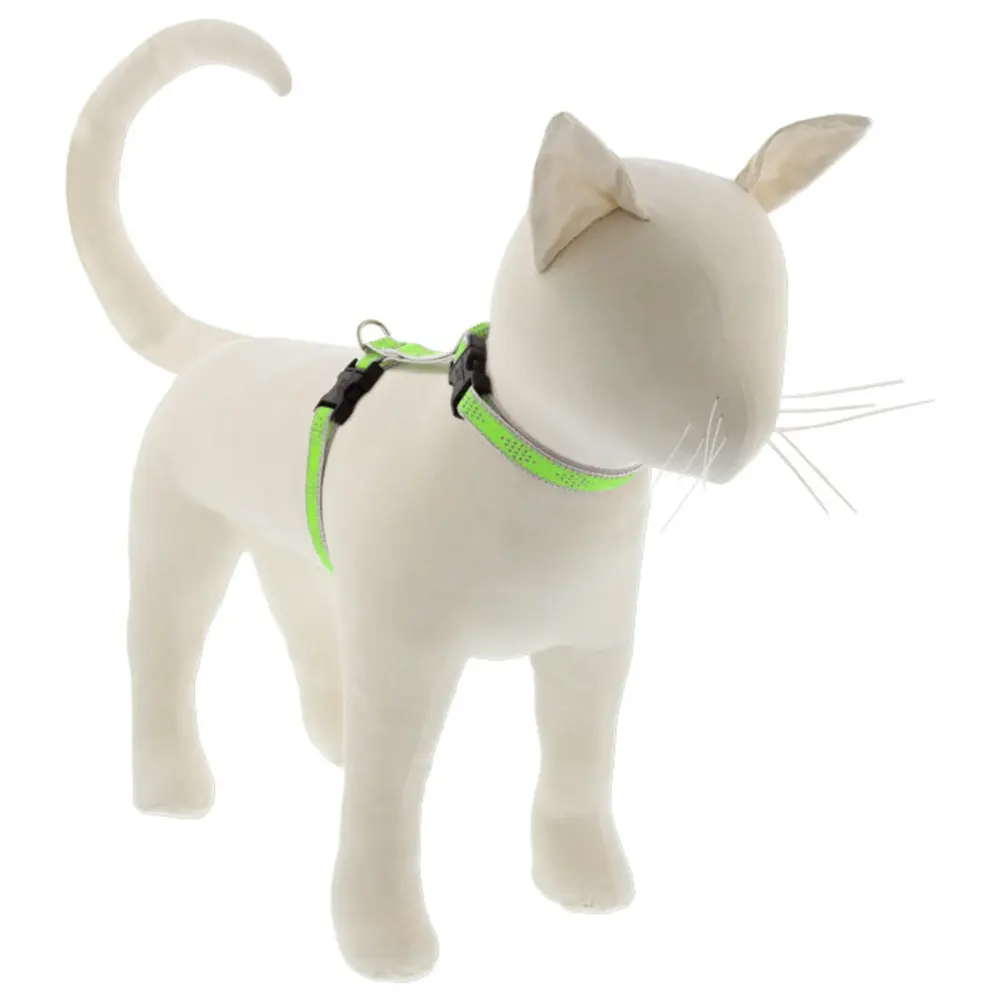
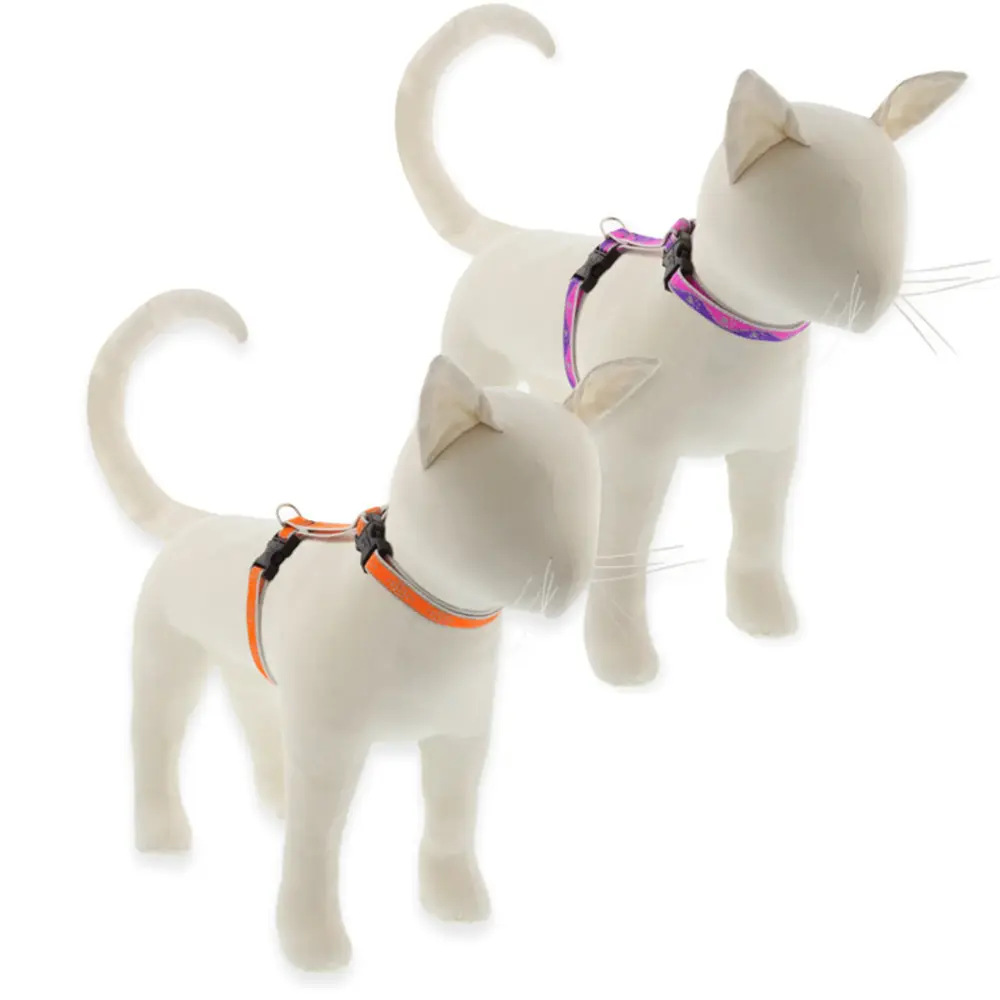
We carry one cat harness and no cat collars. The Lupine Pet Reflective H-Style Cat Harness is a cat-specific H-style that doesn’t restrict the shoulders, with adjustable neck and girth straps, quick-release buckles and a reflective weave that adds visibility at dusk. It comes in six designs and is made in the USA. Like any harness, it’s for supervised outings only. You’ll find it with the rest of our cat essentials.
It’s offered in two girth ranges, 9–14 inches and 12–20 inches, so measure around the chest just behind the front legs before you order. A size you chose that doesn’t fit counts as a change-of-mind return under our returns policy.
For a collar, shop for one made for cats with a snap-open safety buckle and no elastic, and check it against the rules above. The Lupine collar in our walking range is sold as a dog collar, built to hold a leash and ID tags, so it isn’t the one to put on your cat.
Related guides
-
Comparison
Indoor vs Outdoor Cats: Risks, Benefits and the Middle Ground
Indoor-only, supervised, daytime or free outdoor access? Compare all four on safety, disease, wellbeing, weight and wildlife, see which cats suit each, and learn how to move an outdoor cat indoors gradually.
-
Comparison
H-Style vs Vest Cat Harness: Which Is Harder to Slip and Easier to Fit
An H-style harness is two light, adjustable loops; a vest wraps more of the body in fabric. See which is harder to slip out of and why fit matters more than style, how each goes on, which suits kittens, nervous cats and warm days, and how to check the fit of either.
-
How-to
How to Stop a Cat From Running Out the Door
Indoor cats dash for the door because it offers more smells and movement than anything else in the house, and often because that is where they get greeted. Learn a household door routine, how to teach a rewarded spot away from the entry, how to handle guests and moving day, and what to do if your cat gets out.