Journal Checklist
A Realistic Daily Dog Care Routine
Short answer
A dog needs fresh water, one or two measured meals, at least one walk with real sniffing time, some interaction with you, something to chew or work at, and a long stretch of undisturbed sleep. Everything else is useful rather than essential.

The daily minimum
There is a short list that genuinely has to happen every day, and a longer list of things that improve life but can slip without harm. Knowing which is which is what keeps a routine sustainable on a bad week.
- Fresh water, available all day, bowl rinsed
- Measured food, split into one or two meals
- At least one trip outside with time to sniff
- Toileting opportunities at reasonable intervals
- Some direct interaction: training, play, or just company
- Something to chew, lick or work at
- Undisturbed sleep, in large blocks
- A quick look at your dog: eyes, movement, appetite, toileting
Morning
The first part of the day sets the tone. Let the dog out, then feed, then walk once things have settled rather than racing straight out of the door. Dogs who are walked immediately after eating a large meal are better off with a gap, particularly deep-chested breeds.
Use the morning routine as the daily check as well. While you are refilling the water, look at your dog moving across the room, note whether they got up easily, and watch them eat. Three or four seconds of attention here catches most problems earlier than any formal examination.
Through the day
Adult dogs sleep a great deal and should be allowed to. The useful contributions during the day are toileting opportunities and something to do when you are busy.
- Toilet breaks every four to six hours for most adults, more often for puppies and seniors.
- One thing to work at on days you are at a desk: a food puzzle, a stuffed toy or a scatter feed in the garden.
- Short interactions rather than constant attention. Two minutes of training beats an hour of background fussing.
- Quiet. A dog who is woken every time you walk past is not resting properly.
If your dog cannot settle while you work, that is worth addressing on its own terms: keeping a dog busy while working from home covers the practical version.
Evening
The evening walk is where most of the day’s sniffing should happen, because there is usually less time pressure. Slower and shorter beats brisk and long for almost every dog.
After the walk, dinner and then something slow: a chew, a lick mat, or a puzzle. Licking and chewing are settling behaviours, which makes them useful at the end of the day rather than first thing. Finish with paws wiped if it is wet outside, and leave the dog alone to sleep.
-
SodaPup
Honeycomb Slow Feeder Dog Bowl, View product
$30.95
Why it fits: Slows a fast eater without changing the food; the honeycomb ridges turn thirty seconds into several minutes.
-
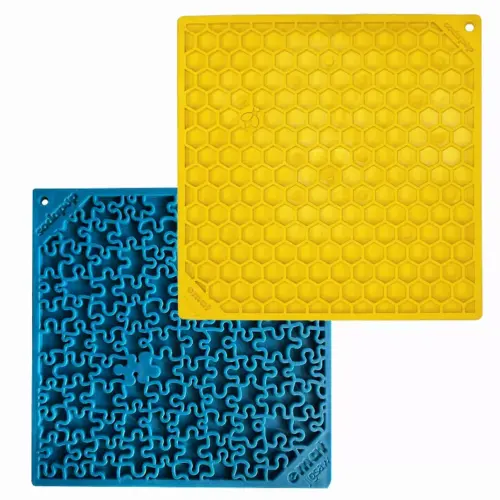
eMat Lick Mat Bundle, View product
$35.95
Why it fits: Two lick mats for the wind-down slot; freeze one and an evening routine takes care of itself.
-
Sakabase
Curved Slicker Brush, View product
$39.95
Why it fits: A curved slicker for the two-minute brush; little and often beats a long session once a month.
-
Mr. Peanut’s
Naturals Pet Wipes
$26.95
Why it fits: Large wipes by the door for muddy paws, ears and faces between baths.
Currently out of stock



How many walks, honestly
Most adult dogs do well on one or two outings a day, and quality matters more than the number. A single forty-minute walk with real sniffing time beats three rushed laps of the block, and two shorter outings suit dogs who struggle to settle in the afternoon.
There are exceptions in both directions. Puppies need frequent short trips and very little sustained walking. Working-bred adolescents often need more, though usually more to think about rather than more distance. Senior dogs and dogs with joint problems generally do better on several short, flat walks than one long one. How long should you walk a dog goes into the specifics.
Water, and why the bowl matters
Water should be available all day, in a bowl large enough that it does not empty, and rinsed daily rather than topped up. A film builds inside a bowl within a day or two and that is what makes a water bowl smell. Stainless steel and ceramic are easier to keep clean than plastic, which scratches and holds bacteria.
Dogs drink noticeably more in hot weather and after exercise, and a dog who suddenly starts drinking much more, or much less, than usual is giving you a medical signal worth a call rather than a wait. On walks and journeys, carry water rather than relying on finding some.
Weekly jobs that get forgotten
- Wash the food and water bowls properly, not just a rinse. See how often to wash dog bowls.
- Brush the coat, even on short-coated dogs
- Check and clean ears, without going into the canal
- Look at the nails and trim or grind if needed
- Check teeth and gums
- Wash or shake out the bed, and look for wear
- Check the harness, collar and lead for fraying
- Weigh the dog, or at least run your hands over the ribs
Most of these take under two minutes and they fit naturally into one session. The weekly at-home health check turns the list into a single five-minute routine.
Training, in the ordinary sense
Training does not need a session. Two or three minutes scattered through the day, attached to things that happen anyway, does more over a month than a weekly half hour. Ask for a sit before the lead goes on, a wait at the door, a recall from the garden, a hand touch while the kettle boils.
This is also how a dog stays mentally occupied without extra walking. Teaching a dog to find a named toy, to settle on a mat, or to go to their bed on cue uses the same brainpower as a long walk and costs you five minutes. For dogs who struggle to switch off, a reliable settle cue is the single most useful thing you can teach.
- Keep sessions under three minutes and finish while it is going well
- Use food the dog would have eaten anyway rather than extra treats
- Practise in different rooms, which is harder than it sounds
- Reward the behaviours you want when they happen by accident
- End with something easy so the last repetition is a success
What you can safely skip
On a difficult day, the non-negotiables are water, food, toileting and rest. A missed walk is not a crisis if the dog gets something to work at instead; a scatter feed in the garden and ten minutes of training will keep most dogs reasonable for a day.
What should not slip repeatedly: measured food, because weight creeps up invisibly, and sleep, because an under-rested dog becomes a difficult dog within days.
Common questions
Once or twice a day for feeding?
Twice suits most adult dogs and is easier on the digestion than one large meal. Puppies need three or four. The total daily amount matters far more than the number of meals, and splitting it does not change the calories.
Should I walk before or after feeding?
Leave a gap around a large meal, particularly for deep-chested breeds. Walking first and feeding afterwards works well for most households and fits the natural pattern of activity followed by food and rest. Feeding a dog before or after a walk covers it properly.
Does my dog need a walk every single day?
Most dogs benefit from getting out daily, but a missed day is not a welfare failure if the dog gets toileting opportunities and something to do. A day of sniffing games in the garden and short training sessions is a perfectly reasonable substitute now and then.
How long can a dog be left alone?
Four hours is a common upper guide for an adult dog who is comfortable alone, less for puppies and for dogs who struggle with separation. What matters more than the number is whether the dog settles; a dog who is distressed for the whole time is not coping, however short it is.
Is a routine the same as a rigid timetable?
No, and rigid timetables can backfire by making a dog anticipate things to the minute. Aim for a predictable order of events rather than exact times.
When the routine has to flex
No routine survives a full week of real life. What matters is knowing which parts can move and which cannot, so that a disrupted day does not turn into a disrupted month.
| Situation | What to protect |
|---|---|
| Working late | Toileting, food, something to chew |
| Illness in the family | Routine timing, even if walks shorten |
| Bad weather | Indoor sniffing games instead of distance |
| Travelling | Food, water, familiar bedding |
| Dog on restricted exercise | Enrichment, since walks are gone |
Dogs cope with less far better than they cope with unpredictable. A short, boring, on-time day is easier on a dog than a brilliant walk at a random hour, which is worth remembering during a difficult week.
Sharing the routine in a household
Most overfeeding happens because two people each give a meal, and most training inconsistency happens for the same reason. A note on the food bin stating the daily amount, and a shared understanding of who does what, solves both.
It is worth writing down the amounts rather than relying on a scoop that everyone fills differently, and agreeing which cues the household uses so a dog is not asked for the same behaviour in four different ways.
Adjusting for puppies and seniors
Puppies need more of everything except exercise: more meals, more toilet breaks, far more sleep, and short bursts of activity rather than long walks. Over-walking a growing dog is a real risk and the usual mistake.
Senior dogs need the opposite adjustment. Shorter, more frequent walks on flat ground, a supportive bed somewhere warm, food and water at a comfortable height, and closer attention to weight and movement. For what to watch, see signs a dog is in pain, and for the longer schedule, the preventive care calendar. The equivalent routine for cats is in a realistic daily cat care routine.
Related guides
-
Checklist
A Preventive Care Calendar for Dogs and Cats
Preventive care is mostly a scheduling problem. This calendar lays out the daily, weekly, monthly and annual jobs for dogs and cats, says which ones belong to a vet, and adjusts for puppies, kittens and senior pets.
-
How-to
The Weekly At-Home Health Check for Dogs
Five minutes a week, done in the same order, catches most problems while they are still small. This guide walks through a nose-to-tail check for dogs, what normal feels like, and the findings worth a phone call.
-
How-to
How to Check Your Dog Is a Healthy Weight at Home
Scales alone will not tell you whether your dog is a healthy weight. This guide covers the three-part hands-on check vets use, what each result feels like, and the changes that work when the answer is not what you hoped.