How to Use a Dog Nail Grinder: Step by Step, Plus Black Nails and Nervous Dogs
Knowing how to use a dog nail grinder comes down to three habits: hold the paw steady, touch one nail to the spinning head for a second or two with light pressure, then lift off and look. Rotate between nails so each one cools, and stop well before the quick, the living core of the nail. Go slower on dark nails, where you can’t see the quick, and introduce the grinder gradually to a wary dog.
Short answer: a few seconds per nail, light pressure, and stop well before the quick
- Touch, lift, look. One or two seconds of contact, then check the end of the nail.
- Light pressure, lower speed first. Pressing harder mostly just warms the nail.
- Rotate around the paw, so each nail cools before its next touch.
- Stop at the first change: pink showing through a light nail, or a chalky ring on the end of a dark one.
- Little and often. One or two nails with a treat in between still counts.
What you need: the grinder, good light, treats and a second pair of hands
- A charged grinder with a guard, which lets only the nail tip reach the grinding head.
- Good light, so you can read the end of each nail.
- Small, soft treats your dog can swallow at once. A helper can also hold a lick mat at nose level; see what to put on a lick mat for baths, brushing and nail trims.
- A helper to hold and reward while you grind.
- Styptic powder or cornstarch, open and within reach.
- A non-slip surface, such as a bath mat on the floor. Never leave a dog alone on a table.
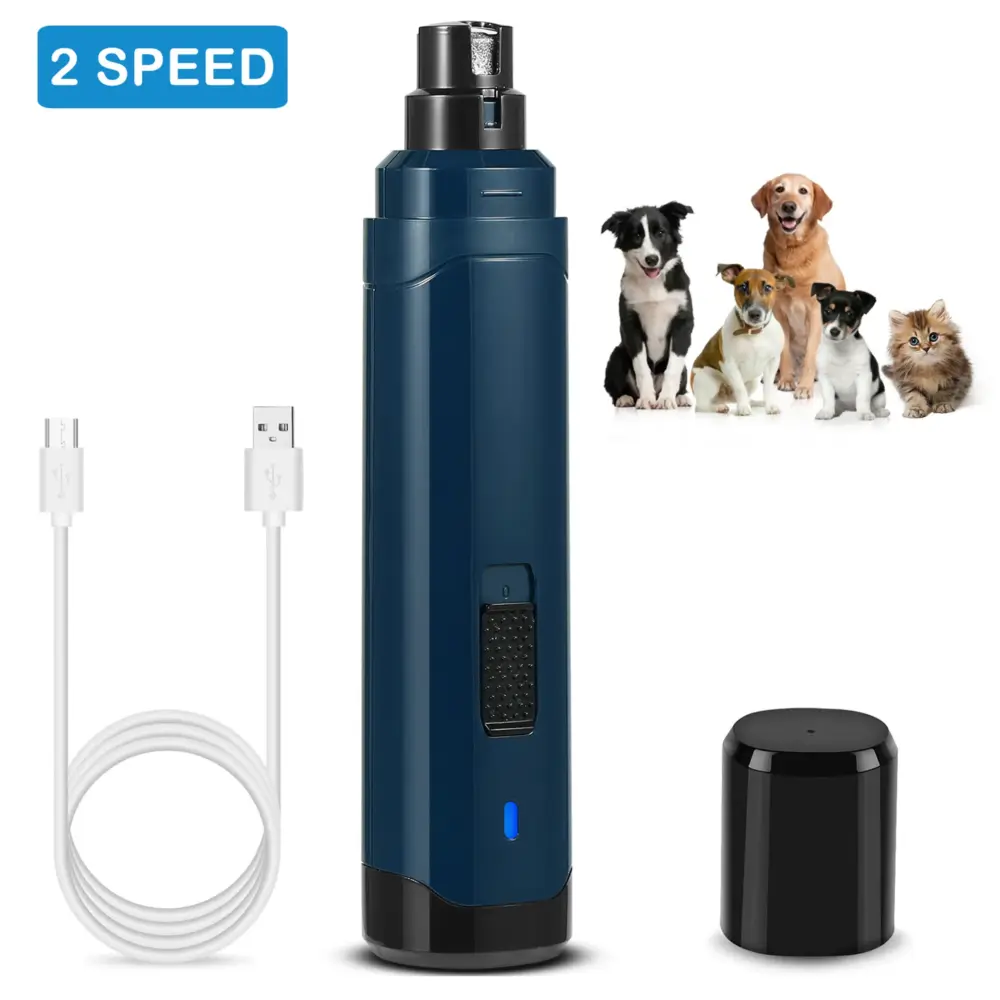
The grinder we carry, the Quiet Rechargeable Pet Nail Grinder, charges by USB and has two speeds for thick and thin nails, a quiet motor meant to bother nervous pets less, and a safety guard with openings sized for dogs, cats, rabbits and other small pets. Quiet is not silent, though: every grinder hums and vibrates, so the slow introduction below is worth the time.

The cat-sized opening means one grinder can serve a cat too; see how to trim a cat’s nails when your cat won’t let you, or browse all our grooming guides.
How to use a dog nail grinder, step by step
If your dog is wary of the grinder, start with the slow introduction further down.
- Settle your dog. A small dog can sit on your lap; a large dog is often easiest lying on its side, with your helper at the head.
- Pick the guard opening and speed. Use the opening that lets the nail tip through but not the toe. Start on the lower speed and save the higher one for thick nails.
- Hold the paw and the fur. Rest your thumb on the toe pad and a finger on top of the toe, then press gently so the nail extends. Keep long hair back from the spinning head.
- Touch for a second or two. Switch on away from the paw, hold the grinder near the top like a thick pen, bring the head to the nail with light pressure, then lift off and look.
- Grind the underside, then the tip. Pass across the bottom of the nail, then work carefully in from the tip, following its curve. Move to the next nail so the first one can cool.
- Check every nail. On a light nail, stop while the pink quick is still a little way back; on a dark nail, use the signs in the next section.
- Smooth the edges and do any dewclaws. A light pass around the rim rounds off sharp edges. Dewclaws, on the inner side of the leg, never wear down on walks and can curl into the toe.
- Reward and tidy up. Treat, praise, and wipe the nail dust off the paws.
Watch your dog, not the clock. Pulling the paw back, lip licking, yawning or turning the head away mean it’s time to stop, even with only two nails done.
Dark or black nails: taking it down a little at a time
You can see the pink quick through a white nail but not through a black one, which is why trimming black dog nails worries so many owners. A grinder helps because it removes thin layers, so you can check the end after every touch. As you work back, it usually changes like this:
- Hard and dark all the way across: you still have room.
- A chalky, whitish ring or center: you’re getting close, so slow right down.
- A small dark dot, or a center that looks moist or shiny: that is the front of the quick. Stop on this nail.
Light nails on the same dog give a rough idea of where the quick sits, but it varies from toe to toe. When in doubt, take just the tip, as VCA Animal Hospitals’ guide to trimming a dog’s nails also advises, and ask your veterinarian or a groomer to show you the first time.
If your dog is nervous: a slow introduction over several days
A dog scared of a nail grinder is usually reacting to the buzz, the vibration and having a paw held, all at once. To get a dog used to a nail grinder, introduce those three things one at a time. Keep sessions to a few minutes and move on only when your dog is relaxed; some dogs need a day per step, others a week.
- Switched off. Let your dog sniff the grinder on the floor beside a few treats.
- Sound at a distance. Run it on the low speed across the room. Treats flow while it runs and stop when it goes off.
- Sound up close. Over several sessions, bring it nearer until your dog eats calmly right beside it.
- Paw handling. Hold a paw for a second, treat, let go, and build up to pressing a toe. Everyday moments count, such as cleaning your dog’s paws after a walk.
- Vibration. Rest the body of the running grinder, not the head, against the paw for a second, then treat.
- One or two nails. One short touch per nail, one treat, and finish on a good note.
If your dog gets frightened, go back to the last comfortable step and stay there longer; never pin a struggling dog down. If your dog growls, snaps or panics, stop and talk to your veterinarian; some dogs do better having their nails done at the clinic or by a groomer.
Grinder vs clippers: when each one makes sense
Choosing between a dog nail grinder and clippers comes down to what your dog tolerates and how sure you are of where the quick is.
- A grinder suits dark nails, thick nails that crack when clipped, dogs who hate the squeeze and snap of clippers, and owners who want a smooth, rounded edge.
- Clippers suit dogs who accept a held paw but not noise, owners who want the job done in a minute, and trips with nothing to charge.
A grinder’s downsides are real: it is slower, it hums and vibrates, it makes fine nail dust, it can catch long paw hair, and a nail warms up if you hold the head on it. Many owners clip a long tip, then grind the edge smooth. We stock a grinder, not clippers, alongside our other dog and cat grooming tools; clippers are a fine choice if they suit your dog better.
How often to grind, and what to do if you nick the quick
Most dogs need a nail trim every three to four weeks, according to the American Kennel Club’s nail-trimming guide, depending on how fast the nails grow and how active the dog is. With a grinder, a light touch-up every week or two is often easier. It’s time when nails click on hard floors or touch the ground while your dog stands still.
Long-neglected nails usually have a long quick, so take a little off every week or so; regular trimming encourages the quick to recede. A nail check fits neatly into the weekly brushing plan in our guide to how often to brush a dog. Ask your veterinarian about any nail that is curling toward the pad, split or cracked.
If you nick the quick
- Stay calm. Press styptic powder or cornstarch onto the end of the nail and hold gentle pressure for a minute or two.
- Keep your dog quiet for a while so the clot isn’t knocked loose, and leave the rest of that paw for another day.
- Call your veterinarian if the bleeding doesn’t stop after a few minutes of steady pressure, if the nail is split, or if the toe looks swollen or sore later.
Dog nail grinder FAQ
How long should you grind a dog’s nails?
About one or two seconds per touch, then lift off and check. Most nails need a few touches, well under a minute in all. If a nail feels warm, move on and come back to it.
How far back should you grind dog nails?
Until the nail clears the floor when your dog stands, or until the first sign of the quick, whichever comes first. If the nails are still long at that point, take a little more each week.
What angle do you grind dog nails at?
Many owners hold the head at roughly 45 degrees to the nail, but following the nail’s own curve matters more than any number: underside and tip first, then a light roll around the edges.
Can a nail grinder hurt my dog?
It can if the head stays on one nail long enough to warm it, is pressed hard, reaches the quick, slips onto the skin or catches fur. Used in short, light touches with the hair held back, it shouldn’t hurt; the noise and vibration are what usually bother a dog.
How do I keep long paw hair out of the grinder?
Hold it back with your fingers as you grip each toe. Some owners pull a piece of old nylon stocking over the paw and poke each nail through, which keeps the fur flat. Tie back your own long hair and any loose drawstrings too.
Related guides
-
How-to
How to Groom a Yorkie at Home: Brushing, Baths, Nails and Trims
A Yorkie’s silky coat keeps growing and knots close to the skin. This routine covers a misted brush-out with a comb check, baths every week or two, eye, ear and teeth care, nails every two weeks, and which trims to do at home or leave to your groomer.
-
How-to
How to Groom a Labrador Retriever: Sheds, Swims, Ears and Paws
A Lab’s short double coat needs a weekly brush, daily combing through the two big sheds, and a fresh-water rinse after every swim. Here is the routine, plus drying a dense coat, checking dropped ears, nails every few weeks and trimming the hair between the pads.
-
How-to
How to Groom a Goldendoodle at Home: Brushing, Mats and Trims
Curly and wavy doodle coats shed little and mat close to the skin, so brushing has to reach the roots. Here is the section-by-section routine, the spots that mat first, face, ear and foot care, bathing and drying, nails, and how often to book the groomer.