Journal Guide
How to Read Cat Body Language: Tail, Ears, Eyes and Posture
Short answer
Cats signal with the tail, ears, eyes, whiskers and posture, and they do it quietly. An upright tail with a slight hook is a friendly greeting; flattened ears, a thrashing tail or a hard stare mean stop. When in doubt, offer a hand and let the cat decide.
Cats signal quietly
The common complaint that a cat attacked out of nowhere is almost always a missed conversation. Cats warn, but their warnings are small: an ear rotates, a tail tip starts to flick, the skin along the back twitches. People notice the swipe because it is the first signal that is loud.
Learning the quiet end is the whole skill. It takes a few days of watching your own cat rather than any amount of theory.
Tail positions and what they mean
The tail is the clearest part of a cat to read from across a room, which makes it a good place to start.
| Tail | Usually means |
|---|---|
| Straight up, tip hooked | Friendly greeting; happy to interact |
| Up and quivering | Excited to see you |
| Low and relaxed | Calm, going about business |
| Tucked under or against the body | Frightened or unwell |
| Tip flicking | Mild irritation; pay attention |
| Thrashing side to side | Stop now |
| Puffed up, arched back | Startled; trying to look bigger |
Tip
A thrashing tail means the opposite in cats and dogs. If you learned on dogs, this is the single most useful correction to make.
Ears and eyes
Ears rotate independently and move faster than anything else on a cat. Eyes are slower but say more about intent.
- Ears forward: interested and comfortable.
- Ears swivelled sideways, sometimes called aeroplane ears: agitated or conflicted.
- Ears flat against the head: frightened or defensive. Back off.
- Slow blink: a genuine comfort signal. Return it slowly and many cats will blink back.
- Hard, unblinking stare: a challenge, not affection.
- Wide pupils in normal light: aroused, frightened or in pain.
- Narrow slits in dim light: focused, often on something they want to chase.
Whiskers and posture
Whiskers are overlooked and very informative. They move with mood and attention, and they are difficult to fake.
- Whiskers relaxed, fanned slightly out: content.
- Pushed forward: interested, hunting, or investigating something close up.
- Flattened back against the cheeks: frightened or defensive.
- Loaf position, paws tucked under: settled, but not ready to run; a cat in pain may also loaf tightly with a hunched back.
- Crouched with the weight over the paws: ready to move; not relaxed.
- Stretched out on one side: genuinely relaxed.
The belly is not an invitation
A cat rolling over and exposing the belly is showing trust. It is rarely a request for a belly rub. The belly is the most vulnerable part of a cat, and the usual response to touching it is a reflex: front paws grab, back legs kick.
Take it as a compliment, rub the head or the cheeks instead, and let the cat keep its position.
Purring is not only happiness
Cats purr when content, and they also purr when frightened, injured or very unwell. A cat purring in a carrier at the vet is usually not happy. Read the purr with the rest of the body: a loose, blinking, kneading cat is content, a tight, crouched, purring cat is not.
Signs a cat wants to be left alone
These come in a fairly reliable order, which gives you time to act if you are watching for them.
- The tail tip starts to flick
- Ears rotate sideways or back
- Skin along the back twitches or ripples
- The cat stops purring mid-stroke
- The head turns toward your hand
- The body goes still
- A low growl, hiss or a quick paw with no claws
Petting-induced irritation builds. Many cats enjoy three or four strokes and then want it to stop, which is why keeping sessions short and letting the cat ask for more works far better than stroking until something happens.
Vocal signals, briefly
Adult cats barely meow at each other. The meow is mostly a cat-to-human signal, developed over domestication because it works on us. That means your cat’s meows are learned and personal, and the useful skill is knowing your own cat’s small vocabulary rather than any general rule.
- Short, bright meow: a greeting, or a request.
- Repeated insistent meowing: a demand, usually food, a door, or attention.
- Chirps and trills: friendly, often used by mothers to kittens and by cats toward people they like.
- Chattering at a window: frustrated hunting excitement, not distress.
- Low growl or long wail: a serious warning. Leave the cat alone.
- Hissing: fear, not aggression. A hissing cat wants the situation to stop, not to start a fight.
- Loud night crying in an older cat: worth a veterinary appointment rather than a behaviour plan.
A sudden change in how much a cat vocalises matters more than what the sounds mean. A quiet cat who becomes loud, or a chatty cat who goes silent, is worth paying attention to.
What a relaxed cat looks like
Knowing the baseline makes everything else easier to spot. A relaxed cat lies with the body stretched or loosely curled rather than tucked tight. The eyes are half closed or blinking slowly. Ears sit forward in their neutral position, whiskers fan gently outward, and the tail either rests still or sways in a slow, loose arc. A relaxed cat grooms properly, in long strokes, and stops when something interesting happens rather than carrying on frantically.
Compare against your own cat rather than a diagram. Flat-faced breeds, cats with folded ears and cats with docked or naturally short tails all have a different neutral, and reading them against a generic chart produces false alarms in both directions.
Reading two cats together
In a multi-cat home, the signals that matter are mostly about space. Cats rarely fight openly when they can avoid each other, so conflict usually looks like one cat quietly controlling the room.
- Blocking: one cat sitting in a doorway, on the stairs or beside the litter box. This is not resting; it is a toll gate.
- Staring: a long, silent look across a room is a complete argument in cat terms.
- One cat always leaving: if the same cat gives up the sofa, the bowl or the windowsill every time, the arrangement is not working.
- Over-grooming or hiding in one cat only: often the clearest sign of pressure between two cats who never fight.
- Genuine friendliness: sleeping in contact, grooming each other, tails up on approach. These are reliable and hard to fake.
The fix is almost always more resources in more places rather than intervention: separate bowls, more than one litter box, and several places to rest at different heights. Multi-cat household setup covers the full layout.
Building trust with a cautious cat
Cats trust predictability. The reliable approach is to make yourself less interesting rather than more: sit at their level, do not reach, look away, and let them close the distance. Offer an index finger at nose height and wait. A cat who rubs it is consenting. A cat who sniffs and walks off has answered too.
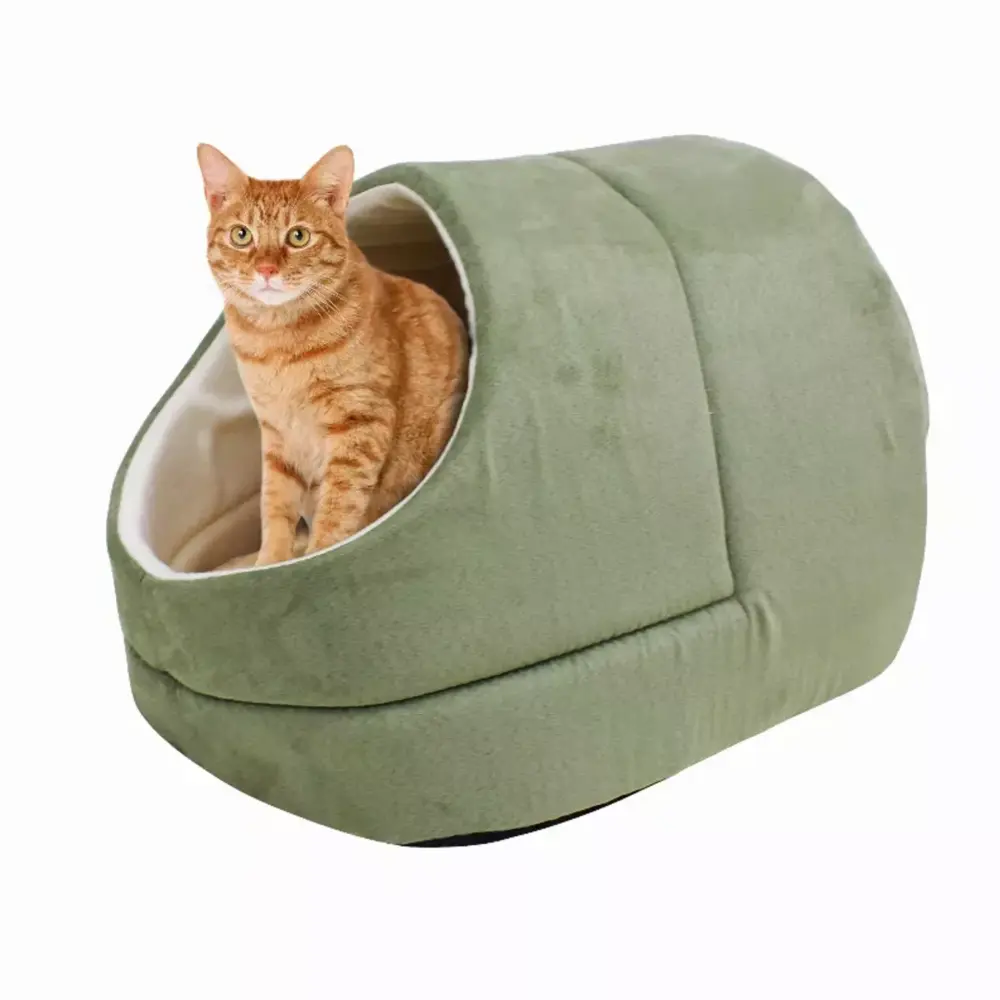
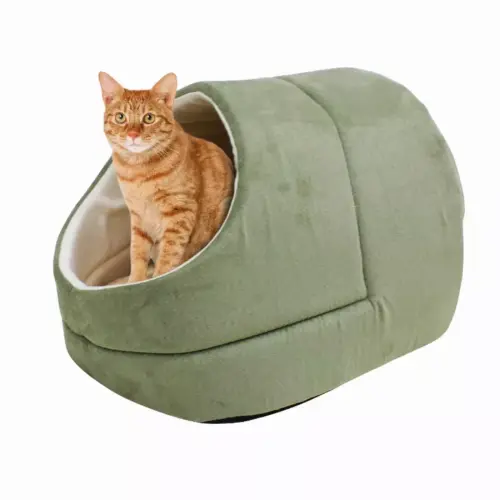
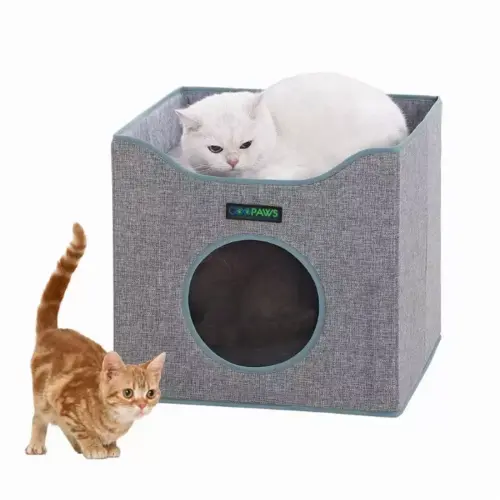
Give them the physical means to opt out as well. A covered bed or a cube at floor level, somewhere they can watch the room without being in it, settles cautious cats faster than any amount of coaxing.
-
GOOPAWS
Covered Cat Cave Bed, Choose color
$45.95
Why it fits: An enclosed bed a cautious cat can watch the room from; hiding places reduce stress more reliably than reassurance does.
-
JESPET
Foldable Cat Cube House with Reversible Cushions, Choose color
$52.95
Why it fits: A cube with a den below and a perch on top; it covers both things cats want in one small footprint.
Scent, which is half the conversation
A large part of feline communication is chemical and therefore invisible. Cats deposit scent from glands on the cheeks, the chin, the paws and the base of the tail, and they use it to mark territory as safe and familiar. Head bunting against your leg, rubbing along furniture and scratching a doorway are all the same behaviour in different forms.
This matters practically. Cleaning everything with strong-smelling products removes a cat’s scent map and can make a familiar room feel unfamiliar, which is one reason some cats react badly after a deep clean or a redecoration. It also explains why a cat who has been to the vet may be hissed at by a housemate: they come back smelling wrong.
Tip
After a vet visit in a multi-cat home, keep the returning cat separate for a few hours and let them groom. Rubbing a soft cloth on the cat who stayed home and then on the returning cat helps restore the shared household scent.
When to seek help rather than interpret
Body language explains most of what cats do, and some changes need a vet rather than an interpretation. Sudden aggression in a previously calm cat, a cat who objects to being touched in a specific place, a cat who stops jumping, or one who starts hiding are all commonly caused by pain rather than mood.
The rule of thumb is that behaviour which appears suddenly, in an adult cat, with nothing changed in the household, is a medical question until proven otherwise. Our guides on signs a cat is in pain and when to call the vet about a cat both cover it.
Common questions
Why does my cat bite me when I am stroking her?
Because the stroking went past the point she wanted it to stop. Cats generally give three or four warnings first: the tail tip flicks, the ears rotate, the skin ripples, the purring stops. Keeping sessions to a few strokes and letting her ask for more removes the problem almost entirely.
What does the slow blink actually mean?
It is a comfort signal. Closing the eyes slowly in company is a cat saying they feel safe enough not to watch you. Returning it, slowly and without staring first, is one of the few reliable ways to tell a cat you are not a threat.
My cat shows me her belly. Can I rub it?
Usually not. Exposing the belly is a sign of trust rather than a request. Most cats respond to a belly rub by grabbing with the front paws and kicking with the back ones, which is a reflex rather than an attack. Rub the cheeks or the base of the ears instead.
Is purring always a good sign?
No. Cats purr when content and also when frightened, injured or seriously unwell. Read it with the rest of the body: a loose, blinking cat who is kneading is content; a tight, hunched, purring cat in a carrier is not.
Why does my cat headbutt me?
Head bunting deposits scent from glands on the face and is a genuine affiliative behaviour. Cats do it to other cats they are bonded with. It is one of the clearest compliments available in cat.
My two cats stare at each other and nothing happens. Is that normal?
That is an argument. Cats resolve most conflict without contact, and a long silent stare, or one cat blocking a doorway, is how it is done. If one cat is consistently giving way, add more resources in more places rather than waiting for an actual fight.
If the signals you are seeing look more like stress than preference, our guides on signs your cat is stressed and why cats hide go further, and things people do that cats quietly dislike covers the everyday habits behind most of them.
Related guides
-
Guide
Why Cats Hide, and When Hiding Means Something Is Wrong
Hiding is normal cat behaviour and also one of the clearest signs that something is wrong. This guide explains the difference, the timeline worth acting on, and why taking hiding places away makes everything worse.
-
Guide
What Cats Actually Enjoy: Hunting, Height, Warmth and Routine
Cat enrichment is usually sold as toys. What cats actually want is the hunt in full, somewhere high, somewhere warm and a routine they can predict. This guide explains all four and how to fit them into a flat.
-
Guide
Signs Your Cat Is Stressed, and the Changes That Help
Cats hide stress by design, so it usually shows up as a change rather than a signal: litter box habits, grooming, appetite and where they spend their time. This guide covers what to look for and the layout changes that fix most of it.