Car Travel How-to
How to Install a Dog Car Hammock So It Stays Put
Short answer
On a clean, dry back seat, loop the rear straps around the rear headrest posts, tuck the cover into the crease and pull the buckles through the seat-belt openings. Clip the front straps around the front headrests, then tighten every strap in stages until the bottom lies flat and the front wall is firm. Recheck after the first drive.
Before you start: prep the back seat
Prep decides whether the cover stays put. Grit under the fabric rubs the upholstery every time your dog shifts, hair and crumbs give the cover something to slide on, and a damp seat sealed under a waterproof layer dries slowly and can turn musty.
What you need:
- The hammock, unfolded, with every strap and fastener present.
- A vacuum with a crevice tool, for the seat crease and the base of each buckle.
- An old towel, to blot a seat that is still damp from the last ride.
- Your dog’s harness and seat belt tether, if your dog rides tethered.
- A front seat cover, only if you are covering the passenger seat as well.
Then get the car ready:
- Clear the back seat, and empty the seat-back pockets of anything you want on the drive; the hammock covers them.
- Vacuum the cushion, the backrest, the crease between them and around each buckle.
- If the seat is damp, blot it and leave the doors open until it is dry right through.
- Set the front seats where their usual occupants keep them, recline included. The front of the hammock hangs from the front headrests, so moving a seat later changes the tension.
- Look at the headrests. Adjustable ones sit on metal posts, where the straps hold best; built-in ones are covered under troubleshooting.
Safety note
Read the airbag section of your owner’s manual before you cover any seat. Many front seats, and some rear ones, have a side airbag in the outer side of the seat back, marked by an airbag label, and manuals warn against covering it or attaching anything near it. Many also warn that a cover on the front passenger seat can stop the occupant sensor in the cushion from reading who is sitting there, which affects the passenger airbag. A child car seat never goes on top of the hammock: install it on the vehicle seat, as its own manual directs.
How to install a dog car hammock, step by step
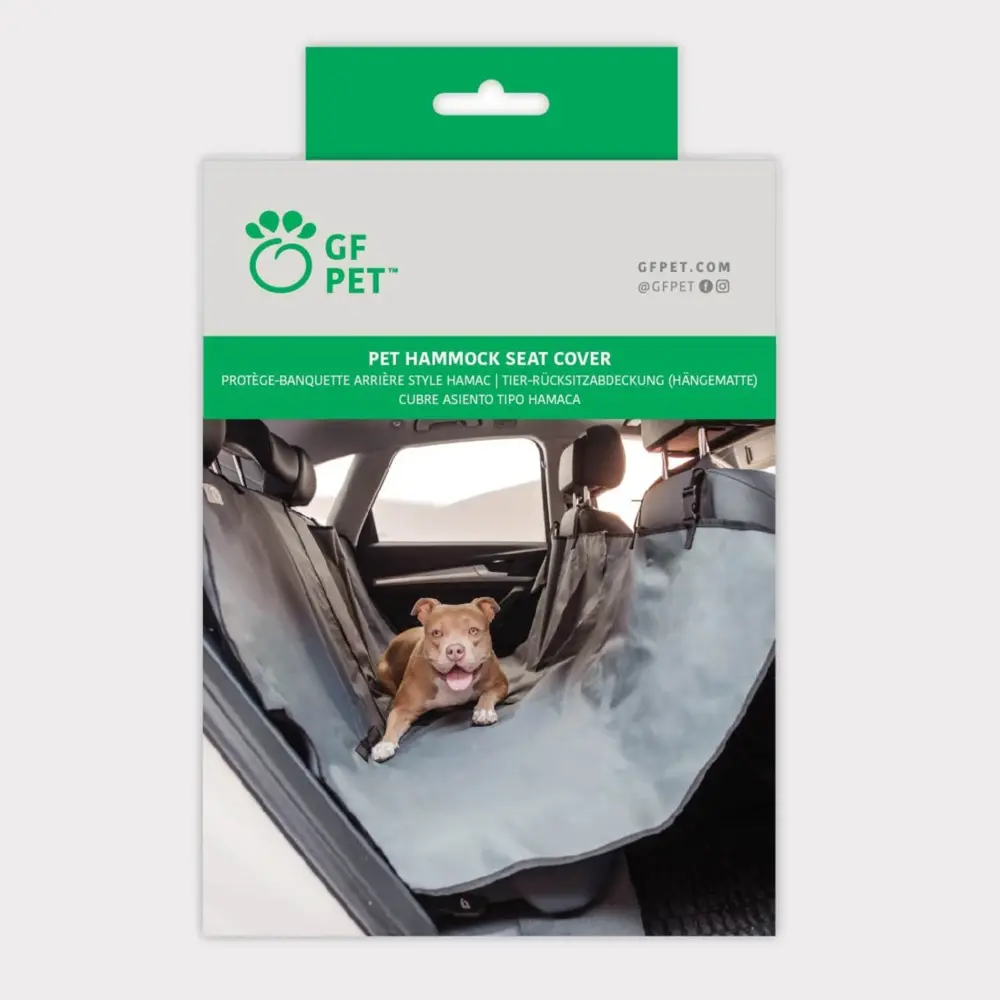
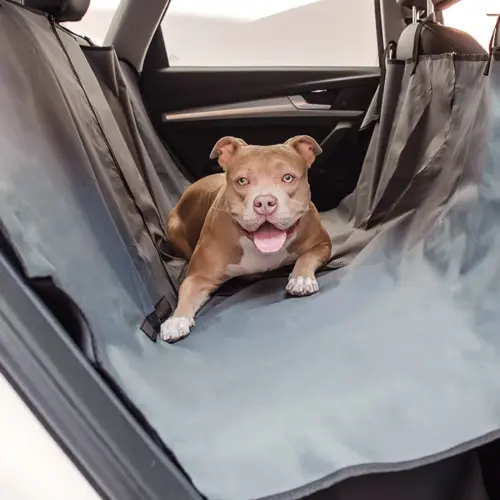
These steps use the features of the GF PET Waterproof Dog Car Hammock Seat Cover: adjustable headrest straps with clip-on fasteners, seat-belt openings and a detachable zipper. Most hammock-style covers go on in the same order.
- Work out which end is which. At 58 × 57 inches the cover is nearly square, so go by the straps, not the shape: one end goes to the rear headrests, the other to the front ones. Lay it right side up with the rear end at the top of the backrest.
- Clip the rear straps first. Loop each one around the posts of a rear headrest, just below the headrest itself, where it cannot ride up and slip off, and close the fastener. Leave the straps loose for now. If you raise a headrest to get a strap under it, lower it back to where it was.
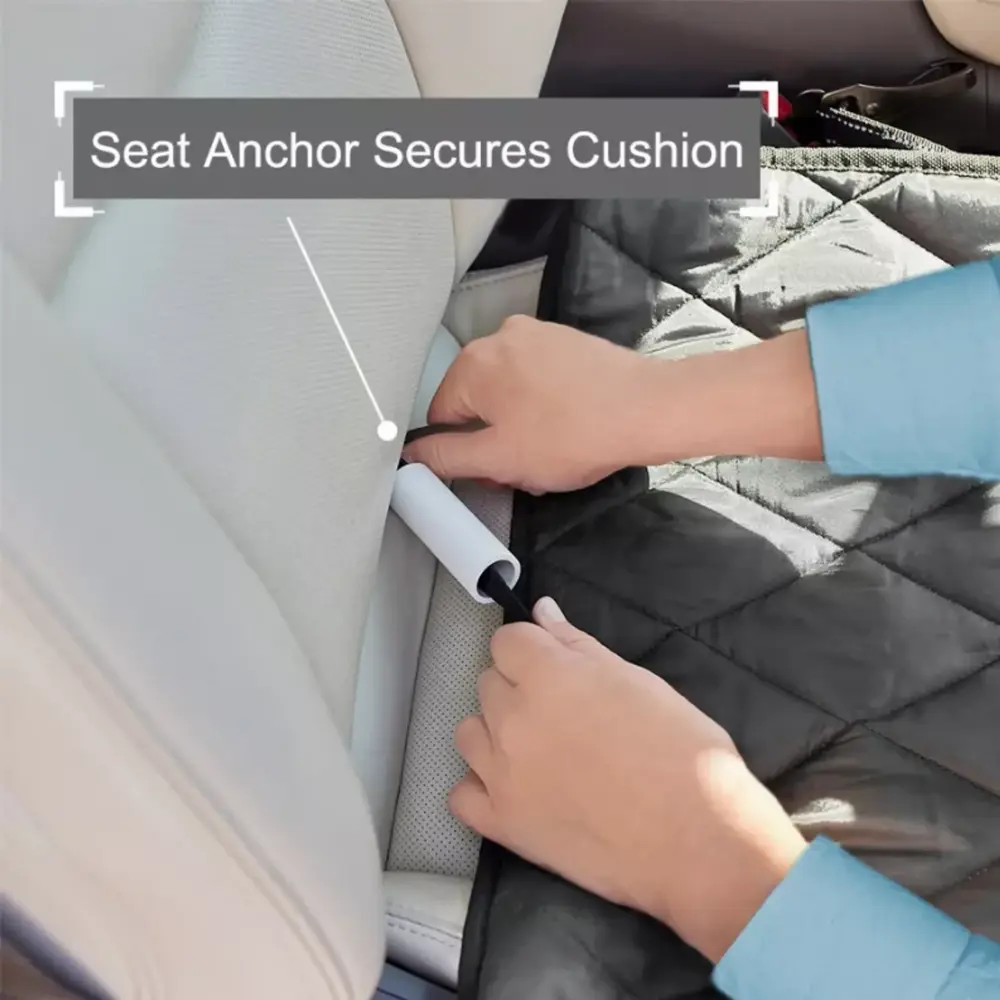
- Smooth it down the backrest and across the cushion. Push a fold of fabric into the crease where the backrest meets the cushion, working between the buckles. The tuck lets the cover follow the shape of the seat and gives it something to hold.
- Line up the seat-belt openings. Do it now, while everything is slack, because a tightened cover will not shift to meet a buckle. Bring the buckles you will use, for your dog’s tether and for any passenger, up through the openings so they sit on top of the fabric.
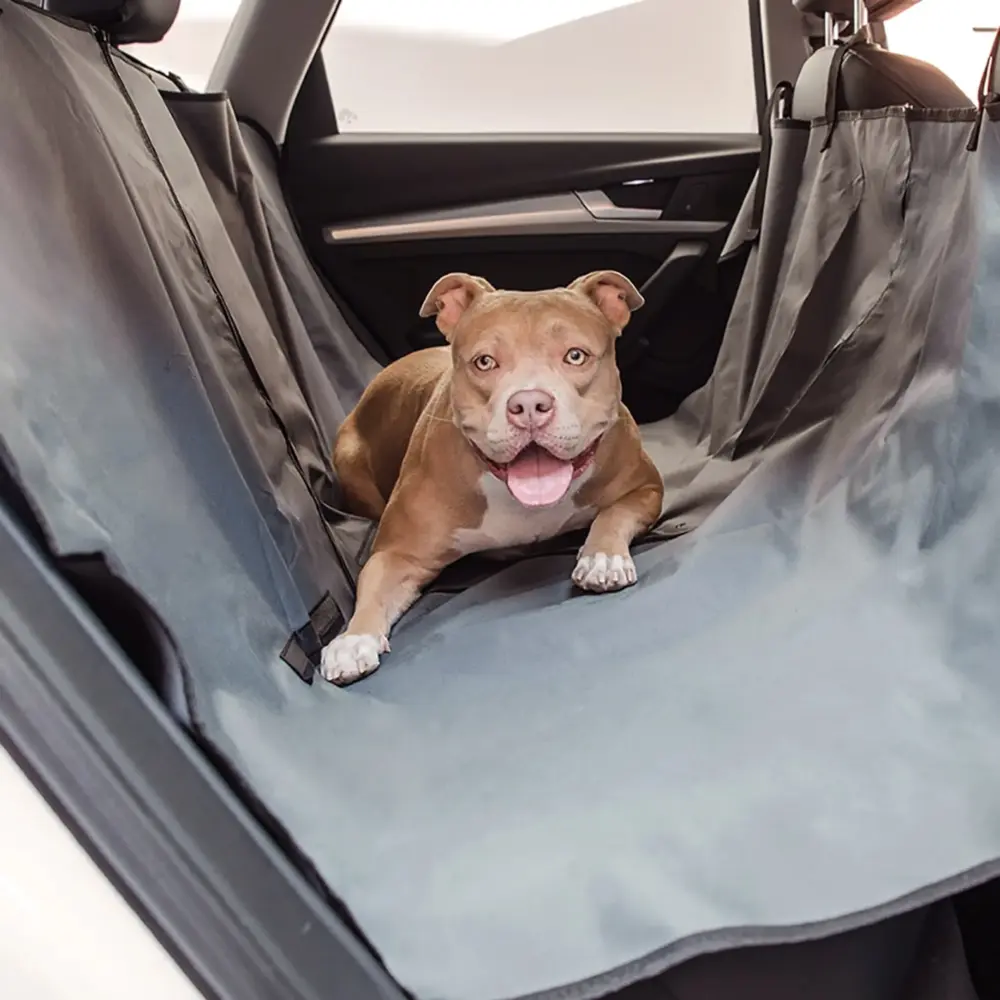
- Clip the front straps around the front headrests. Same as the rear: around the posts, fastener closed, still loose. The cover now rises from the front edge of the cushion to the front headrests, a wall that closes off the footwell and the gap between the front seats.
- Tighten in stages. Take up a little slack on one rear strap, then the other, then each front strap, and go around again. Cranking one strap tight first drags the whole cover off center.
- Check the fit. Run through the tension checks below, then open and close both rear doors to make sure no fabric or strap gets caught, and pull each rear seat belt out and let it retract.
- Recheck after the first drive. The fabric beds into the crease and the straps settle once a dog has ridden on it, so take up the slack again.
-
GF PET
Waterproof Dog Car Hammock Seat Cover, View product
$60.95
Why it fits: Adjustable headrest straps with clip-on fasteners, seat-belt openings and a detachable zipper, the features these steps use. Measure your back seat against 58 × 57 in first.
-
Adjustable Dog Car Seat Belt Tether, View product
$23.95
Why it fits: Its tab plugs into the buckle that comes up through a seat-belt opening, and the carabiner clips to the back of a harness, so your dog stays on their own side of the seat.
-
GOOPAWS
Waterproof Front Seat Cover for Dogs, Choose color
$43.95
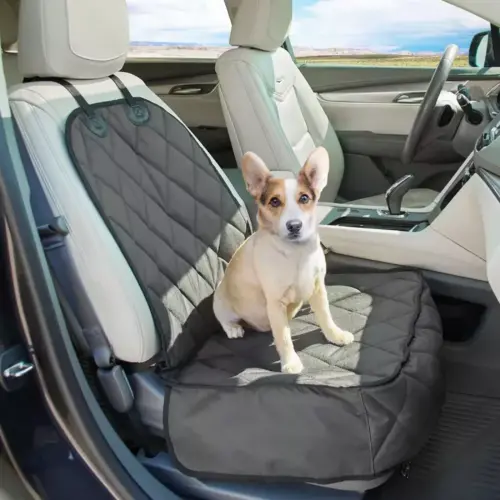
Why it fits: For the passenger seat: a non-slip backing and adjustable straps hold this 40 × 20.5 in waterproof cover in place, and it pairs with the hammock for full coverage.

Getting the tension right
Even matters more than tight. The cover should rest on the seat and be held in shape by the straps, not hang from them.
- The bottom: press down on the middle of the cushion. The fabric should already be touching it. If you can slide a flat hand under it anywhere on the cushion, the straps are lifting it into a trampoline that bounces under your dog; let the front straps out a little.
- The front wall: push a palm into it halfway between the seats. It should give slightly and spring back. If it folds into a pocket over the footwell, take up the front straps; a pocket is where paws slip and a dog ends up half off the seat.
- The front seats: sliding a front seat forward pulls the wall tighter, and sliding it back or reclining it leaves slack. Readjust the front straps whenever someone moves a seat.
- The doors: center the cover so any bare strip is even on both sides. On a wider bench, shift it toward your dog’s usual side; on a narrower one, let the extra fabric lie flat against the side of the cushion, clear of the door.
A cover that leaves wide gaps however you center it is too small for the car. Our guide to choosing a dog hammock or seat cover shows how to measure the back seat against the 58 × 57 in hammock before you order.
Using the seat-belt openings for a tether
The tether plugs into the buckle on your dog’s side, so that buckle has to come through the cover cleanly.
- Pick an outer seat for your dog. The one behind the front passenger lets you load from the curb.
- Check that its buckle stands up through the opening. If it is buried, loosen the nearest straps and shift the cover rather than stretching or cutting the opening.
- Push the tether’s tab into the buckle until it clicks, then tug to make sure it holds. The tab on our Adjustable Dog Car Seat Belt Tether fits most vehicle seat belts, not all, so test it in your car.
- Clip the carabiner to the back attachment of your dog’s harness, not a front clip and never a collar, and set the length so your dog can sit, stand and lie down but cannot climb over the front wall, step off the edge of the seat or reach a window. Our guide to dog seat belts and booster seats walks through the length and reach checks.
Safety note
The hammock’s front wall slows down a dog who wants the front seat, but it is fabric, and a determined dog can push past it. The tether is what keeps your dog in place, and neither the cover nor the tether is sold as crash protection.
Setting it up for one seat with the zipper
The detachable zipper lets you adapt the cover so a person can sit in one rear seat while your dog keeps a covered side. Try it once in the driveway before the day you need it.
- Put your dog on one outer seat and the passenger on the other, then open the zipper and release the passenger’s side as the cover’s own instructions show.
- Retighten the dog’s side. Releasing the other half usually leaves some slack, so take it up until the bottom lies flat on your dog’s cushion again.
- Have the passenger buckle up and check that the belt pulls out and retracts freely.
- Tether your dog to the buckle on their side, short enough that they stay on their half.
If the free seat is for a child car seat, the same rule applies: it goes on the bare vehicle seat, not on any part of the cover.
Fitting a front seat cover
A front cover installs separately from the hammock. The GOOPAWS Waterproof Front Seat Cover for Dogs measures 40 × 20.5 inches, with a non-slip backing and adjustable straps.
- Check your owner’s manual first. If it says not to use a seat cover on a passenger seat with an occupant sensor, leave that seat uncovered.
- Vacuum the passenger seat, so the non-slip backing sits on upholstery rather than on grit and hair.
- Lay the cover backing-side down, top edge at the headrest, and smooth it over the backrest and cushion.
- Fasten the adjustable straps and snug them until the cover lies flat with no bunching at the crease.
- Keep the outer side of the seat back clear if it carries an airbag label, and check that the seat belt and buckle are free.
Using both covers? Fit the front one first, then the hammock, and recheck the hammock’s front strap on that side once both are on.
Whenever the car has a back seat, that is the better place for a dog. Before your dog rides up front, read whether a dog can ride in the front seat, which covers the passenger airbag and how far back to set the seat.
Troubleshooting a hammock that slides or sags
Most fitting problems trace back to the same few mistakes: one strap pulled tight before the others, a strap looped over the top of a headrest instead of around its posts, a skipped crease tuck, or a cover fitted before the front seats were set where they stay. Check those first, then find the symptom below.
- The cover slides forward when your dog jumps in. Redo the crease tuck and even out the strap tension. Leather and vinyl are slicker than cloth, so check the tuck after each ride for the first week; our guide to protecting leather car seats from dogs has more on keeping a cover from shifting on a smooth seat.
- It sags in the middle. A strap has crept up a headrest, or a front seat has moved back since you fitted it. Reset the straps on the posts and take up the front ones.
- The straps work loose on the road. Make sure every fastener has clicked fully shut, then retension after each of the next few drives until it holds.
- Your dog digs or noses under the edge. Some dogs scratch at the seat before they lie down. Shorten the tether so your dog can reach the middle of their side but not the edges, keep the tuck snug so there is no loose lip, and give a nester a folded towel on top of the hammock. Digging with panting, drooling or pacing for the whole ride can mean car anxiety or motion sickness; see the signs in our guide to getting a dog used to car rides and talk to your veterinarian.
- A headrest has no posts. If it is built into the seat, the strap may reach around the top of the seat back instead; keep it clear of any side-airbag label. If it will not reach, or the rear seat has no headrests, this style of cover is not a good match for the car.
- You are fitting it in another car. Every back seat is shaped differently, so run the full fit and tension checks again. For a car you don’t own, see our tips for renting a car with a dog.
Removing it for washing and refitting it
Tip
Leave the strap adjusters alone when you take the cover out. Open the fasteners instead, and it goes back on at almost the same tension.
- Unclip the front straps, then the rear ones, fold the cover in on itself so the hair and dirt stay inside, and shake it out outdoors.
- Machine wash it cold on a delicate cycle and lay it flat to dry. Do not bleach, iron or dry clean it.
- While the seat is bare, vacuum it and the crease between cushion and backrest, where hair collects under the tuck.
- Refit the cover only when it is completely dry, then run through the tension checks again.
The GOOPAWS front cover is machine washable too; follow its care label.
Related guides
-
How-to
How to Protect Leather Car Seats From Your Dog
Claws, grit and wet coats are what mark leather seats. Fit a waterproof cover that stays put, keep nails short and smooth, clean paws at the car door, tether your dog so they lie down on turns, and wipe the leather the right way after muddy rides.
-
Comparison
Cargo Liner vs Back Seat Cover: Where Should Your Dog Ride?
Where your dog rides decides which cover you need, and the two are not interchangeable. This comparison covers coverage, fitting, belt slits and cleaning, and is clear about what a cover does not do.
-
Guide
How to Travel With a Dog in a Pickup Truck: In the Cab, Not the Bed
Your dog rides in the cab, never the open bed. See where a dog sits in a crew, extended or regular cab, how to tether and cover truck seats, how to get in and out of a tall cab, and why a parked truck is no place to wait.