Journal How-to
How to Check Your Cat Is a Healthy Weight at Home
Short answer
Feel along the ribs with flat hands: you should find them easily under a thin layer of fat. Looked at from above there should be a slight waist behind the ribs, and from the side the belly should not hang below the ribcage. A loose flap of skin low on the belly is normal and is not fat.
Why cat weight is hard to judge by eye
Cats are small, so a few hundred grams is a large proportion of body weight. A cat who has gained half a kilogram has gained roughly a tenth of their body mass, which on a person would be obvious and on a cat is invisible under the coat.
Coat length makes it worse. A long-haired cat can look round when they are thin and look fine when they are not. This is why the assessment is done with the hands rather than the eyes, and why the same method works on every cat regardless of breed or coat.
The hands-on check, step by step
- Wait until your cat is relaxed and standing, ideally on a surface at waist height.
- Rib check: run both hands flat along the ribcage with light pressure. You should feel each rib under a thin covering, much like feeling your own knuckles through the back of your hand.
- Spine and hips: run a hand along the back. The bones should be felt easily but should not stick out sharply.
- Waist check: look down from above. There should be a slight narrowing behind the ribs.
- Side view: the line of the belly should run roughly level with or slightly above the bottom of the ribcage, not sagging below it.
- Repeat monthly and write down what you find.
Tip
Use flat hands rather than fingertips. Fingertips will find ribs on almost any cat and give you a falsely reassuring result.
The primordial pouch is normal
Almost every cat has a loose flap of skin and fat hanging along the lower belly, in front of the back legs, which swings slightly when they walk. This is the primordial pouch and it is entirely normal anatomy, present in lean cats and in wild felids. It is not a sign of obesity, and it does not disappear with weight loss.
The distinction is where the fat sits. A pouch low on the belly that swings is normal. Fat you can feel over the ribs, over the spine and around the base of the tail is not.
What a healthy cat feels like
| Result | What you find |
|---|---|
| Too thin | Ribs and spine obvious; no fat cover; hips sharp |
| About right | Ribs easy to feel; slight waist; belly level |
| Overweight | Ribs need pressure; no waist; belly rounded |
| Obese | Ribs hard to find; belly hangs; fat over the spine |
If you are not sure where your cat falls, most veterinary practices will weigh and score a cat at a free nurse appointment. It is worth doing once, because feeling a correctly scored cat teaches you the target better than any description.
Activity, not just food
Indoor cats move very little by default. A cat who eats from a bowl in the kitchen, sleeps on the sofa and uses a box ten feet away can get through a day on a few dozen steps. Adding movement is worth as much as adjusting the portion, and it is easier to sustain.
- Two short play sessions a day, ending in a catch, with the main meal straight afterwards.
- Scatter feeding: throw dry food across a room so each piece has to be found.
- Food in more than one place, so eating involves walking.
- Put a bowl upstairs if you have stairs and your cat is able to use them comfortably.
- Vertical space, which turns a flat home into a climbing one.
- Rotate toys weekly, because novelty drives far more movement than quantity.
-
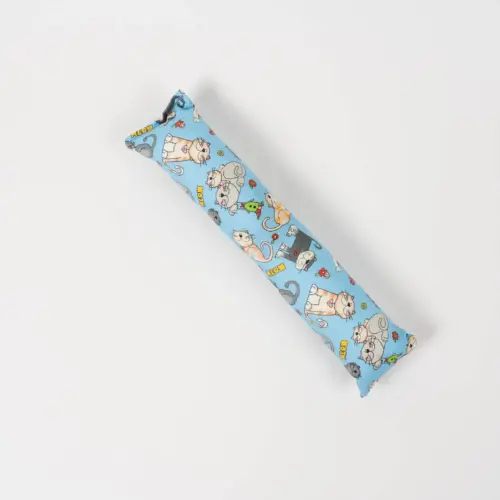
Catnip Stickz
Organic Catnip Cat Toy, Choose size
Price range: $33.95 through $39.95
Why it fits: A kick toy for the catch at the end of a session; cats work harder for something they can hold and wrestle.
-
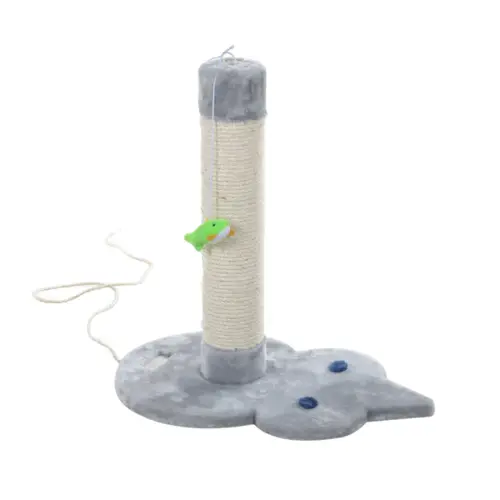
Armarkat
Mouse-Shape Cat Scratcher Post with Rope Toys, View product
$69.95
Why it fits: A sisal post encourages the full stretch and climb; stable posts get used, wobbly ones do not.
-
Armarkat
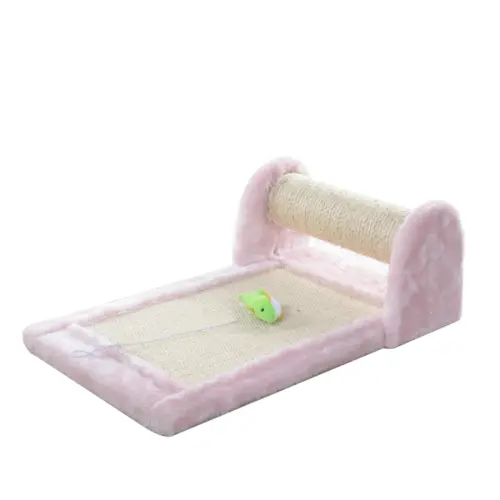
Rolling Cat Scratcher, View product
$59.95
Why it fits: A compact scratcher for small rooms, with a plush surface for the rest afterwards.
-
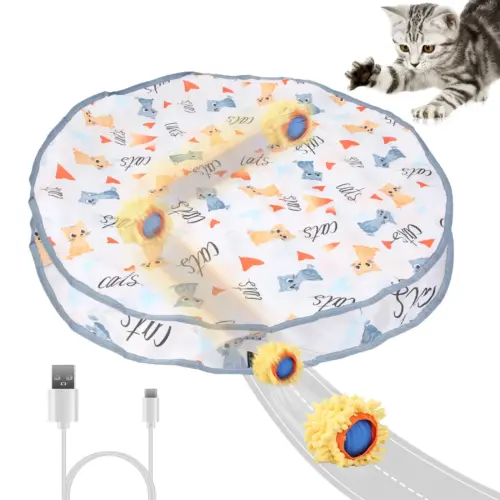
Motion-Activated Rolling Cat Toy Ball, View product
$42.95
Why it fits: A self-moving ball for solo activity between play sessions, useful when nobody is home.
If your cat needs to lose weight
Weight loss in cats must be gradual and should be supervised by your vet. Cats who lose weight too quickly can develop hepatic lipidosis, a serious liver condition, so this is one area where doing it properly matters more than doing it fast.
- Book a weigh-in and ask your vet to set a target weight and a timescale.
- Measure exactly what goes in now, including treats, for one week.
- Cut the extras before cutting the meals.
- Weigh food rather than using a scoop.
- Spread the ration across several small meals and puzzle feeders.
- Weigh the cat every two to four weeks and report back.
- Never starve a cat or skip meals to speed it up.
Safety note
A cat who stops eating for more than 24 hours needs veterinary attention, whatever the reason. This is particularly important during a diet, which is why weight loss plans should always be supervised.
When weight change needs a vet
Unplanned weight loss in a cat is always significant, even when the cat seems well. Common causes include dental disease, kidney disease, hyperthyroidism and diabetes, and most of them are much easier to manage when caught early. Weight loss alongside increased appetite, increased thirst or increased urination is a particularly important combination.
Indoor cats and the obesity problem
Obesity is the most common preventable health problem in indoor cats, and the reasons are structural rather than careless. An indoor cat has food permanently available, no need to hunt, limited space to move in and a life largely free of the demands that would otherwise burn energy.
The consequences are worth stating plainly, because they are easy to underestimate. Excess weight in cats is associated with diabetes, joint disease, reduced grooming, skin problems and a reduced ability to cope with illness. A cat who cannot groom their own back end because of their size is a common and entirely preventable presentation.
Making food take effort
The most sustainable change is not a smaller bowl but a longer meal. Cats evolved to eat ten or more small meals a day, each one requiring a hunt, and a bowl finished in ninety seconds satisfies none of that.
- Scatter dry food across a room so each piece has to be found
- Use puzzle feeders, starting very easy
- Split the daily ration into four or five small meals
- Put bowls in different rooms, and upstairs if your cat can manage stairs
- Feed straight after a play session, completing the hunting sequence
- Weigh food rather than using a scoop
- Count treats as part of the daily total, not as extra
The same total food, spread across the day and requiring effort, produces a cat who behaves as though they are getting more rather than less. That is what makes a weight plan survive past the second week.
Common questions
How often should I weigh my cat?
Monthly is plenty for a healthy adult. Stand on bathroom scales holding your cat, then alone, and subtract. Use the same scales each time so the trend is meaningful even if the number is not exact.
My cat is always hungry. Is the portion too small?
Not necessarily. Many cats learn that asking produces food, and the behaviour continues regardless of intake. Judge by body condition rather than by enthusiasm, and spread the same amount across more, smaller meals.
Is wet or dry food better for weight?
Either can work. Wet food is lower in calories per mouthful and contributes water, which is useful for cats who drink little. Dry food is easier to use in puzzle feeders and scatter feeding. Total calories matter more than format.
Does neutering make cats fat?
It lowers energy requirements, so a cat fed the same amount afterwards will tend to gain. The answer is to adjust the portion at the post-operative check rather than to avoid the procedure.
My cat is skinny but eats constantly. Should I worry?
Yes, that combination deserves a veterinary appointment. Eating well while losing weight is a recognised pattern in several treatable conditions, and it is not something to monitor at home for months.
The dog version of this check is how to check your dog is a healthy weight. For the daily context, see a realistic daily cat care routine, and for the longer schedule, the preventive care calendar. If your cat has also slowed down, read what cats actually enjoy for ways to add activity back.
Related guides
-
Guide
What Cats Actually Enjoy: Hunting, Height, Warmth and Routine
Cat enrichment is usually sold as toys. What cats actually want is the hunt in full, somewhere high, somewhere warm and a routine they can predict. This guide explains all four and how to fit them into a flat.
-
How-to
How to Set Up a Cat Corner in a Small Home
A cat does not need a whole room, but they do need four things in one place: somewhere to hide, somewhere high, somewhere to scratch and somewhere warm. This guide builds that corner in a small home.
-
Guide
Does Catnip Work on All Cats? What to Try When It Does Nothing
Catnip failing is not a sign of a faulty cat or a weak product. The response is inherited and a large minority never have it, while kittens do not develop it until months old. This covers what a real response looks like, the alternatives, and how to keep dried catnip potent.